Reading Time: 8 minutes
To verify a China furniture factory’s real production capacity, do not rely only on a website, catalogue or quotation. Instead, cross-check five types of evidence: the Chinese business license, the physical factory address, current production records, project-relevant certifications and recent customer references.
No single document proves that a supplier can deliver your order. However, when these five checks align, buyers can make a far more informed sourcing decision before paying a deposit or approving production.
For hotel, office, education and healthcare projects, supplier verification matters because delays and quality failures do not only affect furniture costs. They can delay opening dates, interrupt installation schedules and create expensive replacement work after handover.
Key Takeaways
- Verify the legal entity before signing: request the Chinese business license, company name and Unified Social Credit Code.
- Confirm that the production site exists through an onsite visit, live factory video tour, satellite imagery or an independent audit.
- Ask for evidence of current capacity, including production schedules, machine lists, workforce allocation and recent shipping records.
- Check whether certifications apply to your specific product, destination market and material configuration.
- Speak with recent customers who ordered comparable products, volumes and project types.
- Treat claims such as “large factory,” “fast delivery” or “international certifications” as starting points for verification—not proof by themselves.
- For high-value or custom projects, combine document checks with a third-party factory audit and pre-shipment inspection.
What This Guide Covers
This China furniture factory due diligence guide explains how to:
- Verify a Chinese furniture company’s legal registration.
- Confirm whether the supplier operates a real factory or works as a trading company.
- Assess whether its current production capacity fits your project timeline.
- Validate certification claims and test-report scope.
- Check customer references before placing an order.
- Identify red flags that require additional investigation.
- Build a practical supplier-verification checklist for hotel FF&E, office furniture and other commercial projects.
For a wider view of sourcing, budgeting and lead-time planning, read our FF&E Procurement China: Complete Hotel Developer Sourcing Guide.
Step 1: Verify the Chinese Business License
Every legitimate Chinese company should have a current business license. This is the first document to request before discussing deposits, production schedules or contract terms.
The license identifies the legal entity that can sign your contract, issue invoices and accept payment. However, it does not by itself prove that the supplier owns a factory or can produce your project at the required scale.
What to Check
| License Field | Why It Matters | What It Does Not Prove |
|---|---|---|
| Company name | Identifies the legal entity that should appear on your contract | It does not prove manufacturing ownership |
| Unified Social Credit Code | Provides a unique company identifier for registry searches | It does not confirm quality or capacity |
| Business scope | Shows whether production, manufacturing, sales or import/export activities are registered | It does not prove the company makes your exact product |
| Legal representative | Helps cross-check contracts, invoices and corporate records | It does not guarantee your sales contact is authorised |
| Registered address | Creates a traceable company location | It may be an office, not the actual factory |
| Registration date | Helps establish operating history | It does not confirm current financial health |
| Operating status | Identifies whether the company is active, abnormal, revoked or cancelled | It does not confirm delivery reliability |
How to Verify the License
- Request a clear scanned copy of the business license with the official company seal visible.
- Ask for the supplier’s complete Chinese legal name and Unified Social Credit Code.
- Search the company on China’s National Enterprise Credit Information Publicity System at
gsxt.gov.cn. - Compare the registered company name with the name on the quotation, sales contract, bank account and invoice.
- Confirm that the legal representative and business scope are consistent with the supplier’s claims.
- Ask whether the registered address and actual factory address are different. If they are, request both.
A company name that includes terms such as “Trading” or “Import & Export” may indicate a trading company, while terms such as “Manufacturing” or “Industrial” may suggest manufacturing activity. Nevertheless, the name alone is not conclusive. Some trading companies manage projects responsibly, while some manufacturing-oriented companies outsource critical production processes.
The important question is not simply, “Is this a factory or a trader?” Instead, ask: Which legal entity manufactures my furniture, which processes are performed in-house, and who takes contractual responsibility if something fails?
Practical advice: If a supplier refuses to share its full Chinese legal name, business license, or Unified Social Credit Code, stop the process before paying any deposit.
Step 2: Confirm the Physical Factory Exists
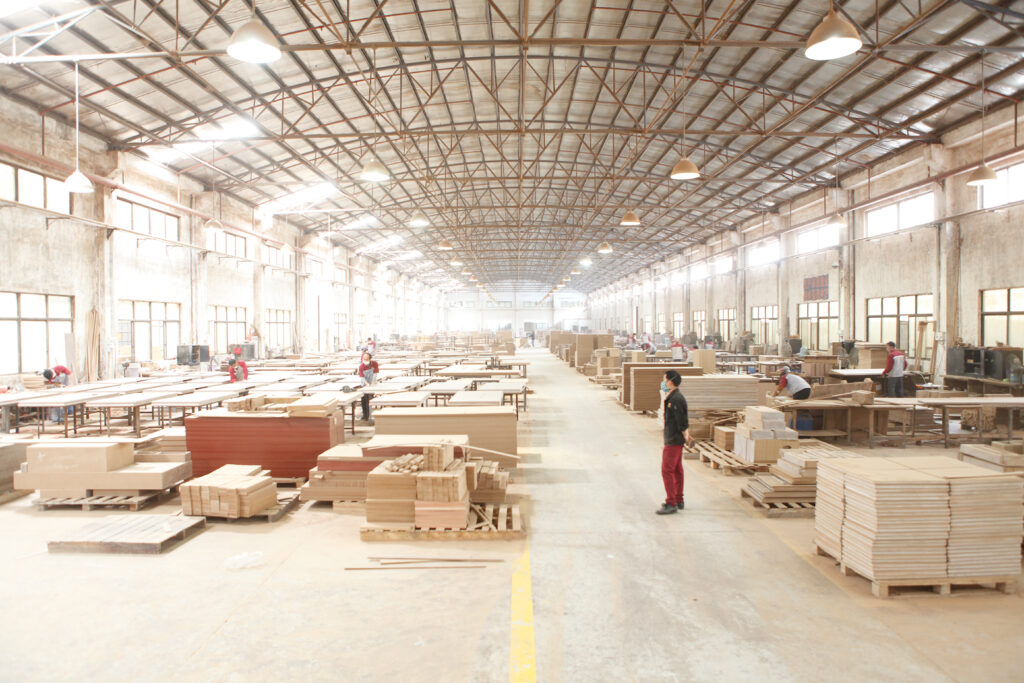
Once the legal entity is verified, confirm that the factory exists at the claimed location and produces the type of furniture you plan to buy.
This step helps distinguish a genuine manufacturer from a trading company that relies on undisclosed workshops or subcontractors. It also reveals whether the supplier has suitable equipment, production flow and quality-control systems for your project.
Factory Verification Methods
| Verification Method | Typical Cost | Reliability | What to Check |
|---|---|---|---|
| Satellite imagery | Free | Medium | Buildings, factory footprint, loading areas and industrial location |
| Live factory video tour | Free | Medium to high | Real-time walk-through, production activity and department signs |
| Third-party factory audit | USD 300–800 | High | Production lines, compliance, QC records and capacity evidence |
| Onsite factory visit | USD 2,000–5,000 | Very high | Facilities, materials, staff, equipment and management systems |
A live video call is much more useful than a pre-recorded promotional video. Ask the factory to begin outside the main gate, show the company sign, enter the production floor, and walk through the areas relevant to your product.
Production Areas to Inspect
A commercial furniture factory does not need to perform every process in-house. However, it should clearly explain which processes it owns, which it subcontracts, and how it controls subcontracted work.
Look for the following areas where relevant:
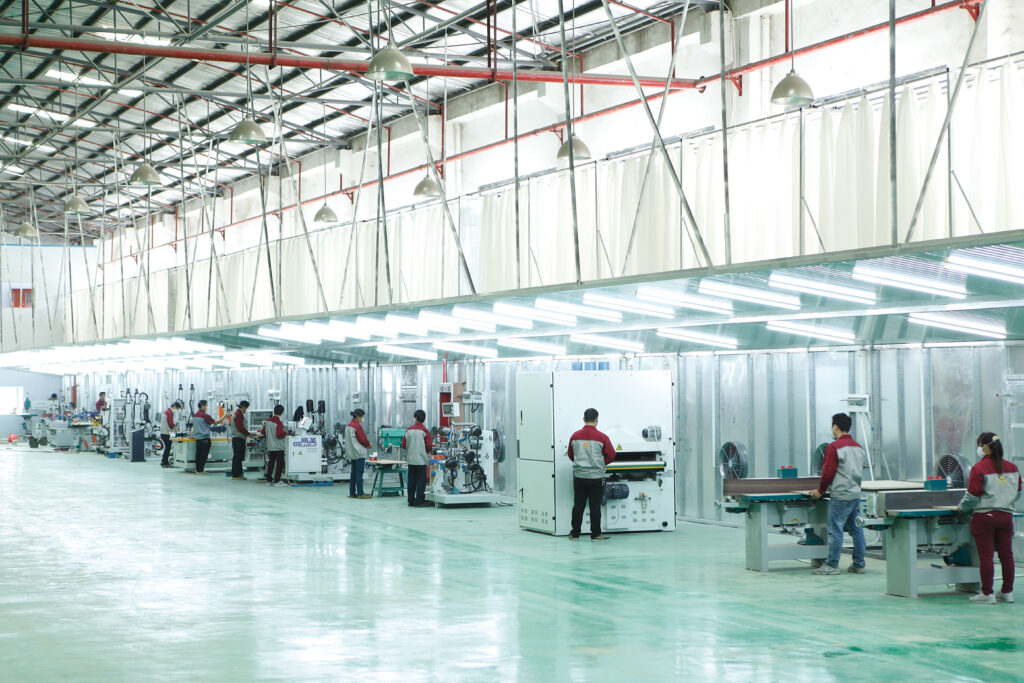
- Raw-material warehouse for panels, solid wood, steel, fabric, foam, and hardware.
- CNC cutting and drilling area for panel furniture, wood components, or metal processing.
- Edge-banding and panel-assembly stations for casegoods and cabinetry.
- Welding area for metal frames, bases, and structural components.
- Upholstery area for frame assembly, foam cutting, sewing, and final upholstery.
- Paint booth or finishing section with controlled ventilation and drying capacity.
- Quality-control station with inspection tools, approved samples, and defect records.
- Finished-goods warehouse with labelled, packed products ready for shipment.
- Container-loading area with loading plans and damage-prevention procedures.
Red flag: A supplier offers a factory tour but refuses to show the production floor, machine area, warehouse, or quality-control station. This may indicate that the facility is a showroom, an assembly site or a borrowed workshop rather than the claimed manufacturing base.
Step 3: Verify Production Capacity for Your Project
Factory size is useful context, but it does not guarantee that your order will be produced on time. A 100,000 m² facility may be fully booked, while a smaller specialist factory may have the right equipment, workforce, and available production window for your project.
Therefore, the goal is not to find the “largest” factory. The goal is to verify whether the factory has enough available and relevant capacity during your production period.
Capacity Evidence to Request
| Evidence | What It Helps Verify | Buyer Follow-Up Question |
|---|---|---|
| Current production schedule | Whether existing orders overlap with your requested delivery date | Which production line and completion date are assigned to my order? |
| Work-in-progress photos or live video | Whether the factory is actively producing similar products | Can you show current projects in cutting, assembly, finishing and packing? |
| Equipment list | Whether key processes can be performed in-house | Which machines will produce my order, and how many shifts do they run? |
| Workforce allocation | Whether sufficient skilled labour is available | How many workers are assigned to welding, upholstery, QC and packing? |
| Monthly output records | Whether claimed volume aligns with actual output | Can you provide recent anonymised output or shipment data? |
| Shipping documents | Whether the supplier exports comparable volumes | Can you share redacted bills of lading for similar projects? |
| Capacity allocation plan | Whether there is enough buffer for delays or rework | What capacity buffer remains during my production window? |
Capacity Metrics by Project Type
| Project Type | Capacity Evidence to Prioritise |
|---|---|
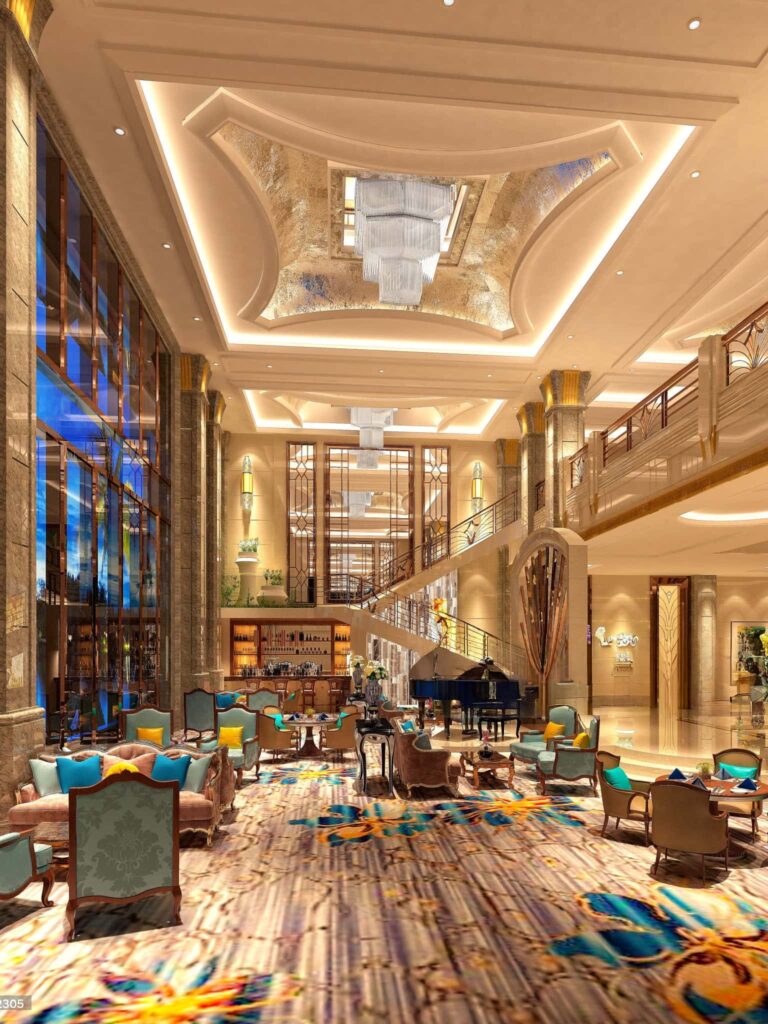
| Hotel guest rooms | Casegoods capacity, upholstery capacity, finishing lines, packing, and room-by-room labeling |
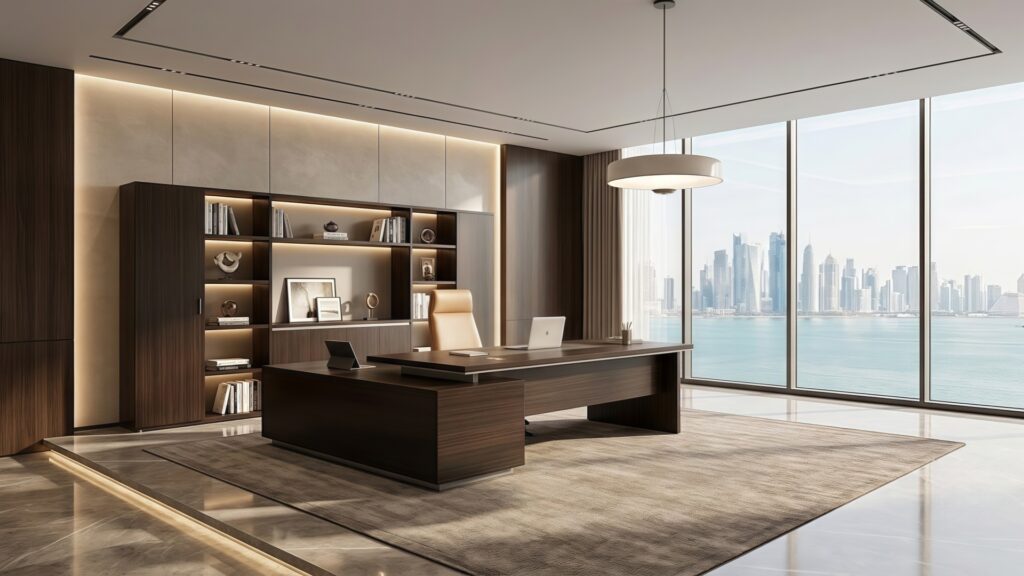
| Office workstations | Panel processing, metal fabrication, workstation assembly, and container-loading capability |
| Healthcare furniture | Compliance documentation, cleanable material handling, upholstery or metalwork consistency |
| Education furniture | Volume output, durability testing, batch consistency, and school-holiday delivery schedules |
| Custom public-area furniture | Engineering capability, prototype approval, specialist materials, and controlled finishing |
Hotel Furniture
A supplier claiming “large scale” without providing machine counts, workforce allocation, production records, or shipment evidence should be treated as a higher-risk supplier. That does not automatically mean the supplier is unreliable. However, it does mean you need more evidence before committing.
What a Realistic Lead Time Looks Like
Lead time depends on product complexity, material availability, sampling requirements, order volume, current factory loading, and destination logistics.
For many standard commercial furniture orders, production may take approximately 45–60 days after technical approval and deposit receipt. However, fully custom hotel FF&E, large office projects, specialist healthcare products, and peak-season orders may require longer.
Be cautious if a supplier promises unusually fast delivery without explaining:
- Which production line is available.
- Whether materials are already in stock.
- Whether the products are standard or custom.
- Whether key components will be subcontracted.
- How quality checks and packaging will fit into the shortened schedule.
Practical advice: Ask for a production schedule that identifies design approval, material procurement, prototype approval, mass production, QC inspection, packing, and container loading. A lead-time promise without a schedule is not a production plan.
Step 4: Validate Certifications for Your Market and Product
Certification requirements vary by country, product type, material configuration, and project specification. A hotel sofa, office chair, student-dorm bed and healthcare waiting-room chair may all require different evidence.
Do not evaluate a factory based on how many logos appear in its brochure. Instead, confirm whether its documentation applies to your actual product and project.
Common Evidence Types
| Evidence Type | Relevant When | What to Verify |
|---|---|---|
| ISO 9001 | You need evidence of a documented quality-management system | Certificate validity, issuing body, company name and factory scope |
| BIFMA-related testing | Your office or education project specifies applicable performance standards | Exact test standard, model coverage and test-report date |
| FSC Chain of Custody | Your project requires certified wood sourcing | Valid certificate code, legal entity and relevant product scope |
| GREENGUARD or low-emission evidence | Your project has indoor-air-quality requirements | Product or material listing and configuration coverage |
| Fire-performance reports | Hospitality, healthcare or local code requirements apply | Exact foam, fabric, construction method and destination requirement |
| CE or market-specific evidence | The destination market or product category requires it | Relevance to the specific product, not a generic company claim |
How to Verify Certification Claims
- Request a clear certificate copy with certificate number, issuing organisation, scope and expiry date.
- Verify that the certificate belongs to the legal entity named in your contract.
- Check that the listed facility includes the actual factory producing your goods.
- Confirm that the certification scope covers your product type.
- Review whether the certificate is current, not expired or superseded.
- For product tests, confirm the report matches the exact model, bill of materials and construction method.
For FSC claims, buyers can use the FSC certificate search database to check certificate and licence information. The key is to verify the certificate holder, current status and scope rather than relying only on a supplier-provided scan.
Red flag: A supplier says it has “all international certifications” but cannot provide certificate numbers, current dates, scope details or test reports for the relevant product.
Step 5: Contact Recent Customer References
Customer references are one of the most valuable—and most underused—ways to verify a China furniture factory.
A credible supplier should be able to provide references from recent projects that are relevant to your order size, product category and market. However, client privacy matters. References may be subject to customer permission and confidentiality agreements.
What to Request
Ask for at least two recent references with:
- Project type and location.
- Approximate order size or room/workstation count.
- Product category supplied.
- Completion year.
- Delivery timeline.
- Whether installation support was included.
- A contactable project manager, procurement manager or owner representative, where client permission allows.
Questions to Ask References
| Question | Strong Answer | Follow-Up Concern |
|---|---|---|
| How was communication during the project? | “The project manager responded quickly and gave clear production updates.” | Vague or evasive answers |
| Did the order arrive on schedule? | “Yes, delivery matched the agreed installation window.” | “Mostly on time” without details |
| Were there quality issues? | “There were minor issues, and they were resolved promptly.” | “No issues at all” may sound unrealistic |
| How did the supplier handle punch-list items? | “They responded quickly and sent replacements or solutions.” | No clear after-sales process |
| Would you order again? | “Yes, we are considering them for another project.” | “Maybe” or reluctance to comment |
| Was the project comparable to mine? | “Similar hotel, office, or education project with comparable scope.” | Reference is for unrelated consumer products |
A perfect supplier does not exist. In fact, references that acknowledge small problems—but explain how they were resolved—are often more credible than references claiming everything was flawless.
What Cannot Be Verified From Documents Alone
Business licenses, certificates, factory videos and shipping records are important. Nevertheless, some of the most expensive risks cannot be fully verified through documents alone.
These include:
- Whether your order will be subcontracted without approval.
- Whether the factory has hidden production bottlenecks or excessive overtime dependence.
- Whether incoming materials match the approved sample.
- Whether welds, moisture content, foam density or finishing quality meet specification.
- Whether the quality-control team can stop non-conforming goods from shipping.
- Whether the supplier will substitute materials after prototype approval.
- Whether packaging can protect the product throughout ocean freight and site delivery.
For high-value, custom or opening-date-critical projects, combine desk research with:
- An onsite factory audit.
- A pre-production sample approval process.
- Independent in-process inspection.
- Pre-shipment inspection using agreed AQL criteria.
- A documented packing and container-loading plan.
For more detail on production, quality and logistics risks, read 5 FF&E Procurement Risks (And How Hongye Mitigates Them).
China Furniture Factory Red Flags
Pause and investigate further if you encounter any of the following:
- The supplier refuses to disclose its Chinese legal entity or business license.
- The contract name, bank-account name and business-license name do not match.
- The factory address cannot be confirmed by live video, satellite imagery or an audit.
- The supplier will only show a showroom, not the production floor.
- Certifications have no visible certificate numbers, expiry dates or scope.
- Test reports cover a similar model rather than your exact product configuration.
- The supplier cannot provide a capacity plan for your delivery period.
- Lead times are unusually short without a production schedule.
- Pricing is dramatically below comparable quotations without a clear explanation.
- Customer references are outdated, unrelated to your project or impossible to contact.
- The supplier refuses third-party inspection.
- The supplier will not confirm which processes are performed in-house and which are subcontracted.
One red flag does not always mean the supplier is unsuitable. However, multiple unresolved red flags should stop you from placing a deposit until the evidence is clear.
China Furniture Factory Due-Diligence Checklist
Use this checklist before placing any furniture order exceeding USD 10,000:
- [ ] Full Chinese legal company name received.
- [ ] Unified Social Credit Code received and checked.
- [ ] Business license verified on
gsxt.gov.cn. - [ ] Contract entity, invoice entity and receiving bank account match.
- [ ] Factory address confirmed through video, satellite imagery, audit or onsite visit.
- [ ] Actual production site is clearly distinguished from registered office or showroom.
- [ ] Production schedule provided for your project window.
- [ ] Key machine types and production processes verified.
- [ ] Workforce allocation explained for relevant departments.
- [ ] Recent work-in-progress evidence reviewed.
- [ ] Comparable export or shipping records reviewed where appropriate.
- [ ] Certifications verified for validity, scope and product relevance.
- [ ] Fire, performance and emissions reports match your product specification.
- [ ] At least two relevant customer references checked, subject to permission.
- [ ] Lead-time commitment is supported by a written production plan.
- [ ] Payment terms protect the buyer and are tied to project milestones.
- [ ] Third-party inspection rights are written into the purchase order.
- [ ] Subcontracting policy is disclosed and approved in writing.
How Hongye Supports Buyer Due Diligence
Hongye encourages buyers to verify supplier claims before placing an order. For qualified commercial projects, our team can support an organised due-diligence process by providing relevant legal entity details, arranging scheduled video tours or onsite factory visits, explaining production plans and sharing project-relevant certification documentation.
Hongye Furniture Group manufactures commercial furniture in Foshan, Guangdong. Our production facilities cover approximately 350,000 m² and include in-house capabilities for panel furniture, steel processing, upholstery, finishing and assembly. For appropriate project opportunities, buyers may request a production-capacity discussion based on product type, quantity, technical requirements and target delivery window.
We encourage buyers to independently verify documentation, certificates and project references. Where required by contract, Hongye can also coordinate third-party factory audits, in-process inspections and pre-shipment inspections.
For projects requiring one accountable partner from engineering through installation, explore our Turnkey Furniture Solution: From Empty Shell to Fully Furnished guide.
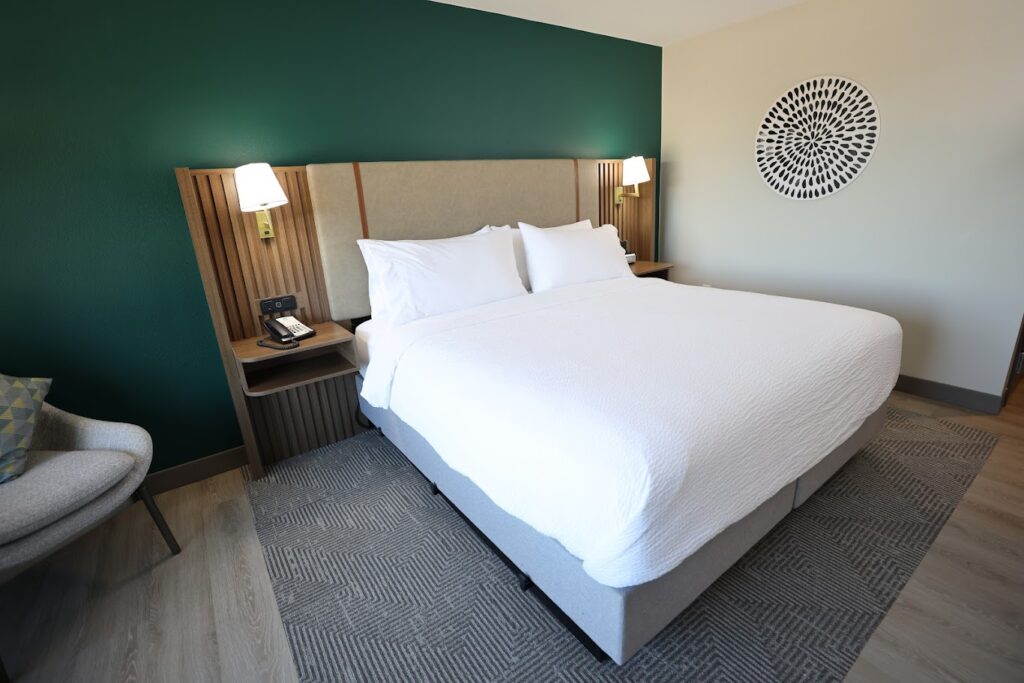
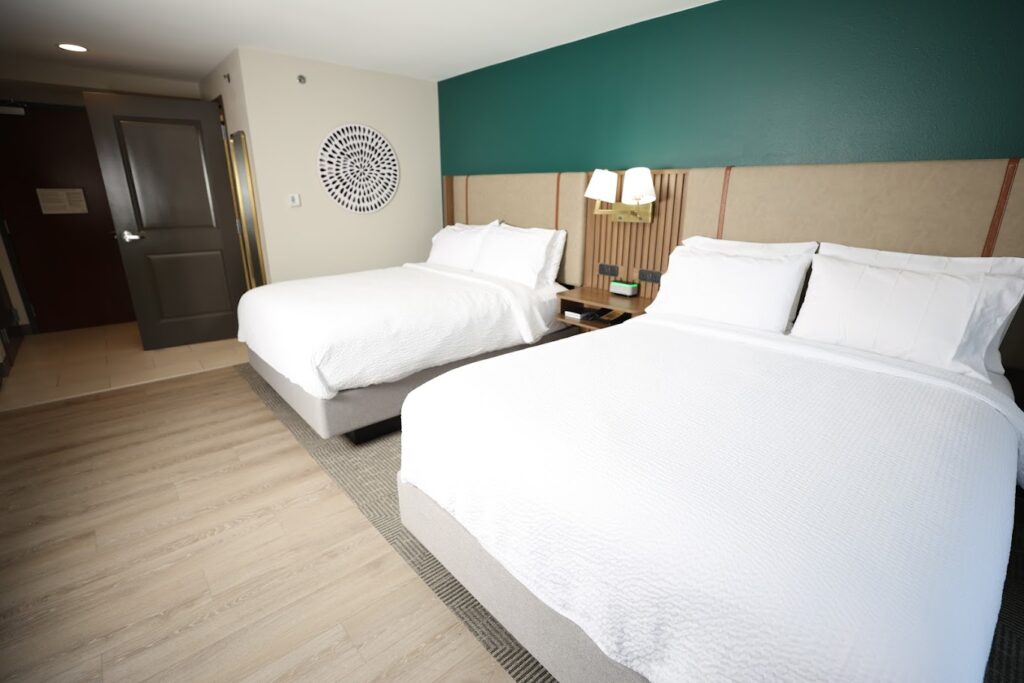
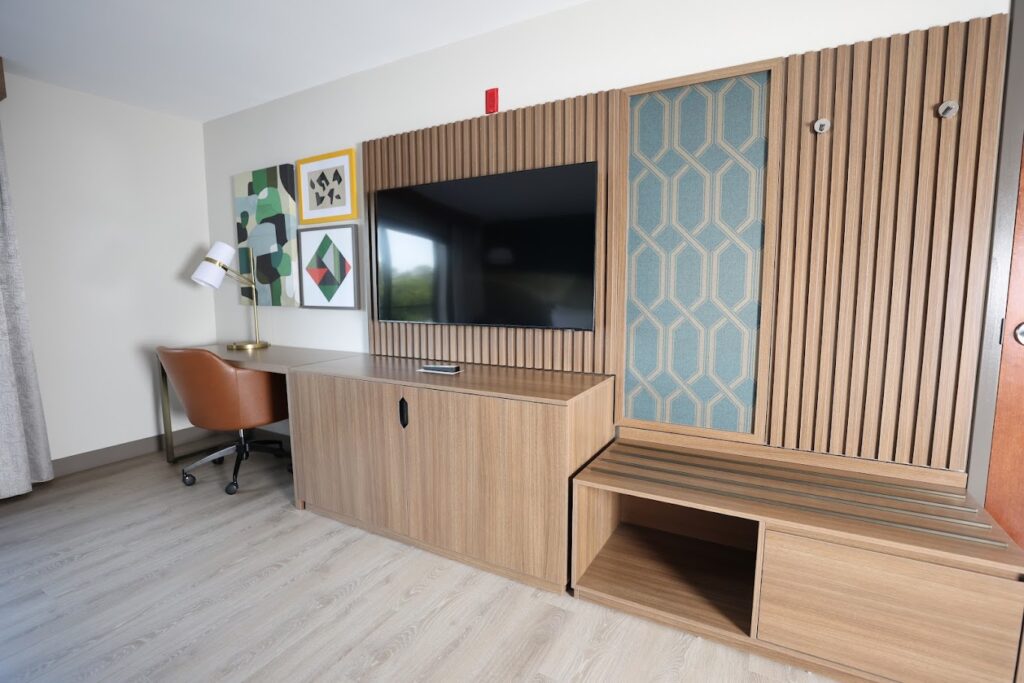
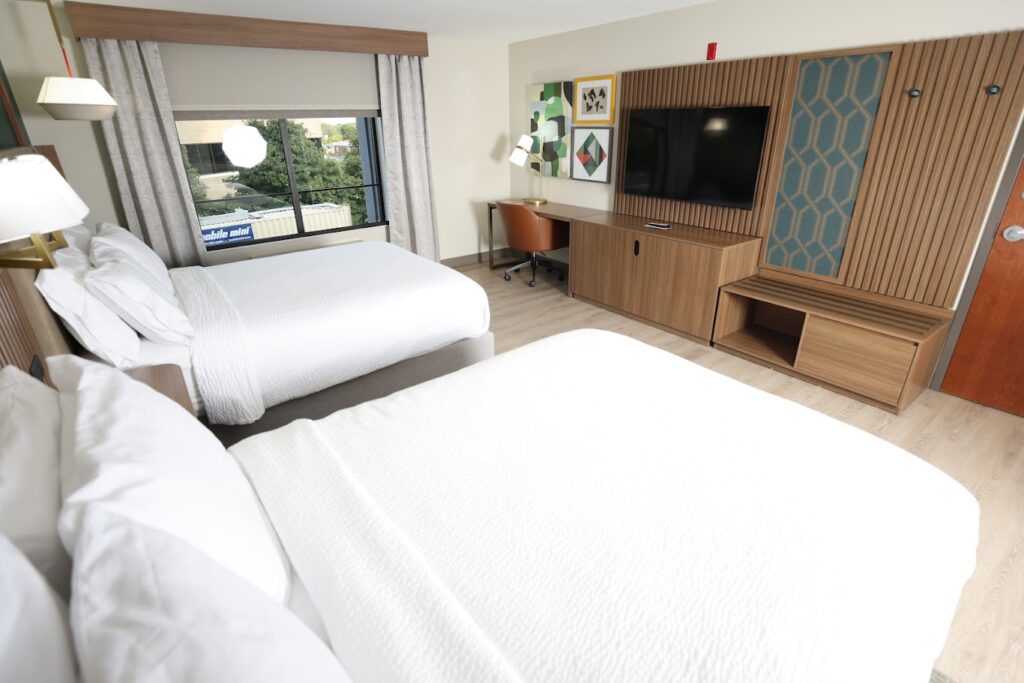
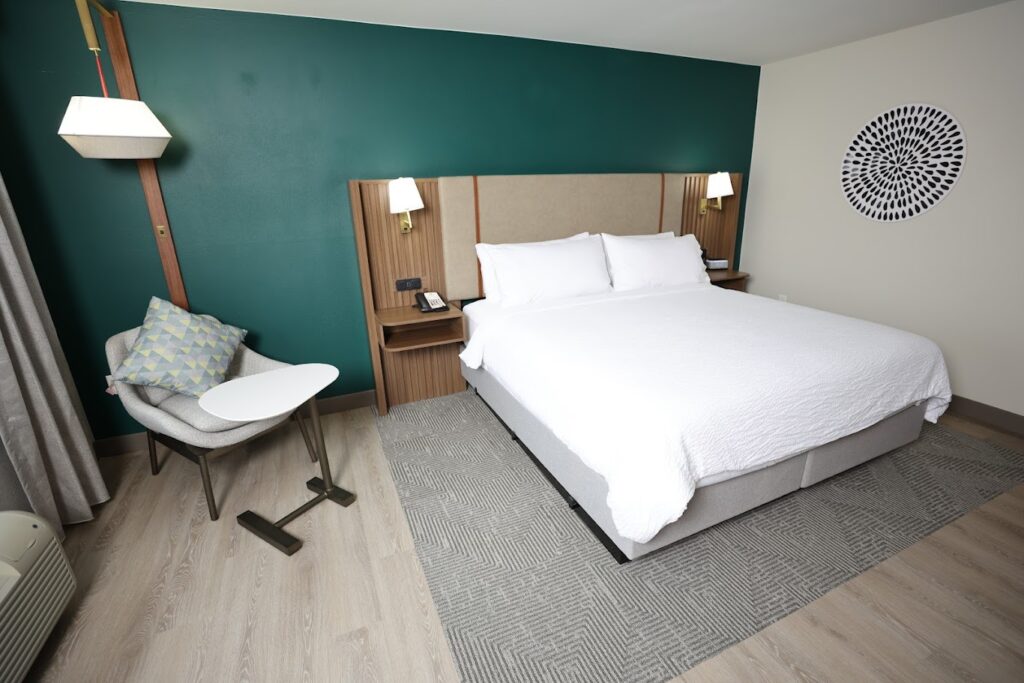
Holiday Inn Fairview Heights | Hospitality Project Solution By Hongye Furniture
FAQ
How can I tell whether a China furniture supplier is a factory or a trading company?
Start with the Chinese business license and business scope, then verify the physical production site through a live video tour, factory audit or onsite visit. Ask which processes are performed in-house, which are subcontracted and which legal entity will manufacture your order. A trading company is not automatically unreliable, but it should disclose the actual manufacturing entity and accept responsibility for quality, delivery and after-sales service.
What production-capacity numbers should I request from a furniture factory?
Request a current production schedule, workforce allocation by department, machine list, work-in-progress evidence, recent output records and a capacity plan for your delivery period. The right numbers depend on your product category. For example, hotel casegoods require panel processing and finishing capacity, while upholstered lobby furniture requires frame, foam, sewing and upholstery capacity.
How do I verify FSC and GREENGUARD certification claims?
Ask for the certificate number, legal entity name, expiry date and scope. For FSC claims, verify the certificate through FSC’s public certificate search. For GREENGUARD-related claims, check whether the actual product or relevant material configuration appears in the applicable listing. Do not accept a generic certificate if it does not cover your product or factory.
Is an onsite factory visit worth the cost?
For high-value orders, highly customised products or opening-date-critical projects, an onsite visit can be worthwhile. It allows you to verify production flow, equipment, staff, materials, QC procedures and factory loading directly. If travel is not possible, a third-party audit plus live video tour and independent inspection can provide meaningful additional assurance.
What lead time should I expect from a China furniture factory?
For many standard commercial furniture orders, production may take approximately 45–60 days after technical approval, deposit receipt and material confirmation. However, lead time varies by order size, customisation, raw-material availability, factory loading, inspection requirements and shipping route. Always request a written schedule rather than relying on a verbal promise.
What red flags should immediately pause a supplier decision?
Pause the order if the supplier refuses to share its legal entity information, cannot prove its factory location, provides expired or unverifiable certificates, will not permit independent inspection, cannot show a realistic production plan or asks you to pay a deposit to a bank account unrelated to the contracting entity.
Verify Before You Commit
A polished catalogue, low quotation or impressive-looking showroom should never replace due diligence. The most reliable way to verify a China furniture factory is to cross-check legal registration, factory evidence, production capacity, relevant certifications and real customer experience.
For hotel, office and institutional furniture projects, this process takes time. However, it is far less expensive than managing missed opening dates, non-compliant products, replacement shipments or disputes after payment has been made.