Furniture MOQ, or minimum order quantity, can shape the price, lead time and design options of a project. However, MOQ is not simply a number that a supplier uses to reject small orders.

In most cases, furniture factories set minimums because custom production creates fixed costs. These costs may include engineering, material sourcing, board cutting, hardware purchasing, finish preparation, packaging and quality checks.
Therefore, small hotels, design firms and renovation projects should plan MOQ early. Instead of asking only for a lower minimum, buyers can reduce product variation, use shared materials, select catalog items, consolidate shipping or phase a wider programme.
This guide explains why furniture factories set MOQs and how buyers can plan around them without losing control of quality, design or budget.
Quick answer: Furniture MOQ often depends on the product design, materials, finish, hardware, production process, total order value and shipping plan. Standard catalog products may allow lower quantities. Fully custom furniture may require larger runs, a higher unit price or more flexible lead times.
Key Takeaways
- Furniture MOQ means the minimum quantity or minimum commercial value that a supplier requires for a product, material, production run or order.
- However, MOQ is not always based on one furniture item. It may apply to a design, finish, board type, hardware set, production process, packaging method or total shipment.
- Standard catalog furniture may have lower practical minimums because drawings, materials, production methods and quality checks already exist.
- Fully custom furniture often needs more planning because the factory may need to create drawings, samples, cutting plans, finish runs and packing methods.
- Material standardisation can reduce setup complexity. Therefore, using fewer finishes, board cores and hardware types may improve pricing and production planning.
- A mixed container can improve freight efficiency. However, it does not automatically remove the production MOQ for every custom product.
- Buyers should compare total landed cost, quality-control scope, delivery risk and warranty support instead of comparing MOQ alone.
- Hongye can review MOQ options by product line, customisation level, material requirements, production capacity and shipping plan for qualified projects.
What Does Furniture MOQ Mean?
MOQ stands for minimum order quantity.
In furniture manufacturing, MOQ is the smallest quantity, order value or production run that a supplier is willing to accept under stated pricing and delivery conditions.
However, an MOQ may apply in different ways.
For example, a factory may require:
- A minimum quantity for one chair design.
- A minimum order value for custom furniture.
- A minimum board quantity for a special finish.
- A minimum fabric quantity from a textile mill.
- A minimum coating batch for a custom metal colour.
- A minimum shipment value.
- A minimum container load.
- A minimum quantity for special hardware.
- A minimum programme volume across several delivery phases.
Therefore, buyers should not ask only, “What is your MOQ?”
Instead, they should ask:
“What MOQ applies to this product, material, finish, hardware, production process and shipment plan?”
MOQ rule: A furniture MOQ is usually a production and commercial planning tool. It is not one universal number for every product.
Why Furniture Factories Set Minimums
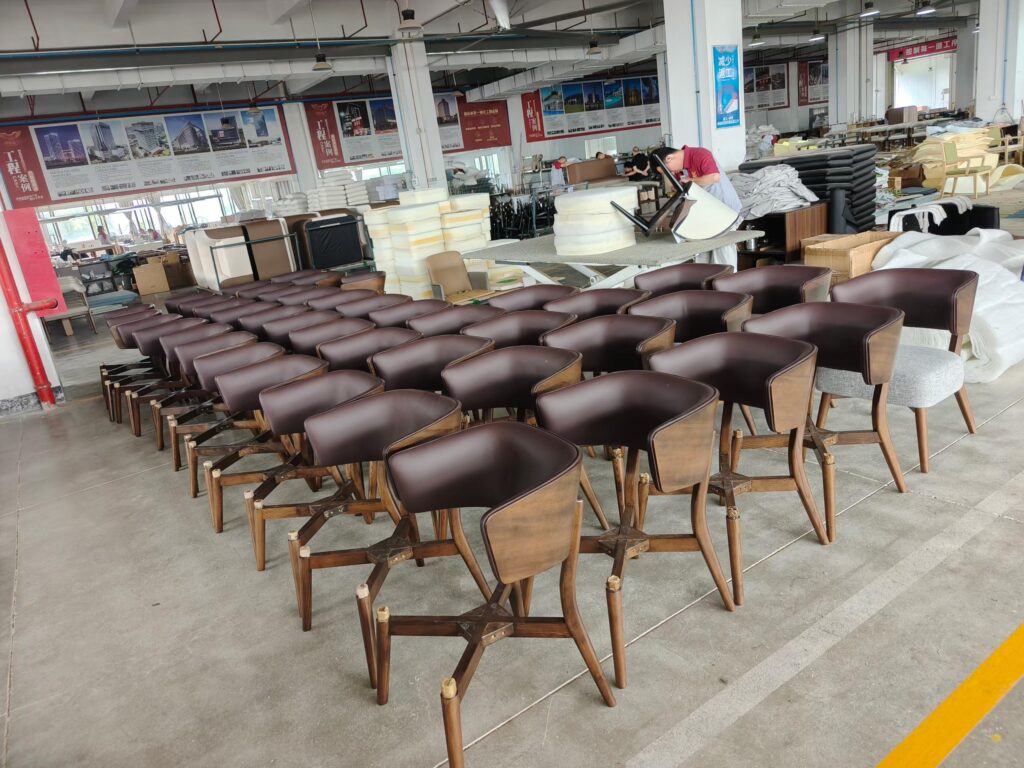
Furniture factories face fixed costs before they produce the first finished piece.
For a custom hotel desk, for example, the supplier may need to review drawings, create a cutting plan, order board, prepare veneer, source hardware, set up a finish process, build a sample and develop export packaging.
These activities create costs even if the factory makes only a few desks.
As order volume increases, the supplier can spread those fixed costs across more units. Therefore, the cost per desk may become more competitive at higher quantities.
Common MOQ Cost Drivers
| Cost Driver | Why It Affects MOQ | Buyer Planning Option |
|---|---|---|
| Engineering and drawings | Custom products need design review, shop drawings and production instructions | Use existing catalog designs or reduce custom changes |
| Board cutting | Small batches can create more offcuts and lower material yield | Standardise panel sizes and use common board types |
| Veneer and laminate | Special finishes may need a minimum material purchase | Use stocked finishes or repeat finishes across items |
| Hardware | Hinges, slides, locks and power modules may have supplier minimums | Use common hardware across multiple furniture items |
| Upholstery | Fabric mills may require minimum fabric quantities | Use a stocked fabric or combine fabric across rooms |
| Metal coating | Special powder or liquid paint colours may require setup and cleaning | Use standard colours or reduce colour changes |
| Packaging | Custom cartons, crates and room-set labels need setup and materials | Use repeatable packing systems where appropriate |
| Quality control | Samples, inspections and production checks create fixed labour costs | Combine related products into one planned production run |
| Logistics | Small shipments may have higher freight cost per unit | Compare LCL, FCL, consolidation and local delivery options |
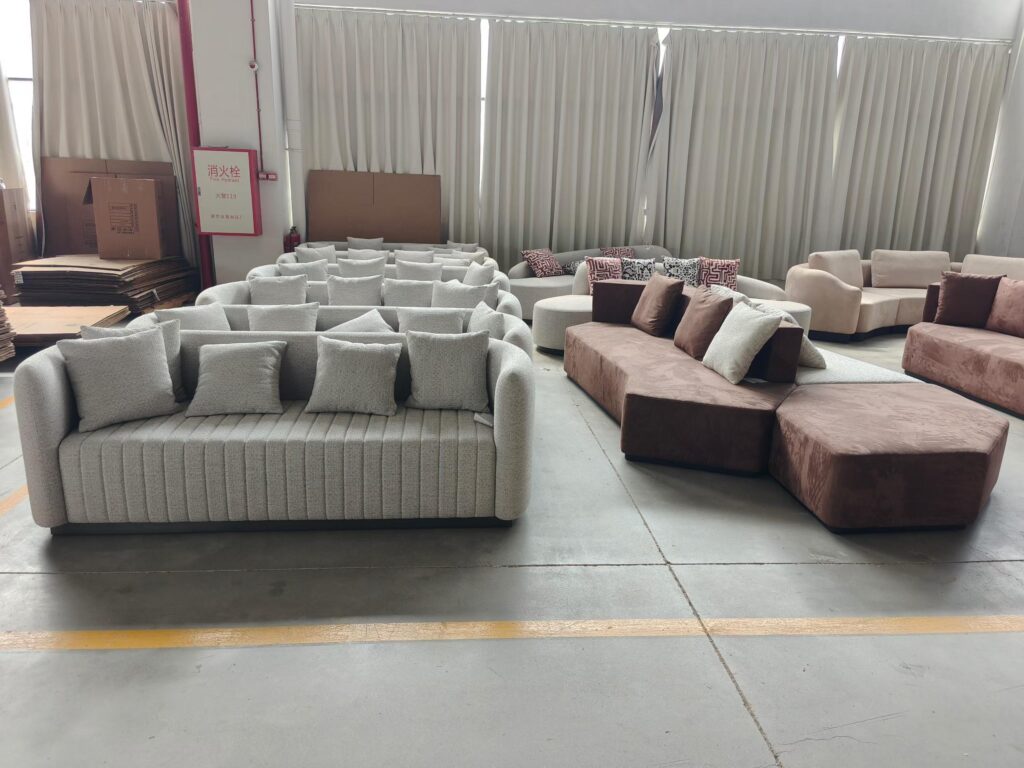
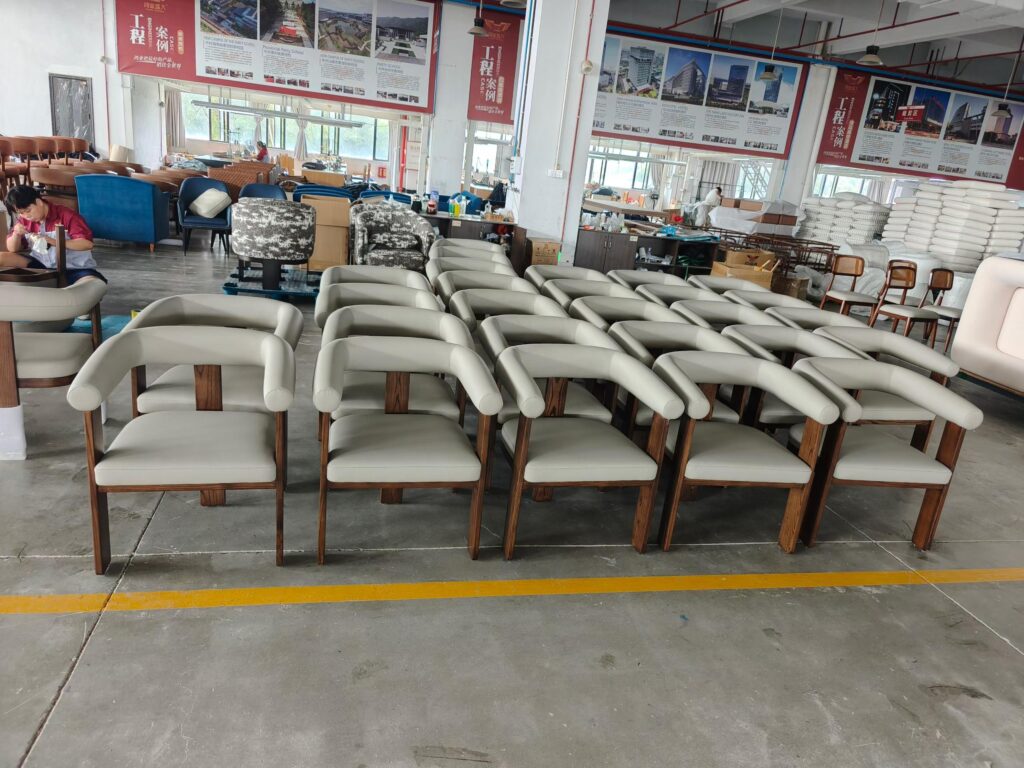
MOQ is often linked to production setup, material sourcing, packaging, quality control and shipping efficiency. Custom furniture generally needs more setup than standard catalog furniture.
Common Furniture MOQ Structures
Furniture suppliers may use several MOQ structures at the same time.
For instance, a hotel project may meet the total order minimum. However, it may still fall below the minimum quantity for a custom lounge chair, special veneer or unusual powder-coat colour.
| MOQ Structure | What It May Apply To | Buyer Action |
|---|---|---|
| Per-design MOQ | One SKU, chair style, headboard design or custom table | Increase quantity per SKU, use a running design or accept a small-batch price |
| Per-material MOQ | One veneer, fabric, board core, finish, hardware or coating colour | Standardise materials across several furniture items |
| Per-order MOQ | Total order value, shipment size or programme volume | Consolidate products, phase deliveries or review total project scope |
| Process MOQ | Upholstery run, powder-coat colour, lacquer batch, CNC programme or special tooling | Reduce variations and align designs with existing production methods |
| Packaging or logistics MOQ | Pallet, crate, LCL, 20-foot or 40-foot container planning | Review packing cube, destination storage and freight options |
Buyer tip: Ask the supplier to separate the MOQ by design, material, process and order value. This makes negotiation more practical.
Catalog, Semi-Custom, and Fully Custom Furniture
The level of customisation strongly affects MOQ.
Catalog Furniture
Catalog furniture already has approved drawings, established materials, known production methods and tested packaging.
As a result, suppliers may be able to accept smaller quantities for these products.
However, buyers should still confirm:
- Current stock availability.
- Available colours.
- Available fabrics.
- Hardware options.
- Lead time.
- Packaging.
- Replacement-part availability.
- Product warranty.
- Freight plan.
Semi-Custom Furniture
Semi-custom furniture uses an existing design with selected changes.
For example, a buyer may choose:
- A standard chair frame with a new fabric.
- A standard hotel desk with a different laminate.
- A catalog table base with a custom top.
- A standard wardrobe with a revised handle.
- A running bed base with a new headboard panel.
This approach can reduce engineering work. However, a special finish, fabric or hardware choice may still create a material MOQ.
Fully Custom Furniture
Fully custom furniture often needs the most preparation.
The factory may need to create drawings, samples, jigs, cutting plans, production methods, finish samples, packaging and inspection requirements.
Therefore, the supplier may require a higher quantity, a higher unit price, a minimum order value or a longer lead time.
Customisation rule: The more unique the product, materials and finish system, the more likely the supplier will need a defined MOQ or small-batch cost adjustment.

Hotel Furniture
How Design Firms Can Plan Around MOQ
Small hotels, boutique properties, offices, show suites and renovation projects often need many different furniture items in low quantities.
This can create MOQ pressure because each product, material or finish may require separate setup.
However, buyers can plan around MOQ without giving up all design control.
Use Fewer Designs
First, reduce the number of low-volume furniture designs.
For example, a hotel may need 900 dining chairs across several spaces. If the design team selects six different chair models, each model may have a low quantity.
In contrast, using two or three chair models can increase the quantity per SKU. As a result, the factory may produce the order more efficiently without reducing the total number of chairs.
Standardise Materials
Next, use shared materials where possible.
A project may use:
- One or two board cores.
- A limited group of laminates.
- Fewer veneer species.
- Shared metal colours.
- One hardware brand.
- Repeated pulls and handles.
- Common fabrics across several room types.
- Standard glides and levelers.
Material standardisation can reduce purchasing complexity and line changeovers.
However, it may not eliminate all design-specific minimums. It simply gives the supplier more opportunity to combine work across products.
Choose Catalog Components
In addition, buyers can use catalog items in selected areas.
For example, a project may use custom casegoods in guestrooms but standard chairs in the restaurant, meeting room or staff area.
This strategy can protect the design budget for high-visibility furniture while reducing MOQ pressure on lower-priority items.
Consider Phased Programmes
Some projects have several sites, floors or development phases.
If the buyer can commit to a wider programme, the supplier may be able to plan production around the total volume.
However, a phased programme should include:
- Total committed quantity.
- Delivery schedule.
- Material continuity plan.
- Price-validity period.
- Storage responsibility.
- Design-change procedure.
- Payment terms.
- Warranty start date.
- Replacement-part plan.Planning rule: A phased order can help a supplier plan capacity. However, it should be documented as a real programme, not an informal future promise.
Mixed Container Furniture Orders
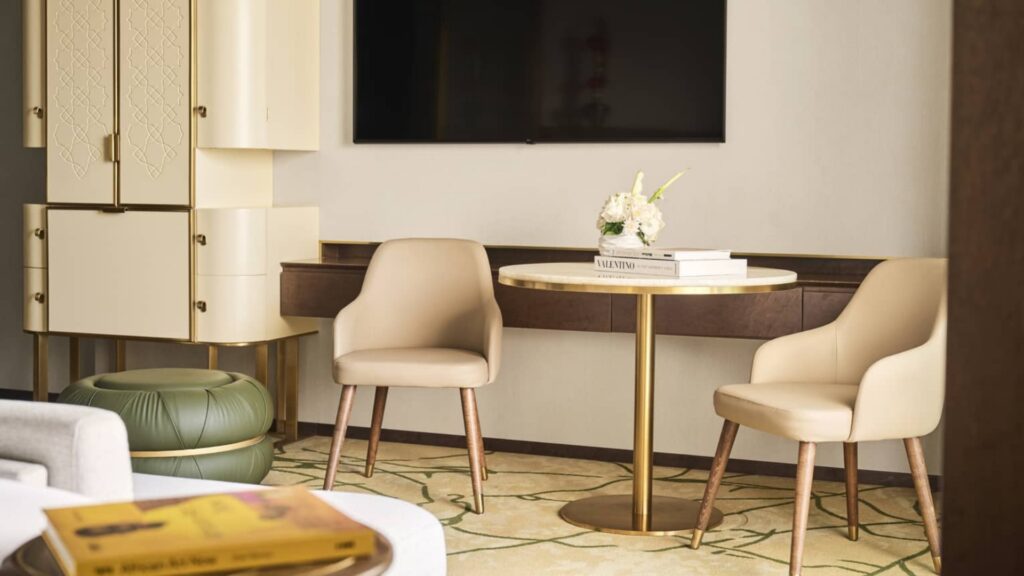
A mixed container order combines several furniture categories in one shipment.
For example, a small hotel may ship guestroom casegoods, lounge chairs, restaurant tables, bar stools, meeting-room furniture and storage cabinets together.
This can improve shipping efficiency because the buyer avoids sending separate small shipments for each product category.
However, a mixed container solves a shipping question. It does not always solve a production question.
A supplier may still require a minimum quantity for a custom chair, a special fabric, a veneer, a powder-coat colour or a hardware item.
What Mixed Containers Can Help With
Mixed containers may help buyers:
- Combine several furniture categories.
- Improve container utilisation.
- Reduce repeated export-document costs.
- Simplify shipment coordination.
- Deliver furniture by project phase.
- Consolidate packing and labelling.
- Reduce the need for multiple LCL shipments.
- Coordinate room-set delivery.
What Mixed Containers Cannot Guarantee
A mixed container does not automatically:
- Remove custom-design MOQ.
- Eliminate material minimums.
- Reduce special-fabric minimums.
- Remove finish-batch requirements.
- Guarantee lower landed cost.
- Solve site-storage limitations.
- Replace a quality-control plan.
- Remove the need for export packaging.
Container capacity also varies widely.
It depends on furniture dimensions, assembly level, packaging, protective materials, weight limits and loading method. Therefore, buyers should ask for a carton cube list and preliminary loading plan instead of assuming that a certain room count will fill one container.
Container rule: Use mixed-container planning to improve logistics. Still, confirm every product’s production MOQ before finalising the order.
Containerised shipments use reusable freight containers. However, the furniture loading plan depends on carton dimensions, handling requirements and shipment constraints.
What “Low MOQ Supplier” Can Mean
The phrase “low MOQ supplier” can describe several different business models.
For example, the supplier may:
- Sell stock catalog items.
- Use existing materials.
- Combine your order with another production run.
- Accept a higher unit price.
- Offer fewer custom options.
- Use a longer production schedule.
- Consolidate orders.
- Operate as a trading company.
- Use flexible manufacturing.
- Require a minimum total order value instead of a per-item quantity.
Therefore, a low MOQ is not automatically good or bad.
The buyer should ask how the supplier will make, inspect, pack and ship the order.
Questions to Ask a Low-MOQ Supplier
- Is the product a running catalog item or a custom design?
- Which materials are already in stock?
- Does the MOQ apply per design, material, colour or total order?
- Does a low MOQ increase the unit price?
- Does a low MOQ increase the lead time?
- Will the supplier combine the order with another production run?
- Which factory will manufacture the item?
- Who controls quality?
- What inspection plan applies?
- Can the supplier provide spare parts later?
- What packaging and shipping method applies?
- Is the supplier quoting EXW, FOB, CIF, DDP or another delivery term?Low-MOQ rule: Do not compare minimum quantity alone. Compare product scope, unit price, quality control, packing, freight, warranty and lead time.
How to Negotiate MOQ More Effectively
MOQ negotiation works best when the buyer helps the supplier reduce setup complexity.
Instead of asking, “Can you lower the MOQ?” try asking more specific questions.
For example:
- Can we use your running laminate colours?
- Can several furniture items share one board core?
- Can all desks and wardrobes use one hardware family?
- Can the project use one metal finish instead of several colours?
- Can the supplier combine this order with an existing material run?
- Can we use a catalog base with a custom top?
- Can we commit to a documented phased programme?
- Can we accept a higher unit price for the low-volume item?
- Can the order ship as LCL rather than waiting for a full container?
- Can the supplier recommend alternative materials that meet the design intent?
This approach changes the conversation.
Rather than treating MOQ as a fixed barrier, the buyer and supplier can identify which cost drivers are flexible.
Negotiation rule: Reduce setup, material variation and process changes. Then ask the supplier which MOQ requirement can change.
Hongye MOQ Review Support
Hongye supports qualified hotel, office, healthcare and education projects with MOQ review by product line, customisation level, material requirements, production capacity and shipping plan.
For smaller programmes, Hongye can discuss:
- Catalog-based furniture options.
- Semi-custom furniture options.
- Material standardisation.
- Shared hardware.
- Consolidated product schedules.
- Room-set planning.
- Phased deliveries.
- Export packing.
- FCL and LCL planning discussions.
- Spare-parts planning.
- Inspection and warranty documentation.
Hongye states that it has more than 30 years of commercial furniture manufacturing experience and operates a 300,000-square-metre production facility in Heshan, Jiangmen, Guangdong, China.
MOQ, unit price and lead time depend on final drawings, materials, quantities, packaging, delivery term, factory capacity and destination.
Therefore, buyers should confirm the agreed MOQ, pricing basis and delivery scope in writing before production begins.
Frequently Asked Questions
What does MOQ mean in furniture?
MOQ means minimum order quantity.
In furniture manufacturing, it may refer to the smallest quantity, minimum order value, material batch, finish run, hardware quantity or shipment volume that a supplier will accept.
Why do furniture factories have minimum order quantities?
Furniture factories use MOQs to manage fixed costs.
These costs may include engineering, board cutting, material sourcing, hardware purchasing, finish setup, packaging, quality control, storage and logistics.
As order volume rises, the supplier can spread more of these costs across the products.
What is a typical furniture MOQ from a Chinese factory?
There is no universal furniture MOQ.
A factory may set a minimum by product design, material, finish, hardware, production process, total order value or shipment plan.
Standard catalog furniture may allow lower quantities. In contrast, fully custom furniture may require a higher quantity, a higher unit price or a longer lead time.
How can I order custom furniture with a low MOQ?
First, reduce variation.
Use fewer designs, shared board cores, repeated finishes and common hardware where possible. Next, ask whether the supplier can use catalog components, run your products with an existing material batch, accept a higher small-batch price or support a phased programme.
Finally, compare FCL, LCL, consolidation and local sourcing options before deciding.
What is a mixed container furniture order?
A mixed container furniture order combines different product categories in one shipment.
For example, a hotel may ship casegoods, seating, tables and storage furniture together. This can improve freight efficiency and simplify export coordination.
However, it does not automatically remove the factory’s production MOQ for custom designs, special materials or low-volume colours.
Are low-MOQ furniture suppliers more expensive?
They can be.
A low MOQ may result from stocked products, flexible manufacturing, shared production, reduced customisation, longer lead times or higher unit prices.
Therefore, buyers should compare total landed cost, quality-control scope, packaging, delivery risk, warranty and replacement-part availability.
Can MOQ be reduced by using one finish?
Often, yes.
Using one or a limited number of finishes can reduce material purchases, colour changes, finish setup and production complexity.
However, the final result depends on the factory’s current materials, production schedule and order volume.
Is a mixed container always cheaper than LCL shipping?
Not always.
A mixed container may improve freight efficiency when the project volume and timing support full-container loading. However, buyers should compare container utilisation, destination storage, delivery schedule, insurance, customs, LCL handling charges and local delivery costs.
Plan MOQ Before Finalising the Design
Furniture MOQ affects more than the purchase quantity. It can change material choices, finish options, unit pricing, lead time, freight strategy and replacement planning.
First, identify which MOQ applies to the project. Next, reduce unnecessary variation in designs, materials, finishes and hardware. Then, compare catalog, semi-custom and fully custom options.
Finally, review mixed-container, LCL, phased-delivery and local-sourcing options against the full landed cost.
By planning MOQ early, design firms and hotel buyers can protect design intent while making production and logistics more practical.