ISO 9001 and ISO 14001 are widely used in furniture manufacturing. However, buyers often misunderstand what these certificates actually show.
ISO 9001 relates to a company’s quality management system. ISO 14001 relates to a company’s environmental management system. Neither certificate proves that a specific chair, desk, hotel wardrobe, or healthcare cabinet is high quality, low emission, fire compliant, or sustainable.
Therefore, furniture buyers should treat ISO certificates as management-system evidence. They should then request separate product-level documents for performance, material sourcing, indoor emissions, fire requirements, and destination-market compliance.
Quick answer: ISO 9001 can show that a furniture manufacturer has a certified quality management system. ISO 14001 can show that a manufacturer has a certified environmental management system. However, buyers still need product drawings, test reports, material records, approved samples, and project-specific compliance documents.
Key Takeaways
- ISO 9001 sets requirements for a quality management system, while ISO 14001 sets requirements for an environmental management system.
- ISO itself does not certify furniture factories. Independent certification bodies issue certificates against ISO standards.
- A certified quality management system does not guarantee that every furniture item is defect-free or that every product meets a buyer’s project specification.
- Likewise, an environmental management system certificate does not prove that a specific furniture product is low-VOC, FSC-certified, recyclable or carbon neutral.
- Buyers should verify the certified legal entity, applicable manufacturing site, certificate scope, validity dates, certification body and accreditation status.
- Product performance requires separate evidence, such as applicable test reports, material declarations, FSC claims, indoor-emissions documentation, fire reports or electrical conformity records.
- IAF CertSearch can help buyers validate accredited management-system certifications where certificate records are available.
- Hongye supports qualified furniture projects with supplier qualification, sample coordination, material schedules and project-specific documentation where applicable.
ISO Does Not Issue Certificates
Many supplier websites say that a company is “ISO certified.” However, ISO itself does not issue certificates to factories or products.
ISO develops and publishes international standards. Independent certification bodies audit organisations against those standards and may issue certificates when the organisation meets the relevant requirements.
Accreditation bodies assess the competence of certification bodies. In addition, the International Accreditation Forum, or IAF, supports international recognition among accreditation systems.
Therefore, a buyer should understand three different roles:
- ISO: Develops international standards.
- Certification body: Audits an organisation and may issue a certificate.
- Accreditation body: Assesses the competence of certification bodies.
- IAF: Supports international cooperation among accreditation bodies and operates tools such as IAF CertSearch.
ISO explains that certification provides independent written assurance that a product, service or system meets specified requirements. However, ISO also states that it does not certify organisations itself.
Buyer rule: Do not ask only, “Do you have ISO?” Ask who issued the certificate, which site it covers, what the scope says and whether the record is current.
What ISO 9001 Means for Furniture Factories

ISO 9001:2015 is a standard for quality management systems.
For a furniture manufacturer, a quality management system may include controls for customer requirements, design review, supplier management, production planning, inspection, non-conforming products, corrective actions, document control and internal audits.
A valid ISO 9001 certificate can indicate that the organisation has been audited against these management-system requirements.
However, ISO 9001 does not certify a specific hotel chair, desk, wardrobe, table top or office workstation.
It also does not guarantee that:
- Every product is defect-free.
- Every shipment meets a buyer’s drawings.
- Every item passes an applicable performance test.
- Every furniture component is correctly installed.
- Every factory worker performs each task perfectly.
- A supplier will meet every project deadline.
- A specific chair complies with BIFMA.
- A specific desk complies with a local fire requirement.
Therefore, buyers should use ISO 9001 as one supplier-qualification signal.
They should also use approved drawings, material schedules, samples, product tests, inspections and contract controls.
ISO 9001 rule: A quality management system can support process control. However, it does not replace product specification or project inspection.
What ISO 14001 Means for Furniture Factories
ISO 14001:2015 is a standard for environmental management systems.
For a furniture factory, the environmental management system may address the organization’s significant environmental aspects, legal obligations, operational controls, and improvement objectives.
Depending on the site and factory activities, these matters may include:
- Waste handling.
- Dust control.
- Chemical storage.
- Solvent handling.
- Coating processes.
- Wastewater controls.
- Energy use.
- Water use.
- Packaging waste.
- Environmental training.
- Emergency response.
- Environmental legal obligations.
However, the exact environmental aspects will vary by organisation, location, production process and risk assessment.
A valid ISO 14001 certificate does not prove that a particular furniture product is environmentally preferable.
For example, the certificate does not automatically prove that:
- The furniture uses FSC-certified wood.
- The furniture contains recycled material.
- The product has low formaldehyde emissions.
- The finish has low VOC emissions.
- The chair is recyclable.
- The factory is carbon neutral.
- The supplied product qualifies for a green-building credit.
- The product meets a project sustainability target.
Therefore, buyers should request separate product-level documents for specific sustainability claims.
ISO 14001 rule: An environmental management system shows how an organisation manages environmental aspects. It does not certify the full environmental performance of every product it manufactures.
ISO 9001 vs. ISO 14001
| Buyer Question | ISO 9001 | ISO 14001 |
|---|---|---|
| Full name | Quality management systems — requirements | Environmental management systems — requirements |
| Main focus | Quality processes and organisational controls | Environmental aspects and organisational controls |
| Typical factory topics | Document control, production controls, non-conformance and corrective action | Waste, chemicals, emissions, legal obligations and environmental objectives |
| Buyer question it may help answer | Does the supplier have a certified quality management system? | Does the supplier have a certified environmental management system? |
| It does not prove | That a specific furniture item is high quality or defect-free | That a specific product is sustainable, low-VOC or FSC-certified |
| Buyer should still request | Drawings, samples, test reports, inspection plan and warranty | Material claims, emissions records, product declarations and relevant project documents |
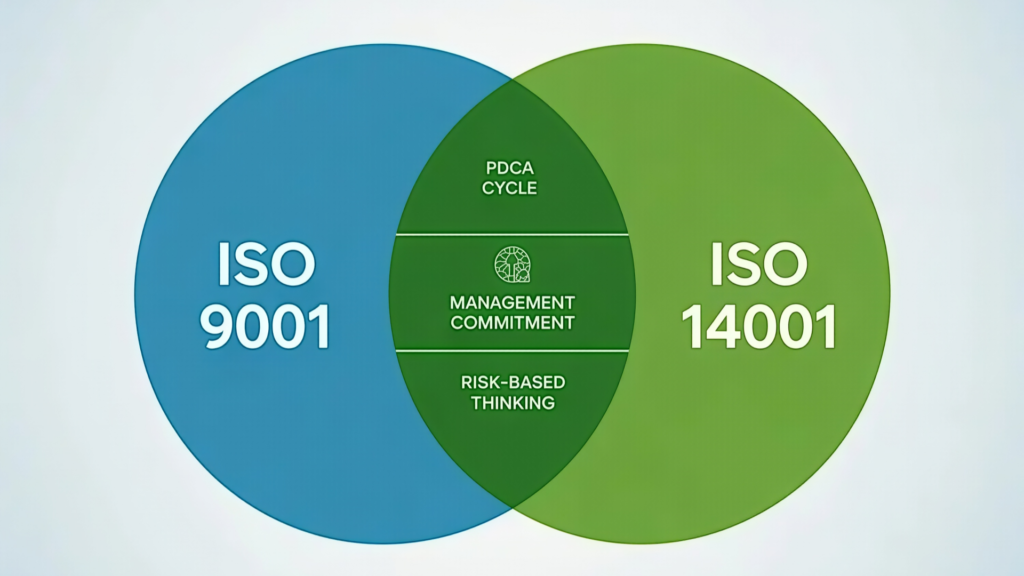
The two standards can complement each other.
For example, a furniture factory may use ISO 9001 controls to manage drawings, samples, incoming materials and corrective actions. Meanwhile, ISO 14001 controls may help the same factory manage coatings, waste, chemical storage and environmental objectives.
However, a buyer should still verify the exact certificate scope and relevant site.
Management Certificates vs Product Evidence
A management-system certificate and a product document answer different questions.
| Buyer Question | Evidence to Request |
|---|---|
| Does the factory manage quality processes? | ISO 9001 certificate, scope, site list and supplier audit evidence |
| Does the factory manage environmental aspects? | ISO 14001 certificate, scope, site list and supplier audit evidence |
| Does this chair meet a performance requirement? | Product-specific test report against the applicable standard |
| Does this wood product carry an FSC claim? | Valid Chain of Custody certificate and transaction-level FSC claim |
| Does this product meet indoor-emissions requirements? | Product- or material-specific emissions documentation |
| Does this upholstered product meet fire requirements? | Applicable test report matching the product construction and destination market |
| Does this electrical furniture item meet market requirements? | Applicable electrical and conformity documentation |
| Does the furniture match the project specification? | Approved drawings, BOM, samples, inspection records and contract documents |
For example, a factory may hold ISO 9001 and ISO 14001 certificates. Still, the buyer must separately confirm whether the proposed chair meets the required test standard, whether the desk uses approved materials and whether the wardrobe matches the hotel drawing.
Evidence rule: Management certificates support supplier due diligence. Product documents support product approval.
How to Verify a Furniture Factory ISO Certificate
A basic certificate check may take only a few minutes. However, a complete supplier review should also include a factory audit, product documentation review and contract checks.
Step 1: Read the Certificate
First, review the certificate itself.
Check:
- Certificate number.
- Standard and edition.
- Certified legal entity.
- Certificate scope.
- Manufacturing-site address.
- Additional site list, if applicable.
- Issue date.
- Expiry date.
- Certification body.
- Accreditation body, where shown.
Do not rely only on a logo, website claim or framed certificate photograph.
Step 2: Match the Legal Entity and Site
Next, compare the certificate details with the actual supplier.
The legal entity on the certificate should match the contracting supplier or clearly show its relationship to the supplier.
In addition, the listed production site should include the factory that will manufacture the ordered furniture.
A group certificate may cover several locations. However, buyers should confirm that the correct manufacturing site appears in the certificate or its approved site appendix.
Step 3: Read the Scope
Then, review the certificate scope.
The scope may describe activities such as furniture design, manufacturing, sales, assembly, warehousing or related services.
However, not every scope covers every site, activity or product category.
For example, a certificate may cover trading and distribution but not manufacturing. Another certificate may cover office furniture manufacturing but not upholstery or metalwork at a separate site.
Therefore, buyers should confirm that the certified scope includes the relevant production activities for their order.
Step 4: Verify the Certification Body
After checking the certificate, review the certification body.
A buyer should ask:
- Is the certification body accredited for the relevant management-system scheme?
- Which accreditation body provides the accreditation?
- Is the accreditation body recognised within the relevant international accreditation framework?
- Does the certification body have a public certificate-verification tool?
- Can the buyer contact the certification body to confirm validity?
ISO explains that accreditation provides added confidence in a certification body’s competence. However, the absence of accreditation does not automatically make a certificate invalid. It does mean that buyers should perform additional due diligence.[iso]
Step 5: Use a Public Verification Channel
Finally, search for the certificate record.
Depending on the certification body and scheme, buyers may use:
- IAF CertSearch.
- The certification body’s public client directory.
- The accreditation body’s directory.
- Direct written confirmation from the certification body.
IAF CertSearch provides a global database for validating accredited management-system certifications where records are available.
Verification rule: Confirm the legal entity, site, scope, certification body and current status. A certificate number alone is not enough.
What to Ask During a Factory Audit
A site visit or remote supplier audit can provide more useful evidence than a certificate alone.
During a furniture factory audit, buyers may ask:
- Which production lines will make this order?
- Which site holds the ISO certificate?
- Does the certificate scope include this site and activity?
- How does the factory control drawing revisions?
- How does the factory approve incoming board, veneer, fabric, foam and hardware?
- How does the factory identify non-conforming products?
- How does the factory record corrective actions?
- How does the factory control chemical storage and coating waste?
- How does the factory separate, label and store materials?
- How does the factory track finished goods and cartons?
- How does the factory manage change orders?
- How does the factory control subcontracted production?
- How does the factory train staff for key operations?
- How does the factory prepare for customer or third-party inspection?
However, buyers should respect confidentiality.
A supplier may not disclose all internal records. Even so, the factory should be able to explain its controls and provide suitable evidence during the audit process.
Audit rule: Certificates show that a system has been assessed. A supplier audit helps buyers understand how the system works on the production floor.
ISO Certification and Green Building Projects

Hotel, office, healthcare and education projects may include sustainability or green-building goals.
ISO 14001 can support supplier due diligence. However, it does not automatically earn a project credit under LEED, WELL, BREEAM or another rating system.
Instead, the project team should map each target to the required evidence.
For example:
- FSC claims may support responsible sourcing requirements for eligible wood-based materials.
- Indoor-emissions documents may support low-emitting material requirements.
- Environmental product declarations may support life-cycle or disclosure requirements.
- Product test reports may support durability or safety requirements.
- Packaging records may support waste-management targets.
- Local declarations may support market-specific regulations.
Therefore, project teams should ask the sustainability consultant, architect, operator or client to define the needed documents before procurement begins.
Green-building rule: ISO 14001 can support factory due diligence. However, the project must still collect product-specific evidence for its sustainability targets.
Hongye Certificate and Compliance Support
Hongye supports qualified hotel, office, healthcare and education furniture projects with supplier qualification, material schedules, sample coordination and project-specific documentation discussions.
During supplier review, buyers can request current ISO 9001 and ISO 14001 certificate details for the applicable manufacturing site.
The requested information may include:
- Certified legal entity.
- Certificate number.
- Certificate scope.
- Applicable site.
- Validity dates.
- Issuing certification body.
- Available verification method.
Product-level evidence should be reviewed separately.
Depending on the furniture type, material configuration and destination market, this may include:
- Product-performance reports.
- FSC claims for eligible wood-based materials.
- Indoor-emissions documentation.
- Fire-performance reports.
- Electrical conformity documents.
- Material declarations.
- Cleaning and maintenance instructions.
- Packaging records.
- Warranty information.
Hongye states that it has more than 30 years of commercial furniture manufacturing experience and operates a 300,000-square-metre production facility in Heshan, Jiangmen, Guangdong, China.
Before production release, buyers should verify that all certificates and documents match the exact furniture product, manufacturing site, material configuration, delivery scope and destination-market requirements.
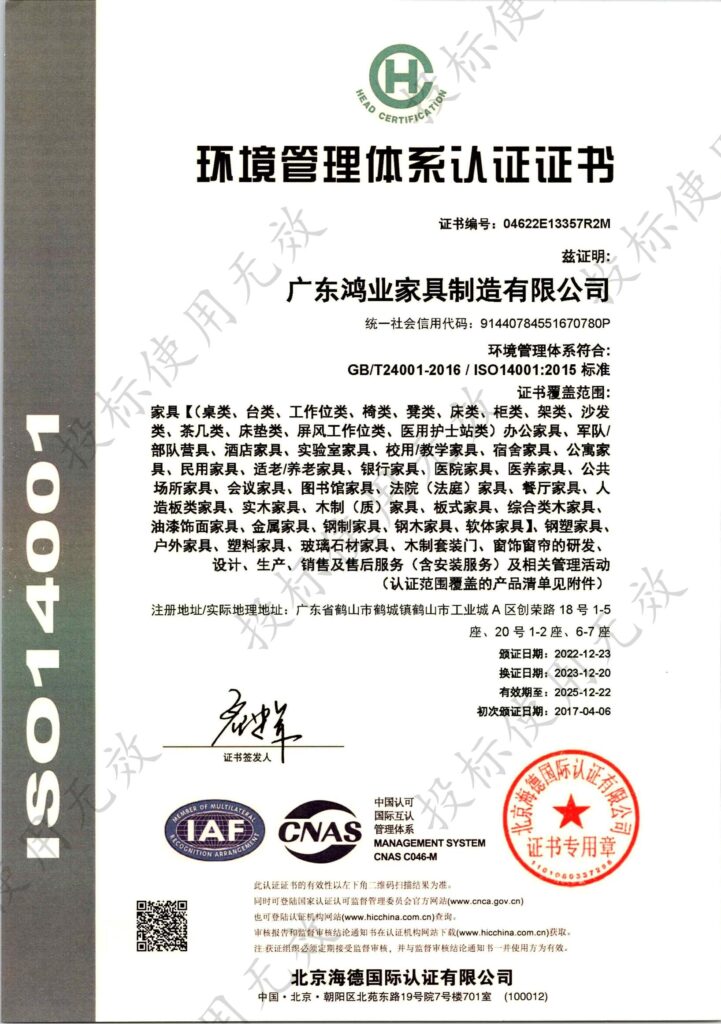
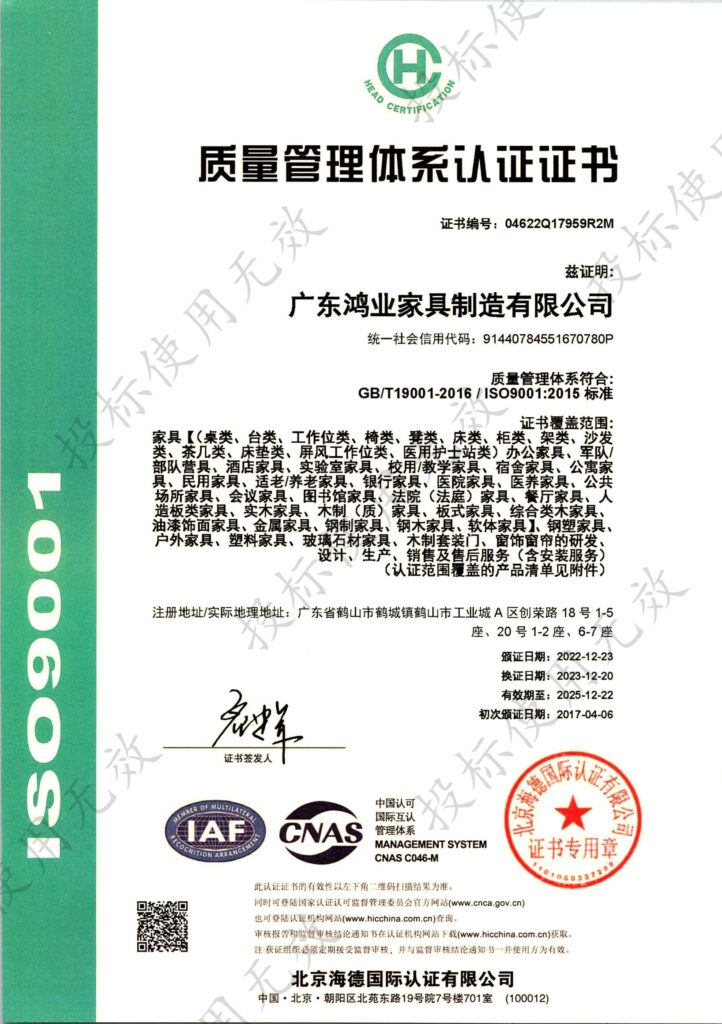
Hongye‘s ISO Certification
Frequently Asked Questions
What is the difference between ISO 9001 and ISO 14001?
ISO 9001 sets requirements for a quality management system. ISO 14001 sets requirements for an environmental management system.
In furniture manufacturing, ISO 9001 relates to quality-process controls. ISO 14001 relates to environmental aspects, controls and objectives.
Neither certificate proves that every furniture product is high quality or environmentally preferable.
Does ISO 9001 mean furniture is high quality?
No.
ISO 9001 can show that an organisation has a certified quality management system. However, buyers still need product drawings, approved samples, applicable test reports, inspection records and contract controls.
Product quality depends on the exact design, materials, manufacturing, inspection and installation.
Does ISO 14001 mean furniture is eco-friendly?
No.
ISO 14001 can show that an organisation has a certified environmental management system. However, it does not automatically prove that a product uses FSC wood, has low emissions, contains recycled materials or qualifies for a green-building credit.
Buyers should request product- and material-specific evidence for those claims.
Does ISO issue certificates directly?
No.
ISO develops international standards. Independent certification bodies audit organisations and may issue certificates against ISO standards.[iso][iso]
How can I verify a furniture factory ISO certificate?
First, review the certificate number, standard, legal entity, scope, sites, validity dates and certification body.
Next, check that the certificate covers the manufacturing site and activities relevant to your order.
Then, use IAF CertSearch, the certification body’s public directory, the accreditation body’s directory or direct confirmation from the certification body where available.
Does ISO 9001 replace furniture inspection?
No.
ISO 9001 can support confidence in a supplier’s management system. However, buyers should still use approved drawings, PP samples, in-process checks, pre-shipment inspection and receiving inspection.
Which other documents should a furniture buyer request?
The required documents depend on the product and destination market.
Buyers may need product-specific performance tests, FSC transaction claims, indoor-emissions documents, fire reports, electrical conformity records, material declarations, cleaning guidance, packaging records and warranty terms.
Does ISO 14001 provide LEED or WELL credits automatically?
No.
ISO 14001 may support supplier due diligence. However, it does not automatically provide project credits. The project team should confirm the exact documentation needed for its selected green-building system.
Use ISO Certificates as One Part of Due Diligence
ISO 9001 and ISO 14001 can provide useful evidence during furniture supplier qualification.
ISO 9001 helps buyers assess whether a supplier has a certified quality management system. ISO 14001 helps buyers assess whether the supplier has a certified environmental management system.
However, neither certificate replaces product tests, material claims, drawings, samples, inspections or contract requirements.
First, verify the legal entity, site, scope and certification body. Next, request product-specific evidence for the ordered furniture. Finally, connect all documents to the purchase order, approved drawings and project quality plan.
By using ISO certificates as part of a wider due-diligence process, furniture buyers can make stronger sourcing decisions and reduce avoidable compliance gaps.