
The extended-stay and serviced apartment segment has experienced remarkable growth, expanding at roughly twice the rate of traditional hotels over the past decade. According to STR data, extended-stay occupancy consistently outperforms the overall hotel industry by 10-15 percentage points. This resilience attracts developers, but it also presents a unique furniture specification challenge: apartment hotel furniture must bridge the gap between residential comfort and commercial durability. Guests staying for weeks or months demand home-like functionality, while operators need furnishings that withstand continuous use and rapid turnovers.
For hotel developers and hospitality project managers, furnishing extended-stay properties requires a fundamentally different approach than outfitting a transient hotel. This guide provides a comprehensive framework for selecting, specifying, and procuring furniture for serviced apartments, aparthotels, and extended-stay properties of any scale.
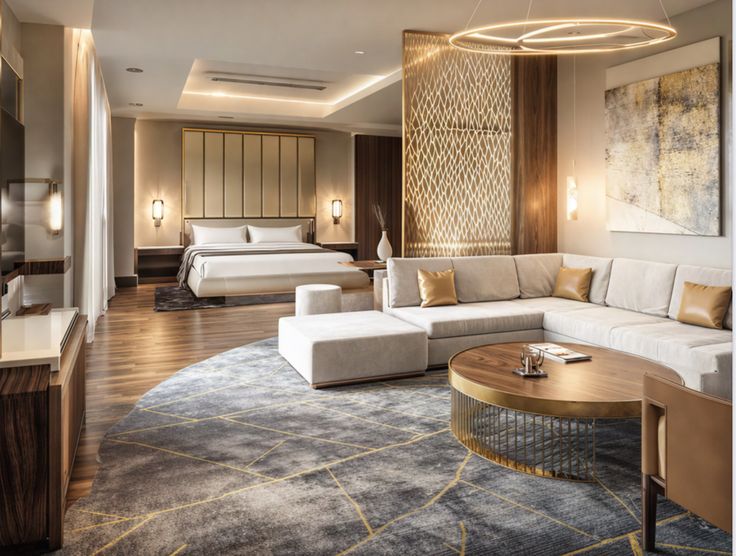
Understanding the Extended-Stay Furniture Paradigm
The core difference between traditional hotel furniture and apartment hotel furniture lies in usage patterns. A transient hotel guest uses a desk chair for perhaps 30 minutes to check email. An extended-stay guest might spend eight hours working from that same chair, cook meals in a kitchenette, and host visitors in their living area. The furniture must perform at residential levels of comfort while maintaining commercial levels of durability.
This dual mandate shapes every specification decision. Drawer slides in an apartment hotel dresser must withstand 50,000 open-close cycles — roughly ten times the cycles expected in a standard hotel dresser over the same period. Sofa cushions require high-resiliency foam with a density of 2.0 lb/ft³ or higher, compared to the 1.8 lb/ft³ minimum acceptable for transient hotel seating. Kitchen cabinets need moisture-resistant core materials that survive daily cooking steam and occasional spills without delaminating.
Room-Type Furniture Configuration
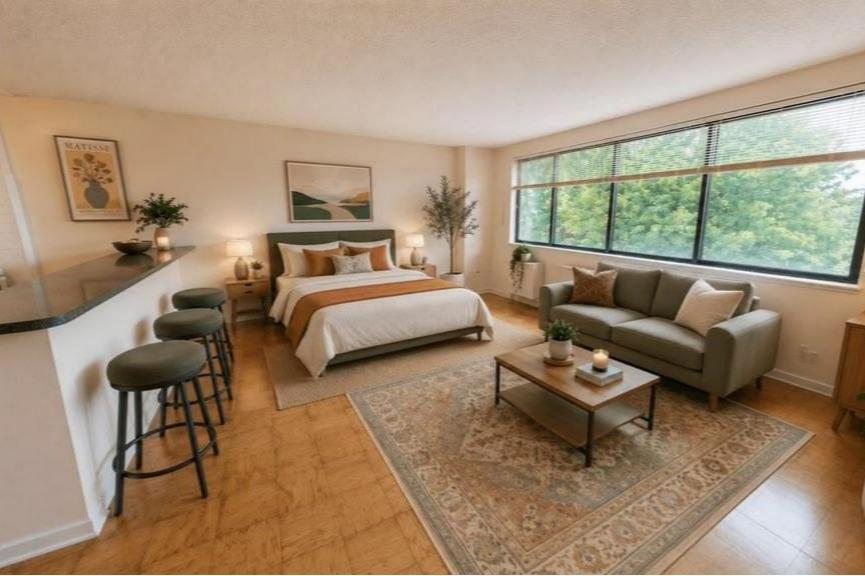
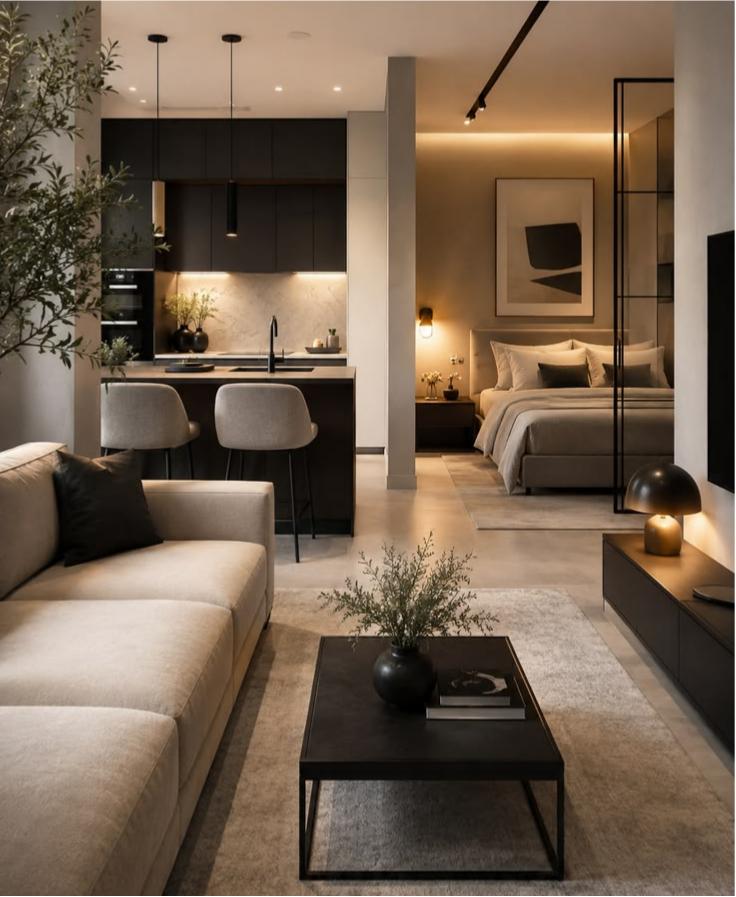
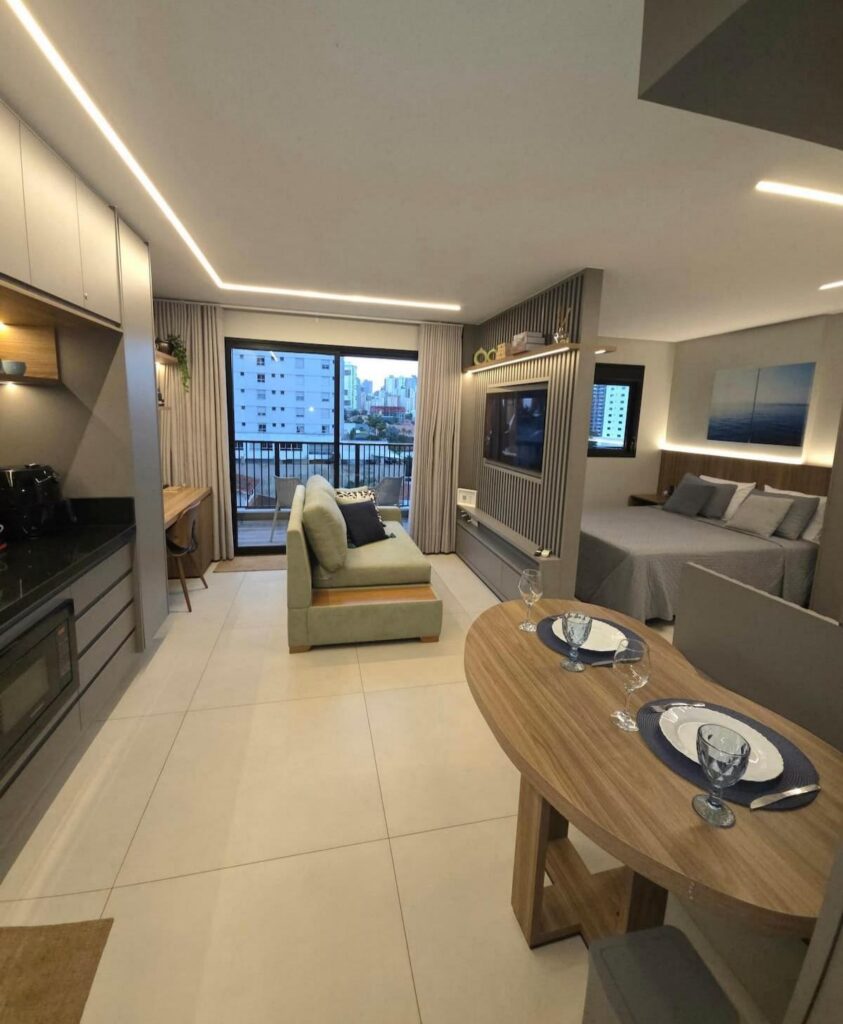
Extended-stay properties span a spectrum from studio suites to three-bedroom apartments. Each configuration demands a tailored furniture package that maximizes space efficiency without compromising on comfort. The table below maps furniture requirements across the most common apartment hotel layouts.
Table 1: Room-Type Furniture List by Configuration
| Room Type | Square Footage | Living Area Furniture | Sleeping Area Furniture | Kitchen/Dining | Work/Desk Area | Additional Items |
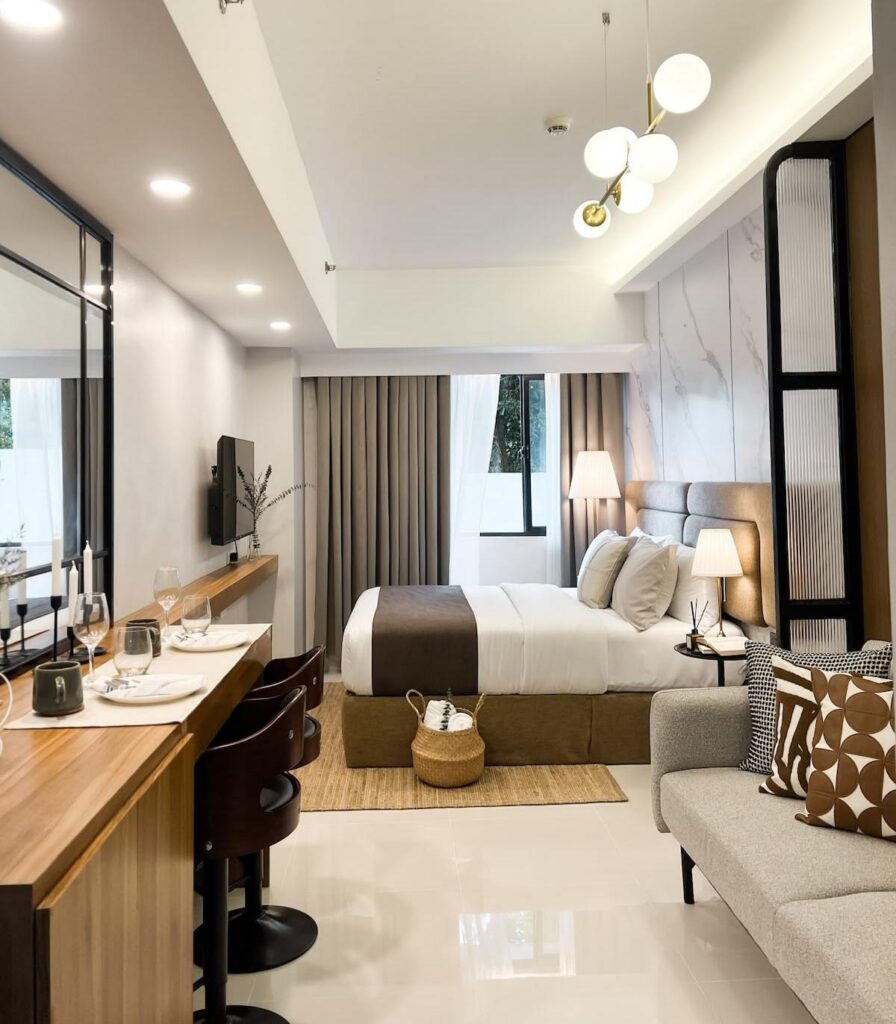
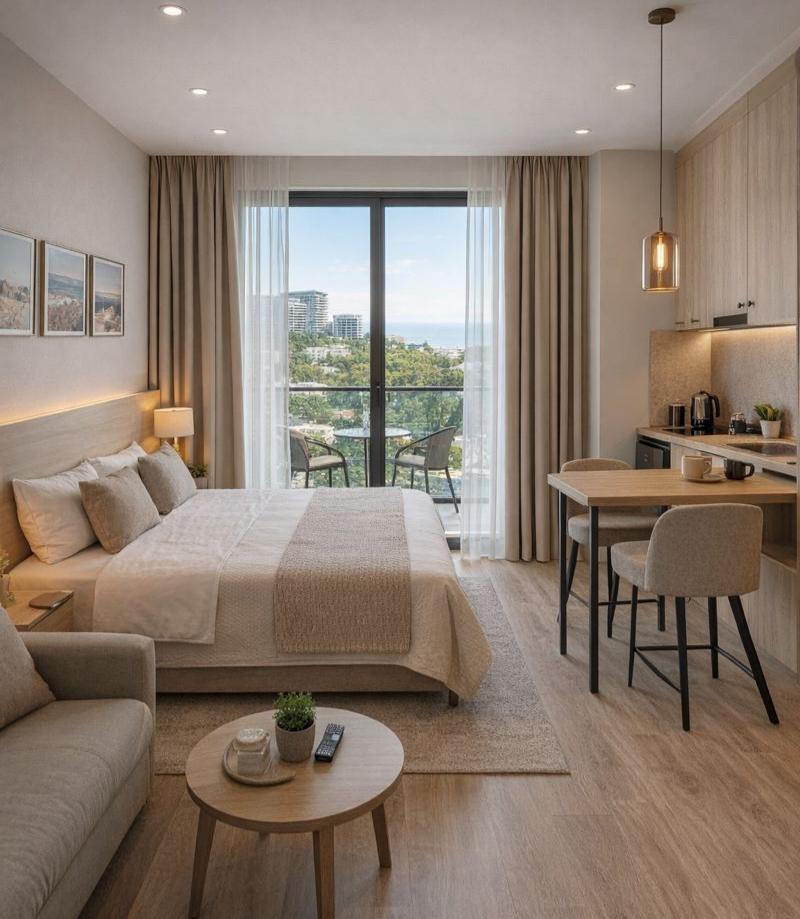
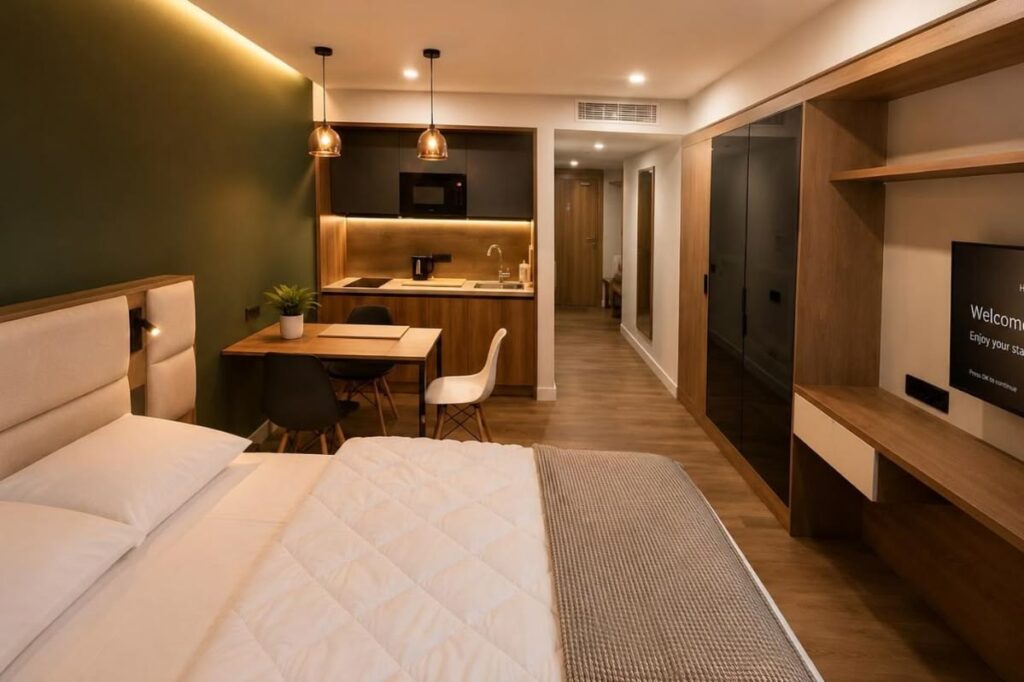
| Studio Suite | 300-400 sq ft | Sofa (or sleeper sofa), coffee table, accent chair (1) | Queen/king bed, 2 nightstands, dresser (4-6 drawers) | Kitchenette cabinets, 2-burner cooktop, microwave, compact fridge, 2 bar stools | Built-in desk with task chair | Luggage rack, full-length mirror, wall-mounted TV |
| One-Bedroom Suite | 450-600 sq ft | Sofa, coffee table, accent chair (2), entertainment unit, floor lamp | King bed, 2 nightstands, 6-drawer dresser, bench at foot of bed | Full kitchen cabinets, 4-burner cooktop, oven, full fridge, dishwasher, dining table (2-4 seats) | Desk with task chair, bookshelf | Luggage rack (2), full-length mirror, closet organizer |
| Two-Bedroom Suite | 650-900 sq ft | Sofa (sectional optional), coffee table, accent chairs (2-3), entertainment unit | Master: king bed, 2 nightstands, dresser. Second: 2 twin/queen, 1 nightstand, dresser | Full kitchen, dining table (4-6 seats), bar stools (2) | Desk with task chair (in master or common area) | Luggage rack (3), mirrors (2), closet organizers, washer/dryer |
| Three-Bedroom Suite | 900-1,200+ sq ft | Sectional sofa, coffee table, ottoman, accent chairs (3), entertainment unit | Per bedroom: bed, nightstand(s), dresser, mirror | Full kitchen, dining table (6-8 seats), kitchen island with stools | Desk with task chair (per bedroom or common area + 1 bedroom) | Luggage rack (4), mirrors (3), closet organizers, washer/dryer, entry bench |
Space planning for apartment hotels follows different rules than traditional guest rooms. The living area must accommodate genuine lounging and socializing, not just a perfunctory seating vignette. Dining tables need to seat the maximum advertised occupancy, not a theoretical count. Work desks require ergonomic setups with proper task lighting and accessible power outlets — extended-stay guests are disproportionately business travelers who value functional workspaces.
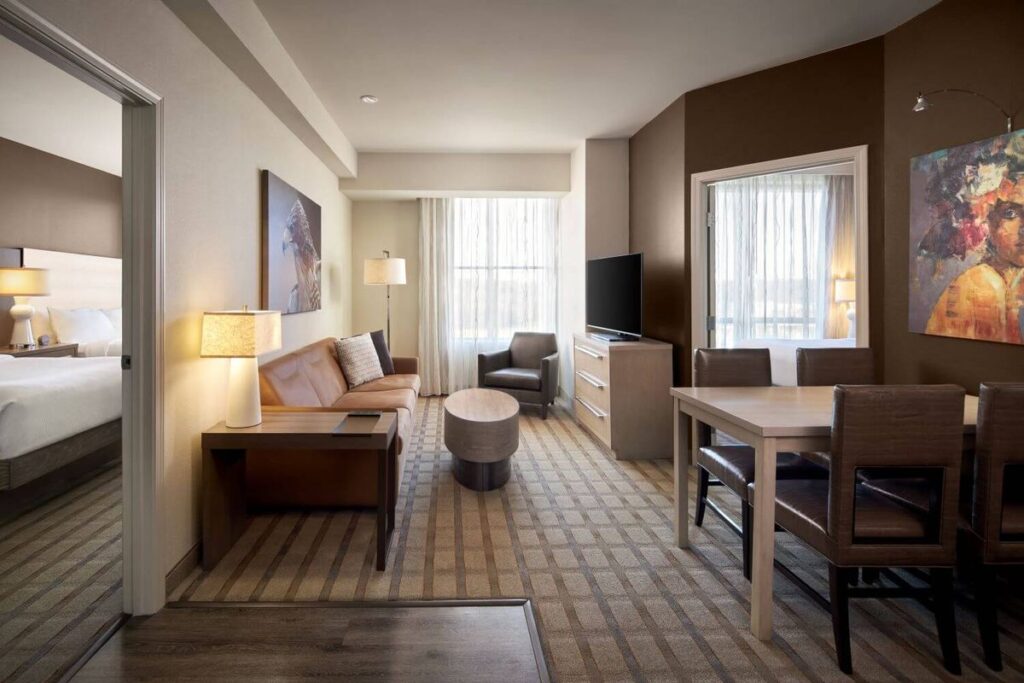
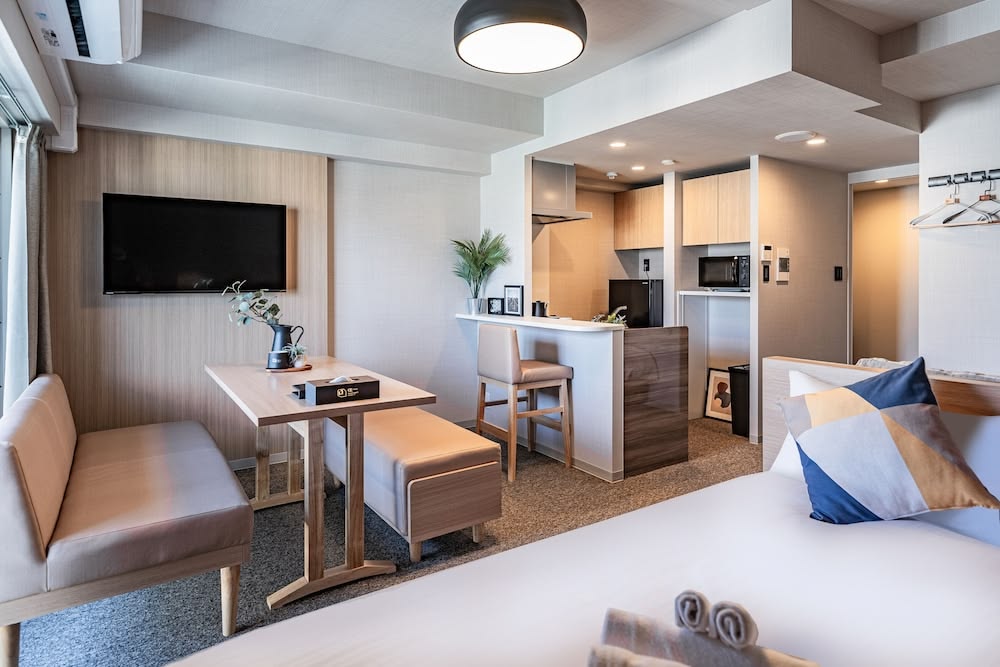
Material Selection: Durability Meets Livability
The extended-stay segment demands materials that can handle heavy daily use for months at a stretch while still looking and feeling residential. The table below evaluates common furniture materials against the specific demands of serviced apartment environments.
Table 2: Material Comparison for Extended-Stay Furniture Applications
| Application | Recommended Material | Alternative Option | Avoid | Performance Expectation | Cleaning Protocol |
| Sofa upholstery | Performance velvet or Crypton | Solution-dyed acrylic | Cotton, linen, viscose blends | 50,000+ Martindale; stain release; liquid barrier | Vacuum weekly; spot clean with water-based cleaner |
| Dining chair seats | PU leather (commercial grade) or vinyl | Crypton fabric | Bonded leather (peels within 2 years) | 60,000+ Martindale; wipe-clean surface | Wipe daily with mild detergent |
| Kitchen cabinets | Plywood core with thermofoil or laminate | MDF with melamine (for low-moisture areas only) | Particleboard core (swells with moisture) | Moisture-resistant; edge-banded all sides | Wipe with non-abrasive cleaner; avoid soaking |
| Countertops | Quartz (engineered stone) | Solid surface (Corian-type) | Laminate (scratches; seams absorb water) | Heat-resistant to 350°F; non-porous | Daily wipe-down; quartz requires no sealing |
| Bed frames | Solid hardwood or steel with reinforced center rail | Plywood with hardwood veneer | MDF bed frames (sag under weight) | Support 600+ lbs static load | Inspect hardware quarterly; tighten as needed |
| Workspace desks | Commercial laminate with 3mm edge banding | Solid wood with polyurethane finish | Unfinished wood (stains from coffee, ink) | Scratch-resistant surface; grommet for cable management | Wipe with mild cleaner; avoid abrasives |
| Mattresses | Hybrid (pocket coil + memory foam) | High-density foam (2.5+ lb/ft³) | Low-density foam (<1.8 lb/ft³); traditional innerspring | 7-10 year lifespan; flip/rotate every 6 months | Mattress protector mandatory; replace protectors every 2 years |
| Window treatments | Blackout roller shades with chain drive | Blackout curtain panels with commercial track | Unlined curtains (inadequate light blocking) | 100% blackout in sleeping areas; cordless for safety | Dry clean curtains annually; wipe shades quarterly |
Material specifications for apartment hotel furniture skew toward higher durability than transient hotel equivalents because the usage intensity is higher. A sofa in a traditional hotel room gets used 3-5 hours per day by a single occupancy. The same sofa in a serviced apartment might see 8-12 hours of use by multiple occupants. This load differential of 2-3x must be reflected in specification grades.
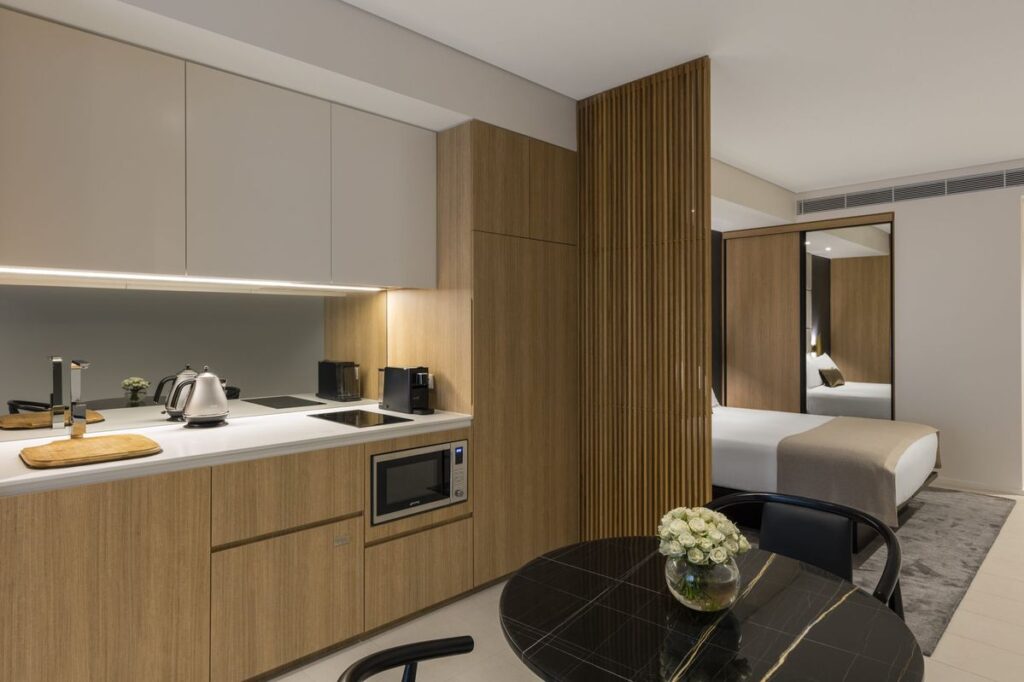
Cost Planning: Budgeting by Room Type
Extended-stay furniture packages carry different cost structures than traditional hotel FF&E. The inclusion of kitchen cabinets, appliances, dining furniture, and more robust living area furnishings drives the per-unit cost higher, but the longer average length of stay and higher ADR in the segment justify the investment. The table below provides budget benchmarks for furnishing different apartment hotel configurations.
Table 3: Estimated Furniture Cost Per Unit by Room Configuration
| Room Type | Furniture Package Cost | Cost Per Sq Ft | Major Cost Drivers | Cost-Saving Opportunities | Notes |
| Studio Suite | $8,000-$12,000 | $24-33/sq ft | Sleeper sofa mechanism; kitchenette millwork | Combine living/sleeping furniture; wall-mounted TV eliminates console | Millwork is typically 35-40% of studio furniture budget |
| One-Bedroom Suite | $14,000-$22,000 | $28-38/sq ft | Full kitchen cabinets; dining set; mattress quality | Standardize kitchen cabinet sizes across units; bulk-purchase appliances | Kitchen represents 30-35% of one-bedroom budget |
| Two-Bedroom Suite | $22,000-$35,000 | $30-40/sq ft | Dual bathrooms; larger dining set; more upholstery | Use consistent furniture pieces across bedrooms; same bed frame model in all rooms | Economies of repetition apply strongly here |
| Three-Bedroom Suite | $32,000-$50,000 | $32-42/sq ft | Three full bedroom sets; largest kitchen; largest dining | Reduce per-bedroom customization; standardize all furniture models | Premium positioning allows and requires higher specification |
| Common areas (per property) | $50,000-$150,000 | $35-55/sq ft | Lobby seating; breakfast area; fitness room; business center | Modular furniture that serves multiple functions | These costs are amortized across all units |
These figures represent midscale to upscale spec levels. Luxury serviced apartments can run 50-100% higher, while budget extended-stay brands may achieve 20-30% lower costs through standardized, volume-purchased packages. Always obtain quotes from at least three qualified hospitality furniture manufacturers to establish competitive pricing benchmarks.
Manufacturers like Hongye Furniture that specialize in both hotel and residential furniture bring a relevant perspective to extended-stay projects — they understand the residential comfort expectations and can translate them into contract-grade specifications. This dual expertise is particularly valuable in the apartment hotel segment.
Durability Requirements: Engineering Furniture for Extended-Stay Use
Durability specifications for apartment hotel furniture must exceed standard hospitality requirements because extended-stay guests use furniture more intensively and for longer continuous periods. The table below provides quantitative durability benchmarks for key furniture categories in serviced apartment environments.
Table 4: Durability Requirements for Extended-Stay Furniture
| Furniture Item | Test Standard | Minimum Requirement | Extended-Stay Target | Failure Mode to Prevent | Testing Protocol |
| Sofa frame | ANSI/BIFMA X5.4 | 250 lb static load per seat | 350 lb static load per seat | Frame cracking at joints; leg failure | Apply load for 1 minute; inspect for structural failure |
| Sofa seat cushion | ASTM D3574 | 34 lb compression (1.8 lb/ft³ foam) | 40+ lb compression (2.0+ lb/ft³ foam) | Permanent compression set; sagging | Measure thickness before/after 80,000 cyclic impacts |
| Bed frame | ASTM F1427 | Static load 400 lbs | Static load 600+ lbs; 200,000 cycle center rail test | Center support failure; side rail cracking | Apply load cyclically; measure deflection |
| Dresser drawer | ANSI/BIFMA X5.9 | 15,000 open-close cycles | 50,000 cycles with 15 lb load | Drawer slide failure; bottom panel sag | Automated cycling with load; measure operation smoothness |
| Desk surface | ANSI/BIFMA X5.5 | 150 lb concentrated load | 200 lb concentrated load | Surface indentation; edge banding separation | Apply load through 3-inch disc for 24 hours; measure impression |
| Dining chair | ANSI/BIFMA X5.1 | 250 lb static + 125 lb dynamic drop | 300 lb static; 75,000 cycle durability | Joint racking; leg splitting | Cyclic backrest loading; seat impact testing |
| Kitchen cabinet door | ANSI/KCMA A161.1 | 50,000 open-close cycles | 100,000 cycles; 250°F heat resistance | Hinge failure; delamination; finish blistering | Cycling with weighted door; heat resistance on exterior surface |
| Workstation chair | ANSI/BIFMA X5.1 | 250 lb; 100,000 cycle | 300 lb; 150,000 cycle; adjustable arm rests | Gas cylinder failure; caster breakage; mechanism seizure | Full range of motion testing under load |
These durability targets reflect the reality that apartment hotel furniture will see continuous use rather than episodic use. A standard hotel guest room chair operates intermittently across check-ins and check-outs; an extended-stay chair operates daily without interruption. Specify accordingly, and request test certificates from manufacturers for these benchmarks.
Layout Specifications: Space Planning for Serviced Apartments
Effective space planning distinguishes well-furnished apartment hotels from those that feel cramped or awkward. Extended-stay guests develop daily routines within their units — cooking breakfast, working from the desk, relaxing in the living area — and furniture placement must support these activity flows without creating bottlenecks or dead zones.
Table 5: Layout Specifications and Clearance Requirements
| Space | Minimum Dimension | Optimal Dimension | Clearance Requirements | Furniture Arrangement Rule | Common Mistakes |
| Living area seating zone | 8 ft x 8 ft | 10 ft x 10 ft | 18-inch clearance between coffee table and sofa; 30-inch walkway between furniture pieces | Orient sofa toward window or TV wall; create conversational grouping with chairs at 90° to sofa | Placing all furniture against walls, which kills intimacy |
| Dining area | 6 ft x 6 ft for 2-seat table; 8 ft x 8 ft for 4-seat | 8 ft x 8 ft; 10 ft x 10 ft for 4+ seats | 36-inch pull-back from table edge to wall; 24-inch between chairs when seated | Center table under light fixture; allow 24 inches of table length per person | Insufficient clearance to pull chairs out; table too large for zone |
| Kitchen work triangle | Sum of three sides: 12-22 ft | 15-18 ft total | 42-inch aisle between facing counters; 36-inch minimum aisle | Sink centered between cooktop and fridge; no traffic through triangle | Aisle too narrow for two people; fridge door blocks pathway |
| Workspace/desk area | 48-inch wide x 24-inch deep desk, 5 ft x 5 ft zone | 60-inch wide x 30-inch deep desk, 6 ft x 6 ft zone | 36-inch chair pull-back; knee clearance 27 inches height x 30 inches width x 19 inches depth | Desk facing window for natural light; power at desk surface level, not floor level | Insufficient knee space; no task lighting; desk too shallow for monitor |
| Bedroom zone | 10 ft x 10 ft for king bed room | 12 ft x 12 ft for king bed room | 30-inch clearance on both sides of bed; 36 inches at foot of bed; 36-inch dresser access | Bed on longest uninterrupted wall; nightstands at equal heights; dresser opposite or perpendicular to bed | Bed blocking window; no clearance on far side; dresser drawers blocked by bed |
| Entry foyer | 4 ft x 4 ft | 5 ft x 5 ft | 36-inch door swing clearance; 48-inch turn radius for wheelchair | Bench or console table against wall opposite door; mirror above for last check | No surface to set keys/bag; no mirror; cluttered transition |
ADA compliance must be integrated into every unit type, not just designated accessible rooms. At minimum, provide a 5-foot turning radius in key areas and knee clearance at one dining position and the desk. Universal design principles benefit all guests — parents with strollers, travelers with rolling luggage, and aging guests appreciate spacious layouts regardless of formal accessibility needs.
Procurement and Installation Sequencing
Furnishing an apartment hotel follows a different installation sequence than a transient hotel because the built-in millwork — kitchen cabinets, closet systems, bathroom vanities — must be installed before loose furniture arrives. The recommended sequencing is: millwork and built-ins first, then large upholstered pieces (sofas, beds), followed by casegoods (dressers, desks, dining tables), and finally accessories (lighting, artwork, soft goods).
Schedule millwork installation to complete at least two weeks before loose furniture delivery. This buffer absorbs the inevitable delays in custom cabinetry production and provides time for punch-list corrections. Receive and inspect all furniture in a staging area before distributing to rooms — discovering damage or defects after pieces are already in units creates logistical chaos and delays opening.
Frequently Asked Questions
1. What is the typical furniture budget for a 100-unit serviced apartment building?
For a midscale to upscale 100-unit serviced apartment building with a mix of studios and one-bedroom units, budget approximately $1.2 million to $2.2 million for furniture, fixtures, and equipment (FF&E). This breaks down to roughly $10,000-$18,000 per studio and $16,000-$24,000 per one-bedroom unit. Add $75,000-$150,000 for common area furniture. Kitchen millwork and appliances typically consume 30-35% of the per-unit budget.
2. How does extended-stay furniture differ from standard hotel furniture?
Extended-stay furniture must meet higher durability standards because guests use it continuously for weeks or months rather than a few nights. Key differences include higher-density foam in seating (2.0+ vs 1.8 lb/ft³), more robust drawer slides (50,000+ vs 15,000 cycle rating), larger and more functional workspaces, and the inclusion of residential-style kitchen and dining furniture that standard hotel rooms do not require. Extended-stay furniture also places greater emphasis on ergonomics and storage capacity.
3. Should I buy residential furniture or commercial furniture for a serviced apartment?
Always specify commercial-grade furniture designed for hospitality use. Residential furniture lacks the durability, fire certifications, and warranty coverage required for commercial operation. While residential furniture may cost 30-50% less upfront, it typically fails within 2-3 years under commercial use and is not covered by warranty when used in a business context. The total cost of ownership for residential furniture in a hospitality setting is almost always higher than investing in proper commercial-grade pieces.
4. What warranty should I expect on apartment hotel furniture?
Standard hospitality furniture warranties provide 5-10 years on frames and structural components, 2-5 years on upholstery fabric and foam, and 1-2 years on moving parts (drawer slides, mechanisms, casters). Extended-stay furniture should target the upper end of these ranges due to more intensive use. Request that warranties explicitly cover commercial use — some manufacturers void warranties if furniture is used in a rental or hospitality context. Get warranty terms in writing and register each piece upon delivery.
5. How do I handle furniture for different guest demographics in the same building?
Extended-stay properties often serve mixed demographics — corporate relocations, traveling medical professionals, families in transition, and leisure travelers — in the same building. Address this through a flexible furnishing model: spec a consistent foundation package (bed, nightstands, dresser, kitchen) across all units, then offer supplementary items on request. This might include cribs for family units, additional desk chairs for dual-occupancy corporate units, or blackout curtain upgrades for night-shift workers. A storage room stocked with these supplementary items enables rapid customization without over-burdening the base budget.