Hotel breakfast rooms put table tops under constant pressure. Every day, staff wipe surfaces, guests spill drinks, plates scrape across finishes, and chairs strike table corners. As a result, a tabletop that looks attractive in a showroom may not perform well in a busy hotel dining area. In addition, repeated cleaning can affect not only the visible surface but also the edges, drilled holes, joints, and table-base fixing points. Therefore, buyers should assess more than color and price. They should also review the core material, edge treatment, cleaning routine, support system, expected traffic, and renovation plan. This guide compares melamine-faced board, HPL, and compact laminate table tops for hotel breakfast rooms. It also explains which option may suit restaurants, banquet areas, meeting rooms, and semi-outdoor dining spaces.
Quick answer: For many indoor hotel breakfast rooms, HPL bonded to a suitable moisture-resistant core offers a practical balance of cost, appearance, and surface durability. However, compact laminate may suit high-turnover or frequently wet-cleaned areas because it does not use a wood-based core with traditional edge banding. Meanwhile, melamine-faced board can work in dry, lower-traffic, or short-horizon applications, but buyers should pay close attention to edge protection and moisture exposure.
Key Takeaways
- Although the three materials can look similar, melamine-faced board, HPL, and compact laminate use different construction methods.
- Consequently, their moisture performance, edge durability, repair options, and long-term costs also differ.
- For dry, lower-traffic hospitality spaces, melamine-faced board may offer a cost-effective option.
- In contrast, HPL bonded to a suitable moisture-resistant core can provide a stronger balance of performance, appearance, and cost for many indoor hotel dining rooms.
- Where tables receive frequent wet cleaning or heavy traffic, compact laminate may reduce wood-core moisture risk because it has no separate particleboard or MDF substrate.
- Even so, compact laminate still needs correct machining, support spacing, table-base fixing, and corner protection.
- Before placing an order, buyers should specify the surface, core, thickness, edge, cut-outs, underside, support system, and cleaning requirements.
What Are the Three Table Top Materials?
At first glance, melamine-faced board, HPL, and compact laminate may look similar. However, manufacturers build them in very different ways. Because construction affects performance, each material responds differently to moisture, edge damage, impact, cleaning chemicals, and repeated use. Therefore, buyers should identify the full table-top system before comparing prices.
Melamine-Faced Board
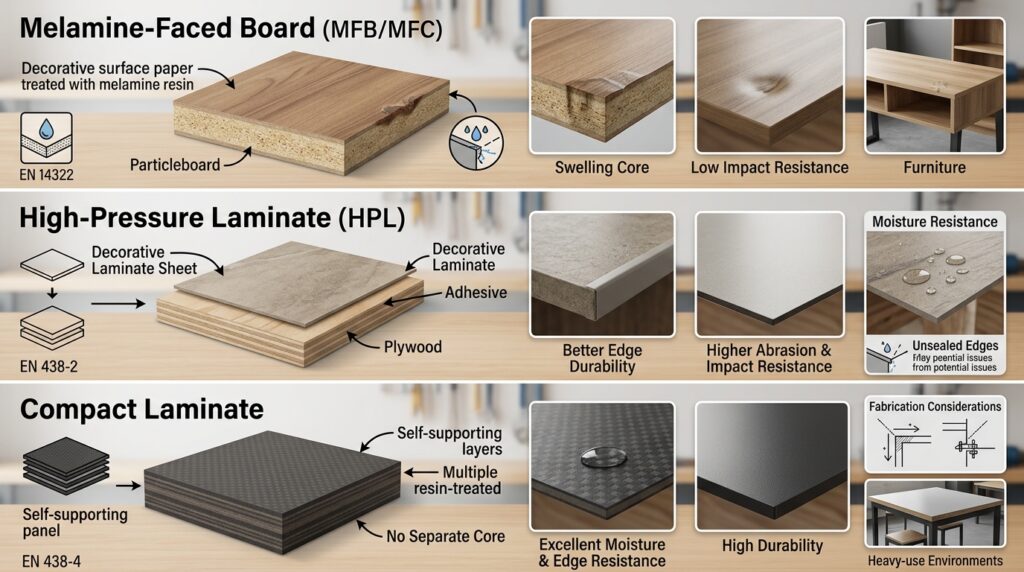
Melamine-faced board, often called MFB or MFC, uses decorative paper treated with melamine resin. Manufacturers fuse this surface to a wood-based panel, such as particleboard or MDF. As a result, MFB can offer a wide range of colours, woodgrain patterns, and lower-cost finish options. It is therefore common in commercial furniture and interior fit-out projects. However, this system needs edge protection. If water enters through a damaged edge, drilled hole, joint, or corner, the wood-based core may swell. For interior use, EN 14322 covers decorative melamine-faced board requirements and classification. In addition, buyers should define the intended use rather than requesting generic “melamine board.”
High-Pressure Laminate
High-pressure laminate, usually called HPL, is a separate decorative sheet. Manufacturers bond the sheet to a selected substrate, such as plywood, MDF, particleboard, or another suitable core. Compared with standard melamine-faced board, HPL can offer stronger surface protection for many commercial applications. In addition, it provides a broad range of colours, textures, wood effects, and stone-look finishes. Nevertheless, the laminate face cannot fully protect a poorly designed edge system. If water enters through a damaged edge, an unsealed screw hole, or a poorly protected cut-out, the substrate may still swell or lose strength. The EN 438 series covers high-pressure decorative laminates. For example, EN 438-2 includes methods for assessing properties such as abrasion and impact resistance.
Compact Laminate
Compact laminate is a self-supporting high-pressure laminate panel. Unlike HPL bonded to a wood-based board, compact laminate does not use a separate particleboard or MDF core. Instead, manufacturers press multiple resin-treated layers into one solid panel. As a result, compact laminate does not have the same wood-core and edge-band interface that can create moisture-related swelling. However, the material still needs correct fabrication. For example, poor support spacing can allow a panel to bend, while sharp or poorly machined corners may chip during daily use. For indoor applications, EN 438-4 covers compact laminate intended for interior use. Therefore, buyers should also follow the product manufacturer’s guidance for thickness, span, fixing points, edge treatment, and table-base support.
Material rule: “Laminate table top” is not a complete specification. Buyers should ask whether the table uses melamine-faced board, HPL bonded to a core or compact laminate.
Why Hotel Breakfast Rooms Damage Table Tops
Hotel breakfast rooms create a difficult operating environment.
First, guests and staff use tables repeatedly within a short morning service period. Next, cleaning teams wipe surfaces several times each day. Meanwhile, spills, plates, cups, service trolleys and chair legs create constant contact with the table.
The surface can suffer abrasion, impact and staining. However, water and cleaning products can also reach edges, joints, drilled holes and fixing points.
Therefore, buyers should evaluate the complete top construction rather than choosing a material only by its colour or pattern.
Common causes of table-top damage include:
- Frequent wiping and plate movement.
- Citrus juice, coffee, milk, water and food spills.
- Wet cleaning cloths left on edges.
- Cleaning agents, sanitizers and degreasers.
- Plate, cutlery and trolley impact.
- Chair contact at corners.
- Heavy serving items and hot tableware.
- Loose table bases.
- Unsealed holes for screws or power modules.
- Poor storage in humid areas.
- Table dragging during daily cleaning.Operating rule: The cleaning method can affect table-top life as much as the surface material. Buyers should provide their planned cleaning products to the furniture supplier before final approval.
The Critical Detail: Core, Edge and Cut-Outs
For table tops with particleboard, MDF or another wood-based core, moisture risk often begins at the edges.
Water can enter through damaged PVC edging, open joints, drilled holes, cracks, corner impacts or poorly sealed cut-outs.
Once moisture reaches a wood-based core, the panel can swell, lose shape and become difficult to repair.
This damage may begin at one small corner. However, the swollen area can spread as cleaning water continues to enter the board.
HPL can protect the face of a top. Yet it cannot fully protect a core if the edge system fails.
Therefore, a hotel table-top specification should always define:
- Surface material.
- Surface thickness.
- Core material.
- Core grade.
- Edge profile.
- Edge-band or edge-sealing method.
- Treatment of drilled holes.
- Treatment of power-module cut-outs.
- Underside finish.
- Table-base fixing method.
- Corner radius.
- Support spacing.
- Approved cleaning products.
Compact laminate removes the wood-core and edge-band interface. However, it still needs correct support and fixing details.
For example, a thin compact laminate panel can bend if the table frame does not support it properly. In addition, poorly machined corners can chip after repeated impact.
Specification rule: A table top is a system. Surface, core, edge, holes, frame and cleaning method all affect long-term performance.
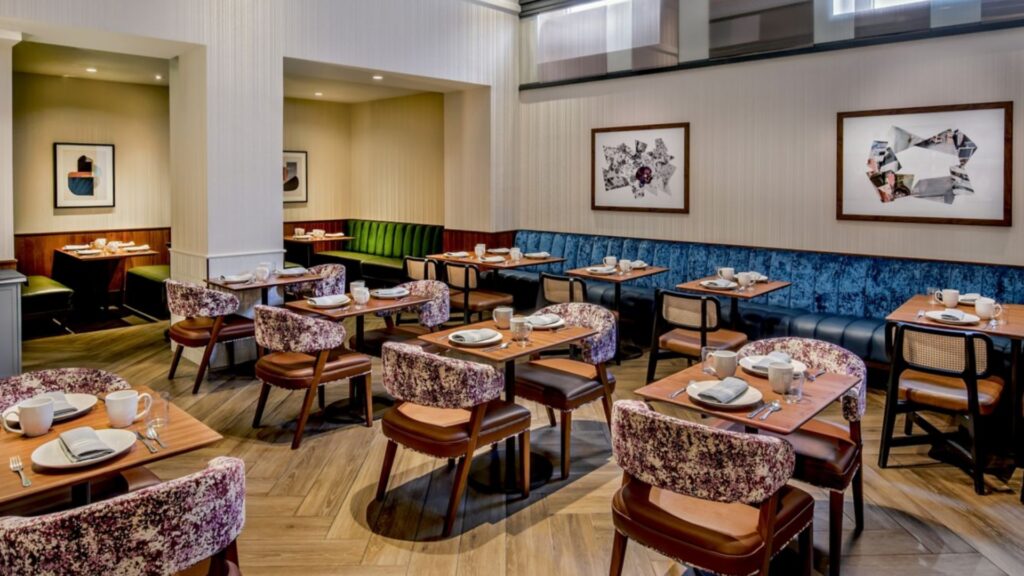
Melamine vs HPL vs Compact Laminate
| Material | Construction | Main Strength | Main Risk | Best Fit |
|---|---|---|---|---|
| Melamine-faced board | Melamine decorative surface fused to a wood-based board | Lower initial cost and broad design options | Edge damage and core swelling after moisture exposure | Dry, lower-traffic or short-horizon indoor use |
| HPL on a substrate | HPL sheet bonded to a selected board core | Strong surface performance and design flexibility | Core, edge and cut-out protection determine durability | Most indoor hotel breakfast rooms and restaurants |
| Compact laminate | Solid, self-supporting laminate panel with no wood-based core | Strong moisture tolerance and solid exposed edge | Needs correct support, machining, fixing and corner protection | High-turnover, frequently wet-cleaned or high-abuse areas |
When Melamine-Faced Board Can Work
Melamine-faced board can be a practical choice for some hotel applications.
For example, it may suit:
- Meeting-room tables with controlled use.
- Banquet tables that remain covered with tablecloths.
- Dry back-of-house dining areas.
- Low-traffic café spaces.
- Short-term renovation projects.
- Furniture with limited water exposure.
- Rooms with controlled cleaning procedures.
However, buyers should avoid treating all melamine-faced boards as equal.
EN 14322 includes several performance classifications for melamine-faced boards. Therefore, the procurement team should specify the intended use and required product classification rather than requesting generic “melamine board.”
When HPL Is a Strong Choice
HPL can work well for many indoor hotel breakfast rooms.
It provides a stronger surface layer than standard melamine-faced board. In addition, it offers many decorative options, including stone, wood, textile and solid-colour finishes.
Still, the HPL face is only part of the system.
For frequent wet cleaning, buyers should select:
- A suitable moisture-resistant substrate.
- Correct laminate thickness.
- Sealed edges.
- Protected corners.
- Sealed drilled holes.
- Suitable underside treatment.
- A stable table base.
- Cleaning products approved by the laminate manufacturer.
HPL table tops can provide a practical balance for indoor hospitality dining areas. However, the project team must confirm the core and edge construction before production.
When Compact Laminate Is Worth Considering
Compact laminate can suit high-use hotel breakfast rooms, public dining areas, café spaces and semi-exposed hospitality locations.
Because it does not use a particleboard or MDF core, it can reduce the risk of moisture-related core swelling.
This feature can matter in areas where staff clean tables frequently or where water spills are common.
However, compact laminate usually has a higher initial cost than melamine-faced board or HPL-on-board construction.
Therefore, owners should compare the initial material cost with the expected maintenance burden, replacement disruption, cleaning intensity and renovation timing.
For a long-hold property with high dining traffic, compact laminate may be worth considering. In contrast, a lower-traffic renovation with a short design life may not need the same material level.
Choosing a Table Top by Hotel Area
No single table-top material suits every hotel space.
Instead, buyers should match the material to the location, traffic level, cleaning plan and expected renovation cycle.
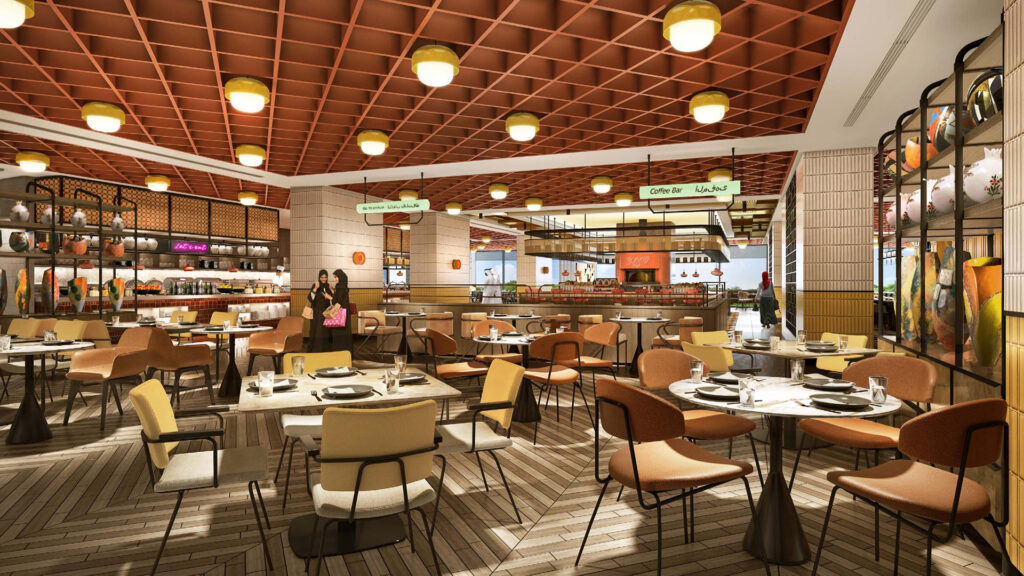
| Hotel Area | Recommended Direction | Why |
|---|---|---|
| Small or low-traffic breakfast room | HPL on a moisture-resistant core | Offers a practical balance of cost, appearance and surface durability |
| High-turnover city-hotel breakfast room | Compact laminate or well-engineered HPL system | Handles frequent cleaning and reduces wood-core moisture risk |
| Indoor hotel restaurant | HPL on a suitable core or compact laminate | Depends on traffic, food service style, cleaning and table design |
| Covered banquet tables | Melamine-faced board or HPL, depending on handling and storage | Tablecloths can reduce surface wear, but edges and storage still matter |
| Meeting-room tables | Melamine-faced board or HPL | Lower spill risk and more controlled use may support lower-cost options |
| Outdoor or semi-outdoor dining | Exterior-grade compact laminate or another outdoor-rated material | Requires UV, moisture, temperature and cleaning resistance |
| Poolside or coastal dining | Outdoor-rated material selected for wet, UV and salt-air conditions | Interior laminate products may not suit direct weather exposure |
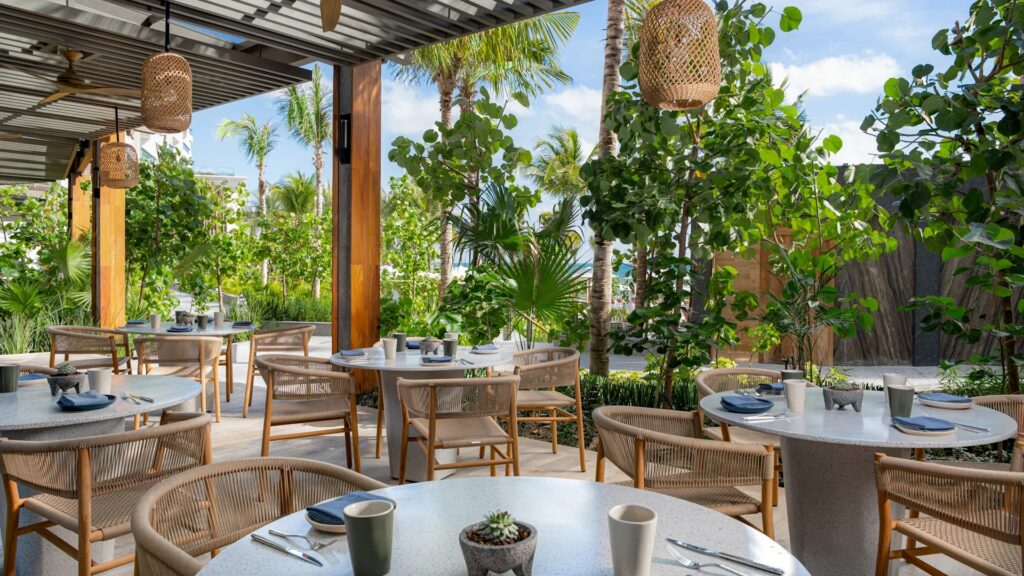
For outdoor and semi-outdoor dining, do not assume that interior compact laminate is suitable.
Instead, specify exterior-grade compact laminate or another product rated for UV, moisture, temperature change and local weather exposure. EN 438-6 addresses exterior-grade compact laminate intended for outdoor conditions.
How to Write a Hotel Table Top Specification
A good table-top specification should describe more than “laminate finish.”
The specification should identify the full construction and the operating conditions.
Example: HPL Table Top Specification
Table top: high-pressure decorative laminate selected in accordance with the applicable EN 438 product classification. Bond the laminate to a moisture-resistant substrate suitable for interior hotel dining use. Provide matching sealed edges, sealed drilled holes, protected cut-outs, and an underside finish appropriate to the table construction. Confirm laminate thickness, core type, edge profile, fixing method, and approved cleaning products before production.
Example: Indoor Compact Laminate Specification
Table top: interior-grade compact laminate selected in accordance with the applicable EN 438 compact laminate classification. Select panel thickness, support spacing, fixing method, edge profile, and corner radius in accordance with the laminate manufacturer’s fabrication guidance and approved shop drawings.
Example: Outdoor Table Top Specification
Table top: exterior-grade compact laminate or equivalent outdoor-rated material suitable for the local UV, moisture, temperature and cleaning conditions. Submit technical data, fabrication guidance, fixing details, edge treatment and maintenance instructions for approval before production.
Buyer rule: Name the surface, core, edge, holes, support and cleaning requirements. A material name alone is not enough for a purchase order.
Cleaning and Maintenance
Hotel breakfast rooms may use detergents, degreasers, sanitizers, and disinfectants.
Their effect on a tabletop can depend on concentration, contact time, wiping method, rinsing practice and the specific surface, edge and adhesive system.
Therefore, buyers should give the furniture supplier or laminate manufacturer a list of planned cleaning products before sample approval.
The supplier should provide written guidance that covers:
- Approved cleaners.
- Prohibited chemicals.
- Dilution instructions.
- Contact-time limits.
- Rinsing requirements.
- Drying requirements.
- Stain-removal instructions.
- Edge-repair procedure.
- Handling of scratches and chips.
- Warranty limitations.
Practical Hotel Maintenance Tips
- Wipe spills quickly, especially at edges and joints.
- Do not leave wet cloths on table corners.
- Inspect edges and drilled holes during routine maintenance.
- Replace damaged glides to reduce table movement.
- Avoid dragging tables across tile or stone floors.
- Check table-base fixings regularly.
- Repair minor edge damage before water reaches the core.
- Store banquet tables in dry, ventilated areas.
- Use manufacturer-approved cleaning products.
- Train staff to report lifted edges, chips and unstable table bases early.Maintenance rule: Once a wood-based core swells, simple resealing may not restore the original shape. Early repair is usually more effective than waiting for visible failure.
Hongye Hotel Dining Table Support
Hongye supports qualified hotel breakfast rooms, restaurants, banquet and public-dining projects with table-top material discussions, product drawings, sample development and project-specific documentation where applicable.
For hospitality dining projects, Hongye can support:
- Melamine-faced board, HPL-on-substrate, and compact laminate discussions.
- Table-top core and edge construction review.
- Table-base and support-structure coordination.
- Material and finish sample approval.
- Product drawings and fixing details.
- Indoor, semi-outdoor, and outdoor material selection.
- Cleaning and maintenance guidance discussions.
- Export packing and shipment planning.
- Spare-part and replacement planning.
- Project-specific quality documentation where applicable.
Hongye states that it has more than 30 years of commercial furniture manufacturing experience and operates a 300,000-square-meter production facility in Heshan, Jiangmen, Guangdong, China.
Before production, buyers should verify the exact table-top construction, material classification, core, thickness, edge treatment, support method, approved cleaning guidance and warranty scope.
Hotel Furniture
Frequently Asked Questions
Which tabletop material is best for a hotel breakfast room?
For many indoor breakfast rooms, HPL bonded to a suitable moisture-resistant core can provide a practical balance of surface performance, cost and design flexibility.
However, compact laminate may be a stronger option for high-turnover or frequently wet-cleaned areas because it does not use a wood-based core that can swell after moisture exposure.
The final choice should consider traffic, cleaning products, table-base design, expected renovation timing and budget.
What is the difference between melamine and HPL table tops?
The melamine-faced board uses a melamine resin decorative surface fused directly to a wood-based panel.
In contrast, HPL is a separate high-pressure laminate sheet bonded to a selected substrate.
HPL often provides stronger surface performance. However, both materials need suitable cores and protected edges for hotel dining use.
Why do hotel laminate table edges swell?
Water can enter through damaged edges, drilled holes, seams, or poorly sealed cut-outs.
If the table uses a particleboard, MDF, or another wood-based core, moisture can enter the core and cause swelling.
The decorative surface may remain intact while the table edge fails. Therefore, core selection and edge sealing are as important as the visible surface.
Is compact laminate waterproof?
Compact laminate does not contain a wood-based substrate that can swell in the same way as particleboard or MDF.
However, it still requires correct fabrication, fixing, support and maintenance. In addition, buyers should choose exterior-grade compact laminate for direct outdoor exposure rather than assuming all compact laminate products are weather resistant.
Can compact laminate table tops be used outdoors?
Some compact laminate products are suitable only for interior use.
For outdoor or semi-outdoor hotel dining, select exterior-grade compact laminate or another outdoor-rated table-top material that the manufacturer rates for UV, rain, moisture, temperature change and local conditions.
Is melamine suitable for hotel banquet tables?
Melamine-faced board may be suitable for protected, dry and lower-abuse banquet applications.
However, tablecloths do not remove the need for proper edge treatment, dry storage, careful handling and moisture control.
How should I specify HPL table tops for a hotel?
Specify the HPL product category, surface thickness, core type, edge profile, edge-sealing method, drilled-hole protection, underside finish, support system, fixing method and approved cleaning products.
In addition, request the laminate manufacturer’s technical data sheet, product classification, fabrication guidance and relevant test evidence.
What should I check before approving a hotel table-top sample?
Check the visible surface, edge profile, corner radius, core material, underside finish, table-base fixing, support spacing, drilled holes, cut-outs, colour consistency, cleaning compatibility and overall stability.
Also test the sample against the hotel’s actual cleaning products before approving mass production.
Specify the Full Table Top System
Melamine, HPL and compact laminate can all serve useful roles in hotel furniture.
However, the best table top is not simply the one with the toughest face. It is the system that matches the hotel’s traffic, wet-cleaning routine, room design, table-base support, maintenance capacity and renovation plan.
For lower-risk indoor spaces, melamine-faced board may provide a cost-effective solution. For many busy hotel breakfast rooms, HPL on a moisture-resistant core can offer a strong middle ground. Meanwhile, compact laminate may reduce core-related moisture risk in high-use or heavily cleaned areas.
Before ordering, define the complete construction. Then confirm the surface, core, edge, cut-outs, support, cleaning instructions and warranty in writing.