
40HQ furniture container loading starts with the packed products—not a fixed number of rooms, chairs or cabinets.
To estimate container requirements, collect the external dimensions, gross weight, quantity, permitted orientation and stacking conditions of every package. Then check how those packages fit within the selected container while allowing for safe handling and securing.
The priority is load feasibility: total cubic metres help with planning, but they do not prove that a particular combination of furniture will fit.
This guide explains how to calculate furniture shipping CBM, compare knock-down and assembled packing, review weight requirements and prepare a documented loading plan.

Key Takeaways
- Use the selected carrier’s equipment specifications and confirm the actual container before loading.
- Calculate CBM from external package dimensions, including crates or pallets where applicable.
- Review package shape, orientation and stackability before confirming container count.
- Distinguish cargo weight, container payload, packed-container gross mass and road-transport limits.
- Follow the applicable SOLAS verified gross mass requirements.
- Check whether wood packaging contains regulated solid-wood components.
- Compare packing options using total project cost, including destination assembly.
- Agree the loading plan, inspection scope and shipment records before loading begins.
Why Nominal Container Volume Is Not a Loading Guarantee

Container specifications provide a starting point for dimensional and weight checks.
However, nominal internal volume does not account for the way furniture packages interact.
A load may leave unused space because:
- Packages cannot be rotated.
- Fragile items cannot carry an upper load.
- Carton heights do not form compatible layers.
- Long components limit placement options.
- Securing materials need space.
- Weight distribution restricts the arrangement.
- The unloading sequence requires access to particular packages.
Conversely, a well-matched set of packages may use space more effectively than an irregular mixed load.
Do not apply one universal “practical CBM” allowance to every furniture shipment.
Confirm the Equipment Being Used
Obtain the carrier’s specification for the proposed equipment and confirm the relevant details of the actual container.
Review:
- Internal dimensions.
- Door opening.
- Maximum permitted gross mass.
- Container tare.
- Available payload.
- Relevant loading restrictions.
A package that fits within the internal dimensions may still be unable to pass through the door or follow the planned handling route.
Build the Furniture Packing List Before Estimating Container Count
The loading calculation should use the shipping configuration, not the furniture’s assembled dimensions.
For each item, establish how many packages it creates and what each package contains.
A wardrobe may have separate panels, doors and hardware cartons. A table may have a top crate and a base package. Counting only the finished product dimensions will not describe the shipment accurately.
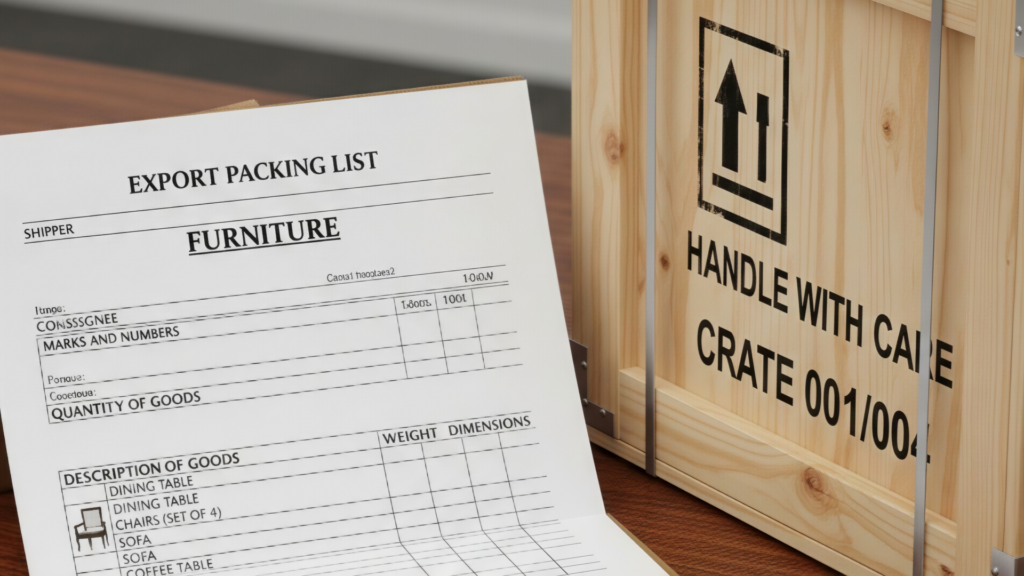
| Packing-List Field | What to Record | Why It Matters |
|---|---|---|
| Item and package reference | Product code, package number and contents | Connects packages to the order |
| Package quantity | Number of identical packages | Supports volume and weight totals |
| External dimensions | Packed length, width and height | Establishes shipping CBM |
| Gross weight | Product plus packaging for that package | Supports load and weight calculations |
| Orientation | Permitted and prohibited positions | Determines placement options |
| Stackability | Whether stacking is allowed and under what conditions | Protects packages from unsuitable loads |
| Handling requirements | Lifting points, fragile surfaces or other restrictions | Supports the handling method |
| Destination reference | Room, floor, site or delivery wave where needed | Supports receiving and distribution |
| Packing status | Estimated, confirmed or measured | Shows the reliability of the data |
Avoid Double Counting
If a listed crate dimension already includes its base, do not add the base again.
Likewise, if several cartons are measured as one palletised unit, explain whether the packing list reports the pallet dimensions or the individual cartons.
Use one consistent basis for the shipment.
Separate Estimates From Confirmed Measurements
At quotation stage, package dimensions may be preliminary.
Label them accordingly and state when they will be confirmed.
A budget estimate based on expected packaging should not be presented as a final container-loading commitment.
How to Calculate Furniture Shipping CBM
For a rectangular package measured in millimetres:

For identical packages:
Total CBM=Package CBM×Quantity
Illustrative Calculation
Suppose a confirmed furniture carton measures:
- Length: 1,200 mm.
- Width: 600 mm.
- Height: 150 mm.
Its external volume is:
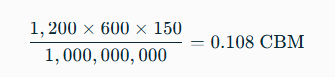
Twenty identical cartons total:
0.108×20=2.16 CBM
This calculation establishes the combined package volume. It does not yet establish the required floor space, stacking arrangement or securing method.
Do Not Round Too Early
Keep sufficient precision in individual package calculations and round the shipment summary consistently.
Repeatedly rounding small packages before multiplying quantities can distort the total.
Convert the Packing List Into a Feasible Loading Arrangement
After calculating volume, check the arrangement.
The loading plan should consider:
- Door access.
- Package dimensions.
- Permitted rotation.
- Stackability.
- Support.
- Weight distribution.
- Handling.
- Securing.
- Unloading requirements.
A total below the container’s nominal volume can still require more than one container if the packages cannot be arranged safely.
Review Different Furniture Constructions
Different product groups create different constraints.
- Flat panels may pack compactly but require suitable support and edge protection.
- Stackable chairs need confirmed nested dimensions and stack limits.
- Upholstered furniture may occupy more space and have restrictions on compression.
- Stone, glass or dense metal components require appropriate handling, support and weight review.
Use the supplier’s packing and handling information for the actual products.
Do not assume that every heavy item belongs in the same location or that every empty space should be filled.
Use a Reviewed Loading Plan
The IMO/ILO/UNECE CTU Code provides a framework for packing and securing cargo transport units across intermodal transport. It addresses responsibilities and practices beyond simply maximising volume.
Have competent loading personnel review the proposed arrangement against the shipment and route.
The article’s calculations should support that review, not replace a securing assessment.
Compare KD, Hybrid and Assembled Furniture Shipping
Knock-down construction can reduce the packed volume of suitable products by removing empty space within assembled furniture.
However, the amount depends on the design and packaging. It should be calculated from the proposed package dimensions rather than a universal percentage.
Hybrid packing may involve removing selected components while keeping major assemblies intact.
| Packing Option | What to Compare | Destination Questions |
|---|---|---|
| Fully assembled | Package dimensions, protection, handling and remaining installation | Can the item reach its final position? |
| Knock-down | Package reduction, hardware, instructions and assembly requirements | Who assembles, checks and fixes the product? |
| Hybrid | Components removed and work left for the site | Are tools, labour and parts available? |
Compare Total Project Cost
Include:
- Manufacturing and packaging.
- Transport.
- Additional handling.
- Destination assembly.
- Supervision.
- Tools.
- Missing-part arrangements.
- Inspection.
- Repair or rework.
Lower shipping CBM does not automatically mean a lower total cost.
Approve the Packing Configuration
Before production, confirm which components will be assembled and which will be packed separately.
Connect the decision to the drawings, hardware schedule and installation information.
For products requiring significant assembly, review a representative assembly process before repeating the arrangement across the order.
Understand Container Weight and VGM Requirements
Keep the different weight terms separate.
Container Payload
Maximum payload is derived from the container’s maximum permitted gross mass minus its tare. The available capacity must account for the contents placed inside, including relevant packing and securing materials. [1006]
Do not treat the published payload as an automatic cargo allowance without reviewing the actual container and shipment.
Packed-Container Gross Mass
The packed-container gross mass includes the container tare together with the cargo, packages, pallets, dunnage and securing materials. [1000]
Road and Inland-Transport Limits
Confirm the planned inland movements with the logistics provider.
A container’s structural rating does not establish that every vehicle, axle arrangement, route or destination can carry the same load.
Avoid mixing vehicle-combination weight with cargo payload in one comparison.
What Does VGM Mean for Furniture Shipping?

Verified gross mass, or VGM, is a SOLAS requirement for packed containers within its scope.
The shipper is responsible for providing the verified mass through the required shipping documentation. The information must be available in time for the relevant vessel-stowage planning process.
IMO identifies two methods:
- Weigh the packed container using suitable equipment.
- Determine the mass of the packages, cargo, packing and securing materials, add the container tare, and use a method certified and approved by the competent authority where packing is completed.
Method 2 is not simply counting cartons and inserting estimated weights.
Confirm the Submission Process
Agree with the logistics provider:
- Applicable method.
- Responsible parties.
- Supporting records.
- Authorised submission.
- Carrier and terminal requirements.
- Submission deadline.
- Correction procedure.
Do not apply a universal submission window or self-selected weight tolerance to every shipment.
Check ISPM 15 Applicability to Furniture Export Packaging
Review the materials used in crates, pallets, bracing and dunnage.
ISPM 15 covers regulated wood packaging in international trade, including relevant dunnage. Packaging made entirely from processed wood materials such as plywood may be exempt. [1012][1015]
A plywood crate may still contain regulated solid-wood runners or framing. Review the complete construction rather than relying on the name “plywood crate.”
Confirm Treatment and Marking Where Required
For regulated components, confirm the applicable treatment and marking arrangements.
Keep the packaging information connected to the shipment documents and check destination requirements with the relevant logistics or plant-health specialists.
Do not assume that every wooden-looking package requires the same treatment—or that all parts of a mixed-material package are exempt.
Specify Protection and Moisture Management for the Route
Packaging should suit the product, handling and transport conditions.
Define:
- Carton or crate construction.
- Product support.
- Edge and surface protection.
- Stack limits.
- Handling method.
- Restraint.
- Identification.
- Storage restrictions.
Avoid prescribing one carton grade or crate design for every piece of furniture.
Review Moisture Sources Before Selecting Measures
Consider product and packaging moisture, container condition, storage and the planned route.
Where liners, barriers or desiccants are proposed, confirm their purpose, suitability and application.
These measures should form part of a considered packaging plan. They are not a guarantee against every moisture-related problem.
What Should a Furniture Container Loading Check Cover?
A loading check should verify the agreed plan and record exceptions.
Define its scope before loading begins, including who may stop the process or approve a change.

| Check | What to Verify | Record to Keep |
|---|---|---|
| Container identity | Correct container and relevant equipment details | Container reference |
| Container condition | Suitability for the cargo and planned use | Condition report and photographs |
| Package identity | Correct items and quantities | Packing-list reconciliation |
| Package condition | Damage or unsuitable packaging | Exceptions and actions |
| Arrangement | Approved orientation, support and stacking | Loading-plan confirmation |
| Weight information | Required cargo and container records | Weight documentation |
| Securing | Measures appropriate to the reviewed plan | Inspection record |
| Wood packaging | Applicable treatment and marking | Packaging verification |
| Changes | Any departure from the agreed plan | Authorised revision |
| Completion | Documents, seal and shipment information | Final loading record |
Use Photographs as Supporting Evidence
Photograph relevant stages, labels, exceptions and the completed arrangement where safe and practical.
Photographs improve traceability, but they do not replace correct loading, measurement or securing.
Do not promise that a photograph will automatically settle a damage claim. Its value depends on what it shows and how it relates to the other records.
Separate Loading Checks From Product Inspection
A loading check is not a substitute for the agreed product-quality inspection.
Likewise, a product inspection does not establish that the container was subsequently loaded and secured correctly.
Connect the records while keeping their purposes distinct.
Compare LCL and FCL Using Complete Quotations
There is no universal CBM point at which less-than-container-load shipping becomes more expensive than a full container.
Request route-specific quotations that identify:
- Freight.
- Origin charges.
- Destination charges.
- Handling.
- Packaging requirements.
- Delivery.
- Storage.
- Schedule assumptions.
Also consider the receiving arrangements and the number of handling stages.
Compare the complete service rather than one freight rate.
Discuss a Furniture Loading Review With HONGYE
Hongye Furniture Group can discuss packing and shipment planning for the confirmed furniture scope.
An initial review should identify what information is available and what remains estimated.
Provide:
- Item schedule.
- Quantities.
- Packing configuration.
- Package dimensions.
- Gross weights.
- Stackability.
- Handling restrictions.
- Delivery destination.
- Site receiving requirements.
Where packaging has not been finalised, request a preliminary estimate and agree when the loading data will be confirmed.
Review timing, documentation and loading-support scope should be established for the actual order.
Use the contact page to submit the project information.
Frequently Asked Questions
How much furniture fits in a 40HQ container?
There is no single reliable quantity.
Use confirmed package dimensions, weights, orientation and stacking conditions to prepare a feasible loading arrangement.
Is total CBM enough to confirm container count?
No.
CBM measures package volume. Fit, stacking, weight distribution, securing and access can change the required arrangement.
Should CBM use product dimensions or package dimensions?
Use external shipping-package dimensions.
Include crates or pallets where they form part of the measured package, and avoid counting them twice.
Is KD furniture always cheaper to ship?
KD may reduce package volume for suitable designs.
Compare the actual freight effect with packaging, handling, assembly and other destination costs.
Does VGM include the container?
Yes.
Packed-container gross mass includes the container tare and the relevant cargo, packaging, dunnage and securing materials. [1000]
Does a plywood crate require ISPM 15 marking?
A package made entirely from exempt processed wood may not require it.
Check for regulated solid-wood components such as runners, framing or dunnage. [1012][1015]
Does a loading inspection replace pre-shipment product inspection?
No.
The two activities address different requirements. Define both scopes where they are needed.
What information is needed for a loading plan?
Provide package dimensions, quantities, gross weights, orientation, stacking conditions, handling restrictions and destination requirements.
The loading team should also confirm the selected container and securing arrangements.
Confirm the Packing Data Before Committing the Container Count
A useful container estimate starts with a complete packing list and ends with a reviewed arrangement.
Calculate the external package volume. Check fit, stacking and weight. Confirm VGM responsibilities, packaging applicability and loading records.
That process gives the buyer, manufacturer, forwarder and loading team a shared basis for shipment planning—without relying on a universal fill rate or a fixed number of rooms per container.