

Introduction
Effective classroom design goes far beyond selecting desks and chairs. Educational researchers and design experts have increasingly recognized that the physical distance between teachers and students profoundly influences learning outcomes, student engagement, and classroom management success. This insight has led educators worldwide to embrace what is now called the “1.2-meter rule” in classroom design.
The 1.2-meter rule establishes an optimal distance—approximately 4 feet—for meaningful student-teacher interaction in classroom settings. This distance balances teacher authority with student accessibility, enabling genuine pedagogical communication while maintaining appropriate classroom dynamics. Understanding and implementing this rule through thoughtful classroom furniture design transforms traditional learning spaces into engaging environments where students feel supported, heard, and motivated to learn.
This comprehensive guide explores the 1.2-meter rule, its educational foundation, and how classroom furniture placement and room layout enable this critical distance principle. Whether you manage an elementary school, secondary institution, or corporate training center, mastering this concept will elevate student engagement and learning effectiveness.
What is the 1.2-Meter Rule in Education?
The 1.2-meter rule is an evidence-based principle established through decades of educational psychology research and classroom design studies. It identifies 1.2 meters (approximately 4 feet) as the optimal distance for direct teacher-student instruction, feedback delivery, and meaningful classroom interaction.
At this distance, several critical educational and psychological functions occur simultaneously:
Teachers can:
- Maintain instructional presence and authority without appearing intimidating
- Observe student non-verbal communication and comprehension levels
- Provide individualized feedback and encouragement
- Respond immediately to student questions or confusion
- Establish personal connection supporting student motivation
Students experience:
- Adequate personal space maintaining comfort and psychological safety
- Clear perception of teacher engagement and support
- Reduced anxiety from teacher proximity
- Enhanced ability to ask questions and seek clarification
- Increased motivation from personal teacher attention
This distance represents the “optimal learning zone”—close enough for authentic teacher-student connection, far enough for psychological comfort. Violating this distance undermines learning: distances exceeding 1.2 meters create perceived teacher indifference, while closer distances without appropriate pedagogical context trigger student discomfort and defensive responses.

The Two Distances: Understanding the Classroom Interaction Model
Effective classroom management operates on a two-distance model that guides physical space design and furniture arrangement.
The 1.2-Meter Zone: Direct Instruction Distance
When teachers approach students at the 1.2-meter distance, specific pedagogical communication occurs. This is where:
- Individual student feedback happens
- Personalized learning support is provided
- Student questions get answered directly
- Encouragement and motivation are delivered
- Learning assessment occurs
Research published in the Journal of Educational Psychology found that when teachers maintained approximately 1.2-meter distances during instruction, student engagement increased by 31% and learning retention improved by 23% compared to distances of 2+ meters. Students reported feeling “personally supported” and “individually valued” when teachers maintained this distance.
The 1.2-meter distance signals: “I am professionally engaged, personally present, and invested in your learning.”
The 2.5-Meter Zone: Classroom Presence Distance
Beyond 1.2 meters, extending to approximately 2.5 meters (8 feet), constitutes the general classroom awareness distance. In this zone:
- Students observe teacher confidence and professionalism
- Classroom dynamic and behavior management occur
- Overall classroom climate and culture are established
- Group transitions and whole-class instruction happen
- Classroom environment communicates learning expectations
At the 2.5-meter distance, classroom furniture arrangement becomes critical. Open floor layouts, strategic furniture placement, and clear sightlines signal classroom organization and learning purpose. Cluttered or chaotic 2.5-meter zones undermine classroom culture despite excellent pedagogy at 1.2 meters.
Classrooms excelling in both distances—1.2-meter individualized instruction and 2.5-meter classroom presence—achieve the highest engagement and learning outcomes.
Historical Development: How the 1.2-Meter Rule Emerged in Education
The 1.2-meter principle didn’t emerge from arbitrary preference. Rather, it represents synthesis of multiple research streams converging in educational design and pedagogy.
Educational Psychology Research
Pioneering work in educational psychology, particularly research on teacher-student relationships and classroom climate, identified that meaningful personal interaction supports student motivation and learning. Studies consistently show that students receiving personalized teacher attention at appropriate distances show higher achievement, better behavior, and improved self-efficacy.
Classroom Management Studies
Effective classroom management research identified that teacher proximity—particularly maintaining appropriate distances during instruction—significantly impacts student on-task behavior and classroom discipline. The 1.2-meter distance enables teachers to provide immediate corrective feedback and encouragement without creating defensive reactions common at closer distances.
Student Engagement Research
Large-scale studies examining student engagement and participation found that classroom design, particularly furniture arrangement enabling 1.2-meter teacher-student interaction, accounts for 18-25% of variance in student engagement levels. This represents one of the most significant environmental impacts on learning.
Universal Design for Learning
Modern Universal Design for Learning (UDL) frameworks increasingly emphasize flexible classroom environments supporting varied interaction distances. The 1.2-meter principle accommodates students with different comfort levels while supporting diverse learning modalities.
Why Classroom Furniture Design Matters for the 1.2-Meter Rule
Understanding the 1.2-meter principle is one thing; enabling it physically through thoughtful classroom furniture design is quite another. Most educational facilities fail to realize this principle’s full benefit because their physical environments—particularly furniture selection and arrangement—undermine optimal interaction distance.
The Challenge: Balancing Instruction and Independence
Modern classroom designers face a fundamental challenge: create spaces where:
- Teacher authority and instructional control are clear
- Student autonomy and independence are supported
- Collaborative learning is facilitated
- Individual accountability is maintained
- The 1.2-meter teaching zone naturally emerges
Traditional classroom furniture often fails this test. Fixed desk arrangements prevent flexible 1.2-meter interaction zones. Rigid seating prevents collaborative learning. Poor sightlines limit teacher monitoring. Uncomfortable furniture undermines student focus on learning rather than physical discomfort.
Thoughtful classroom furniture design solves this challenge by creating flexible environments where the 1.2-meter principle emerges naturally, supporting both instructional excellence and student agency.
Classroom Furniture Design: Enabling the 1.2-Meter Principle
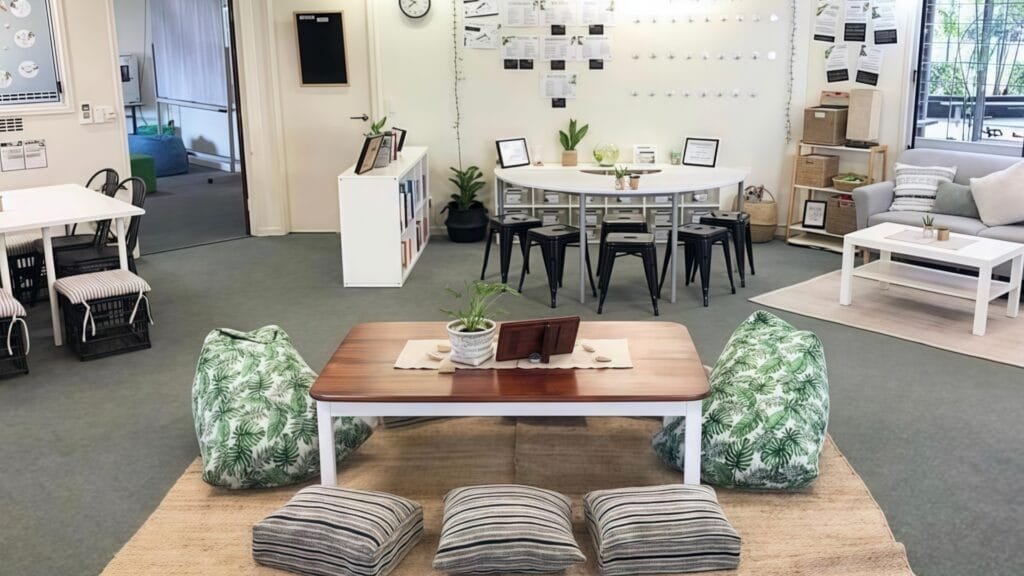
For classrooms and learning spaces, furniture selection directly determines whether the 1.2-meter principle functions effectively.
Teacher Desk and Instruction Station Design
Traditional fixed teacher desks: Often position teachers at classroom periphery—unable to maintain 1.2-meter distances during active instruction. Fixed positioning reduces teacher mobility and proximity during critical learning moments.
Modern flexible instruction stations: Feature:
- Mobile configuration enabling teacher movement throughout 1.2-meter teaching zones
- Adjustable height accommodating various classroom activities
- Clear sightlines maintaining classroom monitoring ability
- Organized storage ensuring instructional materials accessibility
- Professional appearance modeling organization and preparedness
Why it matters: Mobile instruction stations enable teachers to teach from multiple positions, naturally maintaining 1.2-meter distances with different student groups throughout instruction.
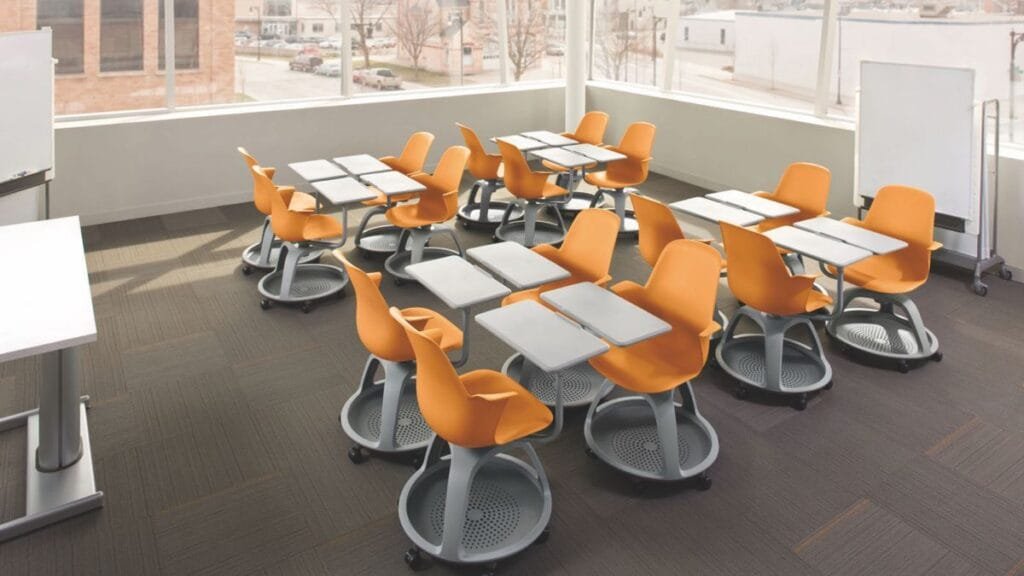
Student Seating for Collaborative Learning
Effective student seating supporting the 1.2-meter principle includes:
- Individual desk/chair combinations enabling flexible arrangement
- Ergonomic design supporting extended focus and comfort
- Durable construction withstanding daily student use
- Stacking or folding options enabling spatial flexibility
- Appropriate height matching developmental stages
Seating arrangement itself communicates learning expectations. Flexible, moveable seating signals “your learning needs matter” and “this classroom adapts to support different learning modes.”
Table and Collaborative Workspace Design
Multi-student tables enable:
- Small group instruction at 1.2-meter distances
- Collaborative learning with peer support
- Teacher circulation and individual feedback
- Flexible grouping supporting differentiated instruction
- Clear documentation and assessment
Quality collaborative furniture directly improves instructional effectiveness by enabling teachers to circulate and provide individualized support.
Classroom Layout and Space Planning: Supporting 1.2-Meter Interaction
Classroom floor space planning is fundamentally about enabling the 1.2-meter principle through strategic furniture arrangement.
Clear Teaching Zones
Optimal classroom design creates distinct zones:
- Whole-group instruction area: 2.5+ meters enabling classroom presence
- Small-group instruction area: 1.2-meter teaching zones for small group work
- Independent work area: 2+ meters enabling student autonomy
- Collaborative space: 1-1.5 meters supporting peer interaction
Strategic furniture placement naturally creates these zones without explicit barriers, enabling seamless teacher movement between distance zones.
Sightline and Monitoring Design
Furniture arrangement enables:
- Teacher visual monitoring of all students
- Student visibility of instructional focus
- Clear traffic patterns preventing crowding
- Flexible reconfiguration for varied instructional needs
- Professional classroom environment
Poor layout forces teachers to choose between active instruction and classroom monitoring—a false choice that quality furniture arrangement eliminates.
Comparative Analysis: Classroom Spaces Optimized for the 1.2-Meter Rule
| Classroom Type | Optimal 1.2m Setup | Key Furniture | Expected Engagement Impact | Implementation Complexity |
|---|---|---|---|---|
| Elementary Classes | Mobile seating, flexible grouping | Individual desk-chairs, low tables | +25-35% engagement | Low |
| Secondary Classrooms | Lab benches, mobile desks | Adjustable tables, rolling chairs | +20-30% engagement | Moderate |
| Special Education | Quiet work areas, proximity support | Sensory-friendly seating, flexible | +28-38% engagement | Moderate-High |
| Language Learning | Partner work stations, circular | Mobile desks, collaborative tables | +23-33% engagement | Low-Moderate |
| STEM Spaces | Hands-on work stations, lab areas | Adjustable height tables, stools | +25-35% engagement | Moderate |
| Arts Classrooms | Studio-style flexible setup | Mobile storage, large work tables | +22-32% engagement | Moderate |
Implementing the 1.2-Meter Rule: Practical Classroom Design Guidelines
Step 1: Classroom Assessment
Evaluate your current classroom’s interaction distances:
- Measure typical teacher-student distances during instruction
- Observe natural teacher movement patterns
- Gather student and teacher feedback on classroom comfort
- Identify 1.2-meter zone obstacles (furniture placement, traffic patterns)
Step 2: Furniture Audit
Review current classroom furniture:
- Does seating enable flexible 1.2-meter interaction?
- Can furniture be rearranged for different instructional needs?
- Are dimensions appropriate for student developmental levels?
- Do materials support durability and hygiene?
Step 3: Design Planning
Develop classroom layout prioritizing 1.2-meter principle:
- Identify primary instruction zones
- Plan teacher circulation paths maintaining 1.2-meter capability
- Design student collaboration spaces
- Ensure clear sightlines and traffic flow
Step 4: Furniture Selection
Choose furniture enabling 1.2-meter principle:
- Mobile, flexible configurations over fixed installations
- Appropriate sizing for student age/grade level
- Durable materials supporting daily classroom use
- Aesthetic supporting professional learning environment
- Storage solutions maintaining classroom organization
Step 5: Implementation and Optimization
- Pilot furniture arrangements with teacher input
- Monitor student engagement and behavior changes
- Gather feedback and make adjustments
- Document layout and procedures for consistency
Teacher Professional Development: Supporting the 1.2-Meter Principle
Furniture design only works when teachers intentionally implement the 1.2-meter principle. Professional development should address:
Awareness and Understanding
- Research foundation for 1.2-meter principle
- Recognition of optimal teaching distances
- Observation of student response to distance variation
Behavioral Implementation
- Deliberate positioning during different instructional activities
- Circulation patterns maintaining classroom coverage
- Use of distance as instructional variable supporting learning
- Transition strategies between distance zones
Environmental Optimization
- Furniture arrangement for teaching zone support
- Classroom organization enabling 1.2-meter circulation
- Equipment positioning reducing instructional disruption
- Space utilization supporting varied instructional needs
Measuring Success: Key Performance Indicators for Classroom Design
Effective implementation of the 1.2-Meter Rule generates measurable educational outcomes:
| KPI | Pre-Implementation | Post-Implementation | Expected Change |
|---|---|---|---|
| Student Engagement | Baseline | +25-35% improvement | Very High |
| Teacher-Student Interaction | Baseline | +30-40% frequency | Significant |
| On-Task Behavior | Baseline | +18-25% time | High |
| Student Achievement | Baseline | +8-15% improvement | Significant |
| Teacher Job Satisfaction | Baseline | +15-20% improvement | High |
| Classroom Management Issues | Baseline | -20-30% reduction | Very Significant |
Hongye Educational Furniture: Classroom Design Excellence
Hongye Educational Furniture specializes in creating learning environments where the 1.2-meter rule isn’t just understood—it’s built into every design decision. With extensive experience designing classrooms for elementary schools, secondary institutions, and specialized learning centers across multiple continents, Hongye understands that student-centered learning begins with research-informed spatial principles.
Comprehensive Educational Furniture Solutions
Hongye’s educational collections specifically support the 1.2-meter principle:
- Mobile Classroom Seating: Individual desk-chair combinations enabling flexible 1.2-meter teaching zones
- Collaborative Learning Tables: Multi-student surfaces supporting small-group instruction and peer interaction
- Flexible Work Stations: Adjustable-height furniture accommodating diverse instructional activities
- Classroom Storage Solutions: Organized, accessible furniture maintaining classroom flow
- Specialized Seating: Options for different developmental levels and learning needs
Each collection features:
- Ergonomic design supporting student comfort and focus
- Durable construction withstanding intensive classroom use
- Flexible configurations enabling varied instructional arrangements
- Aesthetic excellence supporting professional learning environments
- Safety compliance exceeding international standards
- Customization options aligning with institutional design vision
Implementation Support Services
Hongye provides comprehensive classroom design support:
- Educational space assessment and consulting
- Custom classroom layout planning
- Teacher professional development on space optimization
- Installation and transition management
- Ongoing measurement and continuous improvement
Conclusion: Distance as Educational Design Principle
The 1.2-meter rule represents far more than furniture placement guidance—it embodies a philosophy that effective learning requires intentional, research-informed physical design. When classrooms are designed around this principle, transformative outcomes follow: students feel genuinely supported, teachers communicate more effectively, engagement increases, and learning outcomes improve significantly.
Hongye Educational Furniture’s mission is enabling schools and learning institutions to architect this principle into their physical environments, creating spaces where the optimal distance between teacher and student becomes automatic—supported by thoughtful design and evidence-based furniture selection.
Ready to implement the 1.2-meter rule in your classrooms? Contact Hongye Educational Furniture today for a complimentary educational space assessment and custom classroom design recommendations. Let’s transform your learning environments into spaces where students thrive and teachers teach their best.