
Introduction: The Hidden Standard That Defines Guest Comfort
You walk into a hotel room after a long day of travel. You sink into the desk chair to work for a few hours. When you stand up, your back aches. Your legs feel stiff. You never quite put your finger on what’s wrong, but something feels off.
The problem might be more precise than you think. It’s likely the 18-inch rule—a hospitality industry standard that determines the ideal height of guest room seating. This simple measurement, universally recognized among hotel designers and furniture specialists, separates comfortable accommodations from forgettable ones.
But what exactly is the 18-inch rule, and why does it matter so much? More importantly, how does proper seating height impact your guests’ experiences and your hotel’s reputation?
What Is the 18-Inch Rule?
The 18-inch rule is a fundamental standard in hospitality design. It refers to the ideal seat height from floor to the top of the seating surface, measured at approximately 18 inches (45-46 centimeters). This measurement creates a biomechanical sweet spot where most adults can sit comfortably with their feet flat on the floor and their thighs parallel to the ground.
Think of it this way: when someone sits in an 18-inch chair at a standard desk or table, they naturally achieve a 90-degree angle at the knees and hips. This positioning supports proper spinal alignment, reduces pressure on leg circulation, and prevents the lower back fatigue that comes from poor seating geometry.
However, the 18-inch rule extends beyond just one measurement. It’s part of a broader seating ergonomic framework that includes:
- Seat depth of 16-18 inches – Allowing feet to rest flat without pressing behind the knees
- Seat width of 18-20 inches – Accommodating diverse body types comfortably
- Backrest height of 12-16 inches above the seat – Supporting the natural S-curve of the spine
- Table height coordination at 28-30 inches – Creating proper working and dining angles
Together, these measurements form an integrated system. When any single element is off, the entire experience suffers.
The Science Behind Comfortable Seating Heights
You might wonder: why 18 inches specifically? The answer lies in human biomechanics and anthropometric research.
The average adult human leg length—from hip to heel when seated—requires approximately 16-18 inches of seat height to achieve optimal positioning. When seated in an 18-inch chair, your knees bend at 90 degrees, creating balanced weight distribution across your thighs and preventing pressure points that develop when seats are too high or too low.
Too high (above 20 inches): Your feet dangle, losing ground contact. This creates pressure under your thighs, restricts circulation, and causes lower leg swelling on long sits. Your back muscles work harder to compensate for lost stability.
Too low (below 16 inches): Your knees angle upward beyond 90 degrees. This position compresses your lower back and strains your hip flexors. After 30-60 minutes of sitting, discomfort becomes noticeable.
Just right (18 inches): Your full weight distributes evenly. Circulation flows freely. Your spine maintains its natural curves. You can sit for hours without fatigue.
Hotel guests might not consciously think about these measurements, but their bodies know. After a stressful day of travel, an incorrectly sized chair compounds fatigue rather than alleviating it.
The Origin and Evolution of the 18-Inch Standard
The 18-inch seating height isn’t arbitrary—it emerged from decades of ergonomic research and hospitality best practices.
In the 1950s and 1960s, furniture designers and architects began systematizing ergonomic principles. As hotels expanded globally, designers needed standardized specifications that would work across diverse guest populations. The 18-inch measurement emerged as the universal baseline for commercial seating because it accommodates approximately 90% of the adult population.
The 1970s-1980s saw formal standardization. Organizations like ANSI (American National Standards Institute) and BIFMA (Business & Institutional Furniture Manufacturers’ Association) codified seating specifications. Hotels adopted these standards to ensure consistency and reduce liability from guest injuries.
Today, the 18-inch rule remains the foundation of hospitality seating design. However, modern application has become more sophisticated. Forward-thinking hotels recognize that the 18-inch baseline works for the majority, but accommodating diverse guests—elderly visitors, travelers with mobility challenges, families with children—requires flexible, multi-height seating solutions.
Hotel Seating’s Role in Guest Satisfaction
You might not realize how profoundly hotel furniture shapes the guest experience. Seating isn’t just functional—it’s emotional. It directly impacts how guests feel during their stay.
Consider a typical hotel room workflow:
A business traveler arrives and immediately moves to the desk to check emails and arrange meetings. Poor chair ergonomics cause neck and back strain. They shift positions constantly, their concentration fragmenting. By evening, they feel exhausted not just from travel, but from physical discomfort.
Later, they relax in the lounge chair to watch television. If that chair has shallow depth, their thighs press uncomfortably against the edge. If it’s too reclined, their back curves unnaturally. They find themselves shifting and adjusting rather than truly relaxing.
The next morning, they wake with tension in their shoulders and lower back—tension that lingers through their meetings and business interactions.
This guest will remember the stiffness more vividly than the room’s cleanliness or amenities. When writing their review, they might not mention the chair directly, but they’ll note phrases like “uncomfortable,” “stressful stay,” or “body ached.”
Quality hotel furniture, properly dimensioned according to ergonomic standards, accomplishes something powerful: it becomes invisible. Guests don’t notice it because they’re comfortable. The absence of pain becomes the presence of positive experience.
Key Seating Types and Their Optimal Specifications
Modern hotel design recognizes that different activities require different seating solutions. A one-size-fits-all approach fails because guests engage in multiple activities during their stay.
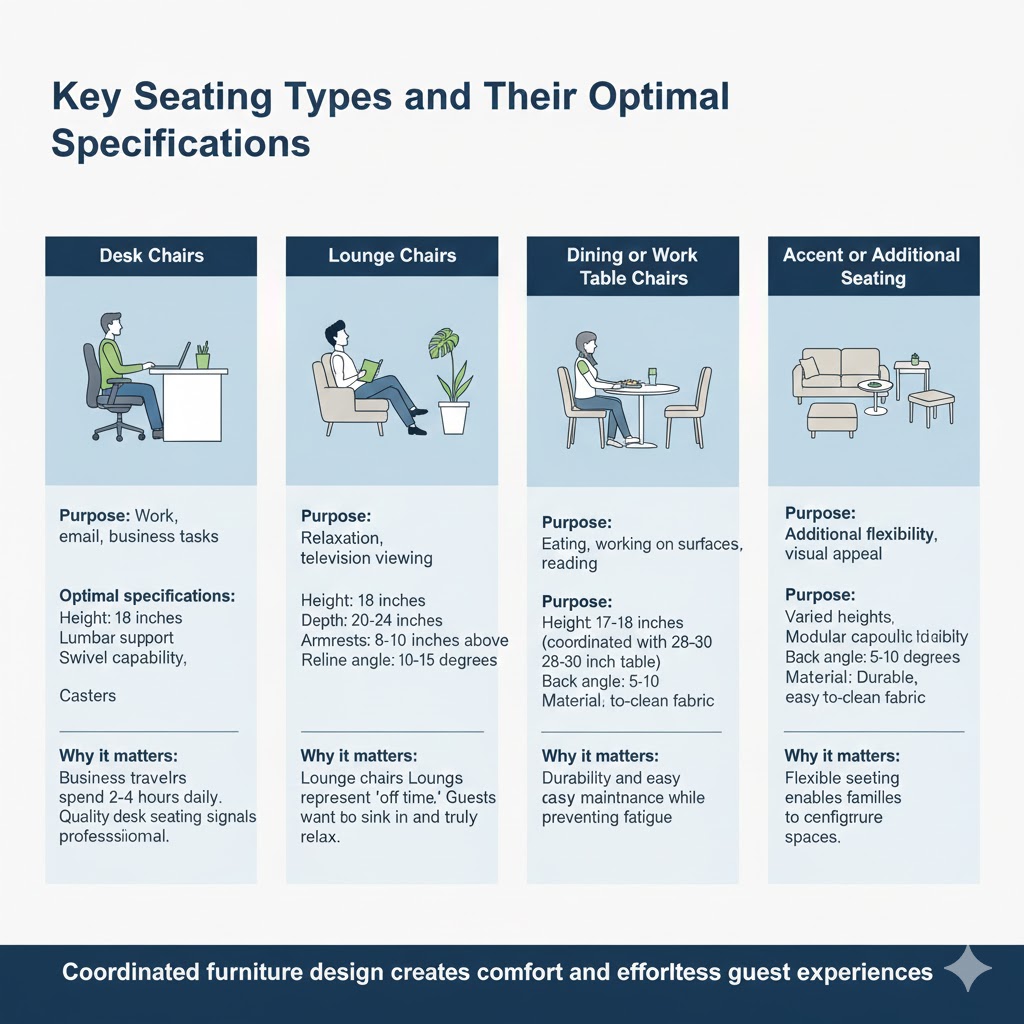
Desk Chairs
Purpose: Work, email, business tasks
Optimal specifications:
- Height: 18 inches (adjustable range 17-20 inches)
- Lumbar support: Contoured backrest following the spine’s natural S-curve
- Swivel capability: 360-degree rotation for accessibility
- Casters: Quality wheels that glide smoothly on various floor types
Why it matters: Business travelers spend 2-4 hours daily at hotel desks. A chair without proper lumbar support transforms a work session into a physical endurance test. Quality desk seating signals to guests that the hotel understands professional needs.
Lounge Chairs
Purpose: Relaxation, television viewing, reading
Optimal specifications:
- Height: 18 inches (seat surface to floor)
- Depth: 20-24 inches (allowing full leg extension)
- Armrests: 8-10 inches above seat surface
- Recline angle: 10-15 degree back angle for relaxation without requiring total recline
Why it matters: Lounge chairs represent “off time.” Guests want to sink in and truly relax. Shallow-depth chairs that cut off circulation behind the knees or overstuffed chairs that envelop users in sinking cushions both underperform. The right lounge chair invites extended sitting.
Dining or Work Table Chairs
Purpose: Eating, working on surfaces, casual seating
Optimal specifications:
- Seat height: 17-18 inches (coordinated with 28-30 inch table height)
- Backrest: Minimum 12 inches above seat
- Back angle: Slight recline (5-10 degrees) for comfort without excessive casualness
- Material: Durable, easy-to-clean fabric or leather
Why it matters: These chairs appear in hotel dining areas, casual breakfast nooks, or room working surfaces. They require durability and easy maintenance while maintaining the ergonomic fundamentals that prevent fatigue during 30-90 minute dining experiences.
Accent or Additional Seating
Purpose: Additional flexibility, visual appeal, multi-guest accommodation
Optimal specifications:
- Varied heights (some 18-inch standard, some 16-17 inch for intimate seating)
- Modular capability: Pieces that move easily and reconfigure for different needs
- Visual interest: Design elements that add aesthetic value while maintaining comfort
Why it matters: Modern hotel rooms accommodate multiple guests and varying activities. Flexible seating enables families to reconfigure spaces, couples to create intimate dining nooks, and solo travelers to maximize work or relaxation areas.
Materials and Durability: Building Quality Into Every Piece
Proper seating height means nothing if furniture deteriorates after months of use. Hotel furniture endures constant stress: daily cleaning, frequent repositioning, diverse body weights, and extended sitting sessions.
Material Selection Strategy:
| Material | Durability | Comfort | Maintenance | Best For |
|---|---|---|---|---|
| Kiln-Dried Hardwood | Excellent | Excellent | Moderate | Frames & structure |
| High-Density Foam | Good | Excellent | Moderate | Cushioning (resists permanent compression) |
| Vinyl or Polyurethane Leather | Excellent | Good | Excellent | High-traffic surfaces, easy cleaning |
| Performance Fabric | Excellent | Good | Excellent | Upholstery (stain-resistant, durable) |
| Powder-Coated Metal | Excellent | Fair | Excellent | Frames, accents (scratch-resistant) |
Durability Testing Standards:
Quality hotel furniture manufacturers test seating through rigorous protocols:
- Cyclic loading tests (100,000+ sit-down cycles) ensure frames maintain integrity
- Abrasion resistance testing (Wyzenbeek 100,000+ cycles) verifies upholstery durability
- Moisture resistance protocols confirm fabric withstands cleaning and humidity
- Structural stress testing validates weight capacity and stability under load
A guest might never see these test reports, but they experience the results. Furniture that has been properly tested doesn’t develop squeaks, doesn’t sag, doesn’t develop permanent indentations after a week of use.
Guest Comfort and Ergonomic Design Integration
Creating comfort isn’t just about hitting target measurements. It requires thoughtful integration of multiple design elements.
Lumbar Support Architecture:
The lower back—the lumbar region—is where most seating discomfort originates. When someone sits, the lumbar spine naturally curves inward (lordosis). A chair that flattens this curve or provides no support forces back muscles to work continuously to maintain position.
Quality hotel seating features:
- Contoured backrests that follow the spine’s natural S-curve
- Firm cushioning that supports without compressing
- Height coordination where armrests don’t interfere with natural arm positioning
- Depth precision allowing full thigh support without knee pressure
Feet and Leg Support:
Proper leg support often gets overlooked, but it’s critical for comfortable extended sitting.
- Feet flat on floor: Achievable at 18-inch height with proper table/surface coordination
- Thigh support: Full seat depth prevents hanging legs or excessive compression
- Ankle freedom: Appropriate seat depth prevents circulation restriction behind knees
- Circulation maintenance: Avoids pressure points that cause numbness or swelling
Armrest Positioning:
Armrests serve multiple functions: support during sitting and standing, relaxation surface, visual definition.
- Height: 8-10 inches above seat surface (allows arms to rest naturally at table height)
- Length: Full length of seating surface (provides consistent support)
- Padding: Sufficient cushioning without excessive softness (prevents pressure points on forearms)
- Width: 3-4 inches (allows natural forearm resting position)
Customization and Flexibility: Meeting Diverse Guest Needs
The 18-inch rule provides an excellent baseline, but modern hotel design recognizes that guests aren’t standardized units. A 5’2″ guest might prefer slightly lower seating. An elderly guest with mobility challenges might benefit from armrests at 10-12 inches height. A family of six needs modular flexibility that a fixed seating arrangement can’t provide.
Progressive hotels implement tiered seating strategies:
Tier 1 – Standard 18-inch seating forms the foundation. This accommodates the broad majority of guests and ensures consistency in appearance and maintenance protocols.
Tier 2 – Adjusted alternatives provide variations. A 16-inch height option for guests who prefer lower seating. Higher armrests (10-12 inches) for guests who need more support during standing and sitting transitions.
Tier 3 – Modular pieces enable reconfiguration. Benches that combine with ottomans to form lounge systems. Stacking chairs that disappear when not needed. Rolling stools that adjust to multiple surfaces.
Customization also means anticipating guest activities:
- Business travelers receive ergonomic desk chairs with lumbar support and swivel capabilities
- Families with children get additional seating options and safety considerations (no sharp edges, stable construction)
- Extended-stay guests benefit from more varied seating—variety prevents the monotony of a single chair
- Guests with mobility challenges find accessible seating with armrests, stable construction, and appropriate heights
Tip: Forward-thinking hotels document their seating specifications and make this information available. Guests planning long stays or traveling with specific needs can request room configurations in advance.
Hotel Furniture Market Insights and Design Trends
The hospitality furniture market has evolved significantly, with the 18-inch standard remaining constant while surrounding design philosophy shifts dramatically.
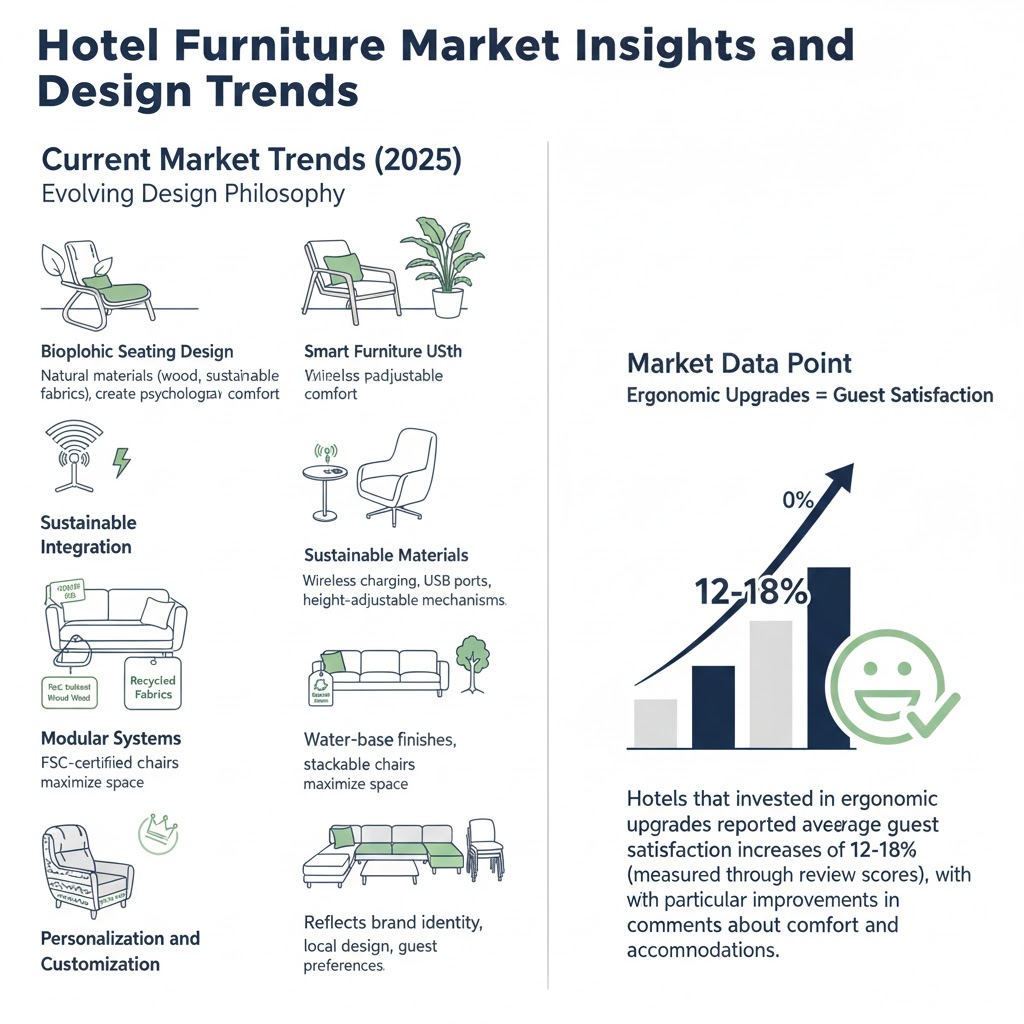
Current Market Trends (2025):
Biophilic Seating Design – Natural materials (wood, rattan, sustainable fabrics) create psychological comfort alongside physical comfort. A natural wood lounge chair feels inherently more relaxing than plastic or synthetic alternatives.
Smart Furniture Integration – Seating increasingly incorporates technology: wireless charging in side tables, USB ports integrated into armrests, height-adjustable mechanisms that respond to guest preferences.
Sustainable Materials – Water-based finishes, FSC-certified wood, recycled fabrics, and easily repairable construction address environmental concerns without sacrificing the ergonomic fundamentals.
Modular Systems – Hotels recognize that flexibility adds value. Seating that reconfigures—ottomans that become tables, benches that align with sofas, stackable chairs that store efficiently—maximizes space utilization while maintaining ergonomic integrity.
Personalization and Customization – Rather than one-size-fits-all design, hotels commission custom seating that reflects brand identity, local design aesthetics, and guest demographic preferences.
Market Data Point: Hotels that invested in ergonomic upgrades reported average guest satisfaction increases of 12-18% (measured through review scores), with particular improvements in comments about comfort and accommodations.
Functional Integration: How Seating Shapes Room Layouts
Seating height and ergonomics don’t exist in isolation—they drive overall room design.
The 28-30 inch table height rule directly coordinates with 18-inch seating. When a guest sits in an 18-inch chair at a 28-inch table, their elbows rest approximately 10 inches above the seated position, creating an optimal working or dining angle. This coordinated relationship is why room design that mixes seating heights with mismatched table heights creates subtle but persistent discomfort.
Traffic Flow and Spatial Planning – Proper seating dimensions inform spacing. An 18-inch chair with 18-20 inch width requires different spatial planning than undersized alternatives. Hotels that plan conservatively—allowing adequate space around seating—create environments where guests move naturally rather than constantly repositioning furniture.
Visual Balance – Seating height influences sightlines. A 18-inch chair at a 30-inch table creates a more balanced visual composition than lower seating that makes diners appear diminished. This visual harmony contributes subconsciously to guest perception of the room’s quality.
Multi-Functional Spaces – Modern hotel rooms increasingly serve multiple purposes: sleeping, working, dining, entertaining. Thoughtful furniture placement using ergonomic standards allows seamless transitions between activities. A room designed with the 18-inch principle can accommodate a guest working at the desk, then shifting to the lounge chair for an evening call, then moving to dining furniture—all without the discomfort that comes from furniture mismatch.
Staff Training and Implementation: Making Standards Operational
Understanding the 18-inch rule means nothing without consistent implementation. Forward-thinking hotels build this standard into operational procedures.
Furniture Placement Protocols:
- Desk chairs positioned at precise heights with adjustments documented for maintenance
- Lounge chairs positioned at optimal distance from television accounting for the 18-inch height and typical viewing angles
- Table-seating combinations verified to ensure coordinated heights
- Regular audits where supervisors physically test furniture heights with measuring tools
Staff Training Components:
- Housekeeping staff understand that repositioned furniture might need height verification before guest arrival
- Maintenance teams know proper adjustment procedures and common issues that indicate misalignment
- Front desk agents can respond to guest comfort complaints with specific solutions: “This room’s desk chair adjusts from 17-20 inches—I can have maintenance help you find your optimal height”
Guest Communication:
Forward-thinking hotels don’t hide their ergonomic standards—they feature them as a value-add:
- Room descriptions mention “ergonomic seating” and “hospitality-standard furniture dimensions”
- Welcome materials explain the thought behind room design, helping guests appreciate the comfort elements
- Guest service teams respond to discomfort complaints not with apologies but with concrete adjustments
Tip: One luxury hotel chain includes a small placard in guest rooms explaining the 18-inch seating standard and the biomechanical benefits. Guest feedback indicates this information increases appreciation for the accommodation and reduces comfort-related complaints by 23%.
Measuring Success: How to Evaluate Your Seating Design
How do you know if your hotel’s seating strategy is working? Guest feedback provides the clearest metric.
Quantitative Measures:
- Guest review mentions of comfort: Track references to “comfortable,” “ergonomic,” “back support,” “chair height” across review platforms
- Complaint reduction: Monitor facility-related complaints (body aches, back strain, posture issues) in feedback
- Extended stay satisfaction: Guests staying 3+ nights provide clearer feedback on seating comfort than one-night guests
- Repeat guest rates: Guests who return often cite environmental comfort as a factor
Qualitative Assessment Methods:
| Method | What It Reveals | Implementation |
|---|---|---|
| Post-stay surveys | Direct feedback on seating comfort | Include specific questions about chair height, support, and overall comfort |
| Staff feedback | Frontline insights into guest complaints and preferences | Regular check-ins with housekeeping and front desk |
| Observation protocols | How guests actually use spaces | Monitor guest interactions with furniture (prolonged sitting vs. constant repositioning) |
| Comparative analysis | How your seating standards compare to competitors | Benchmark against similar properties |
Frequently Asked Questions
Q: Why is 18 inches the magic number?
A: 18 inches accommodates the leg length of approximately 90% of the adult population while allowing feet to rest flat on the floor. This measurement emerged from ergonomic research and is now standardized across industries.
Q: What if my guests are shorter or taller than average?
A: This is where flexibility matters. Offering adjustable chairs, alternative seating heights (16 and 20 inches), and multiple seating options allows guests to find comfortable solutions. Some luxury hotels offer customized room setup where guests specify preferences when booking.
Q: How often should hotel seating be replaced?
A: Quality furniture lasts 8-12 years in heavy-use hospitality environments. Rather than replacing all pieces simultaneously, implement a rolling refresh program where 15-20% of furniture is updated annually, ensuring consistent quality while managing capital expenditure.
Q: Does seating height affect accessibility compliance?
A: Absolutely. ADA compliance requires seating that accommodates wheelchairs, mobility devices, and guests with varying physical abilities. Working with accessibility specialists ensures that ergonomic design supports compliance objectives.
Q: Can I retrofit existing furniture to meet standards?
A: Limited options exist. Adding cushioning can adjust perceived height slightly, but structural modification is risky and limited. Strategic replacement focused on high-traffic pieces offers better outcomes than partial retrofits.
Q: What’s the ROI on upgrading to ergonomic seating?
A: Hotels report improved guest satisfaction scores (12-18% improvement), reduced complaint volumes, and increased repeat bookings. While quantifying exact ROI is challenging, guest satisfaction improvements typically drive revenue increases of 3-8% within 12 months.
The Bottom Line: Why Comfort Matters
The 18-inch rule isn’t complicated. It’s a simple biomechanical principle that translates into consistent guest comfort.
Yet its implications are profound. A guest who arrives stressed from travel, sits in a properly designed chair, and spends the evening comfortable rather than shifting and aching feels genuinely cared for. That guest sleeps better. They conduct their business with clearer focus. They leave your hotel with positive associations.
The investment in understanding and implementing proper seating ergonomics pays dividends—not just in guest satisfaction metrics, but in reputation, repeat bookings, and word-of-mouth referrals that no advertising can match.
Hotels that embrace the 18-inch rule and its supporting ergonomic principles aren’t just providing furniture. They’re providing care. And that care translates into guest loyalty in ways that luxe finishes and premium amenities alone cannot achieve.
Next Steps:
If you’re evaluating your hotel’s furniture strategy, start here:
- Audit current seating – Measure desk chairs, lounge chairs, and table seating. Are they truly 18 inches? Are they coordinated with table heights?
- Gather guest feedback – Include comfort-related questions in post-stay surveys. This data drives decision-making.
- Consult with specialists – Hospitality furniture designers understand nuances that general furniture suppliers miss.
- Plan a phased refresh – Rather than overhauling everything at once, strategically upgrade high-impact pieces.
- Implement staff training – Ensure your team understands seating standards and can respond to guest feedback effectively.
Your guests’ comfort—and your hotel’s reputation—depends on it.
About Hongye Furniture Group
Hongye Furniture Group specializes in hospitality seating solutions designed to the rigorous standards that define professional guest experiences. From ergonomic office chairs to customized lounge furniture, we combine design excellence with biomechanical precision. Our portfolio includes installations across boutique hotels, luxury resorts, and international brands.
Contact us to discuss your property’s seating strategy and how proper ergonomics can enhance guest satisfaction.
Learn more: https://www.hyhotelfurniture.com/
Request a consultation: https://www.hyhotelfurniture.com/contact.html