
When planning to refresh your office space, understanding the financial commitment is crucial. Office refurbishment costs vary significantly based on your company’s size, location, and desired scope of improvements.
Average Office Refurbishment Costs by Scope:
| Renovation Type | Cost Per Square Foot | Typical Project Size | Estimated Total |
|---|---|---|---|
| Basic Refresh | $50–$100 | 5,000 SF | $250,000–$500,000 |
| Mid-Range Remodel | $125–$200 | 5,000 SF | $625,000–$1,000,000 |
| Full Renovation | $200–$400 | 5,000 SF | $1,000,000–$2,000,000 |
A basic office refresh might cost your company $50–$100 per square foot, while a comprehensive full-scale renovation can reach $200–$400 per square foot. Location dramatically impacts these figures. A mid-range renovation in a major metropolitan area like Manhattan can exceed $300 per square foot, whereas the same project in secondary markets might cost 30–40% less.
Understanding where your budget goes is the first step to making smart refurbishment decisions that enhance employee satisfaction, improve productivity, and maintain your company’s competitive edge.
Understanding Office Refurbishment: What’s Included?
A complete office refurbishment goes far beyond a fresh coat of paint. It’s a comprehensive update of your workplace environment that impacts how your team works, collaborates, and feels about coming to the office.
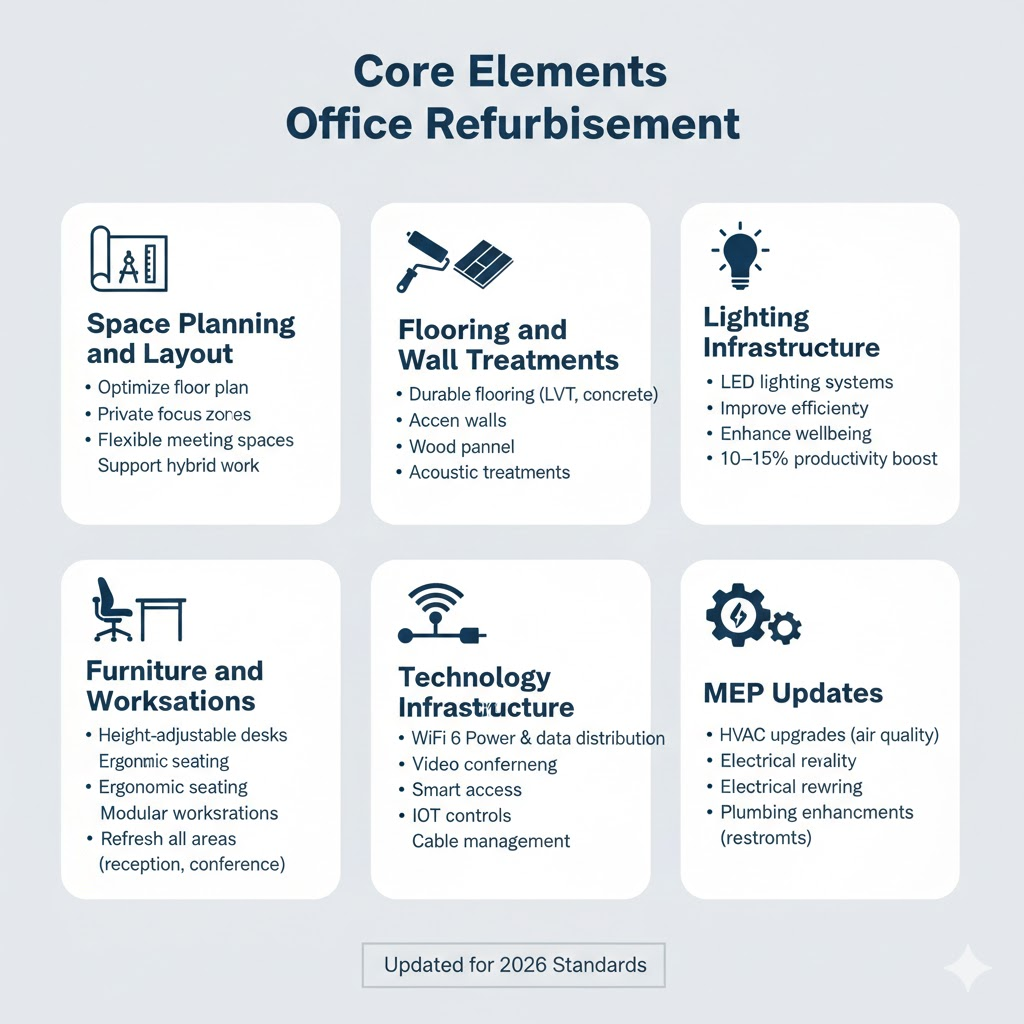
Core Elements of Office Refurbishment:
Modern office refurbishment typically includes several interconnected components. Space Planning and Layout forms the foundation, where architectural designers assess your current floor plan and optimize it for contemporary work patterns. This might involve creating collaborative zones, private focus areas, and flexible meeting spaces that support hybrid and in-office work simultaneously.
Flooring and Wall Treatments represent significant visual and physical upgrades. Worn carpet gets replaced with durable, sustainable materials like luxury vinyl tile or polished concrete. Wall surfaces receive fresh paint in professional color schemes, while some companies add accent walls, wood paneling, or acoustic treatments to control noise and create visual interest.
Lighting Infrastructure receives considerable attention in modern refurbishments. LED lighting systems replace outdated fluorescent fixtures, improving both energy efficiency and employee wellbeing. Studies show proper lighting can increase productivity by 10–15% while reducing energy costs by 40–50%.
Furniture and Workstations constitute the most visible and frequently used components. Height-adjustable desks, ergonomic seating, and modular workstations replace aging cubicles and fixed furniture. The furniture refresh extends to reception areas, conference rooms, breakrooms, and collaborative spaces.
Technology Infrastructure integration has become essential in 2026. This includes Wi-Fi 6 implementation, power and data distribution, video conferencing systems, smart access controls, and IoT-enabled environmental controls. Cable management and technology-ready workstations ensure seamless connectivity.
Mechanical, Electrical, and Plumbing (MEP) Updates may include HVAC system upgrades to improve air quality and temperature control, electrical rewiring to support modern power demands, and plumbing enhancements for updated restroom facilities.
Cost Breakdown: Where Your Office Refurbishment Budget Goes
Breaking down office refurbishment costs helps you understand the financial allocation and make strategic decisions about where to invest.
Construction and Labor: 40–50% of Total Budget
Construction costs form the largest expense category, typically consuming 40–50% of your total refurbishment budget. For a $1,000,000 project, expect $400,000–$500,000 allocated to construction and labor.
These costs include demolition and removal of existing materials, structural modifications like adding or removing walls, flooring installation across the entire space, painting and wall treatment application, electrical and plumbing updates, and HVAC system modifications.
Labor expenses vary significantly by geography. Manhattan construction labor costs approximately $250–$300 per hour for skilled trades, while secondary markets might average $120–$180 per hour. Geographic variation can shift project costs by 30–50% even with identical scope.
MEP (Mechanical, Electrical, Plumbing) Work Breakdown:
- HVAC upgrades: $15–$40 per square foot
- Electrical work and data cabling: $10–$25 per square foot
- Plumbing and restroom upgrades: $8–$20 per square foot
For a 5,000 square foot office, MEP updates alone might total $175,000–$425,000, depending on scope and system upgrades.
Furniture, Fixtures, and Equipment (FF&E): 20–35% of Budget
Office furniture represents the second-largest expense category, typically consuming 20–35% of your total budget. For a $1,000,000 project, allocate $200,000–$350,000 for FF&E.
Furniture costs break down by employee count and quality tier:
- Basic Furniture Package: $1,500 per employee (essential desks, chairs, storage)
- Mid-Range Package: $3,000–$5,000 per employee (ergonomic seating, height-adjustable desks, quality finishes)
- Premium Package: $7,000–$10,000+ per employee (designer furniture, extensive customization, luxury materials)
For a 50-person office, mid-range furniture would cost $150,000–$250,000. A 100-person office would budget $300,000–$500,000 for quality workstations and common area furniture.
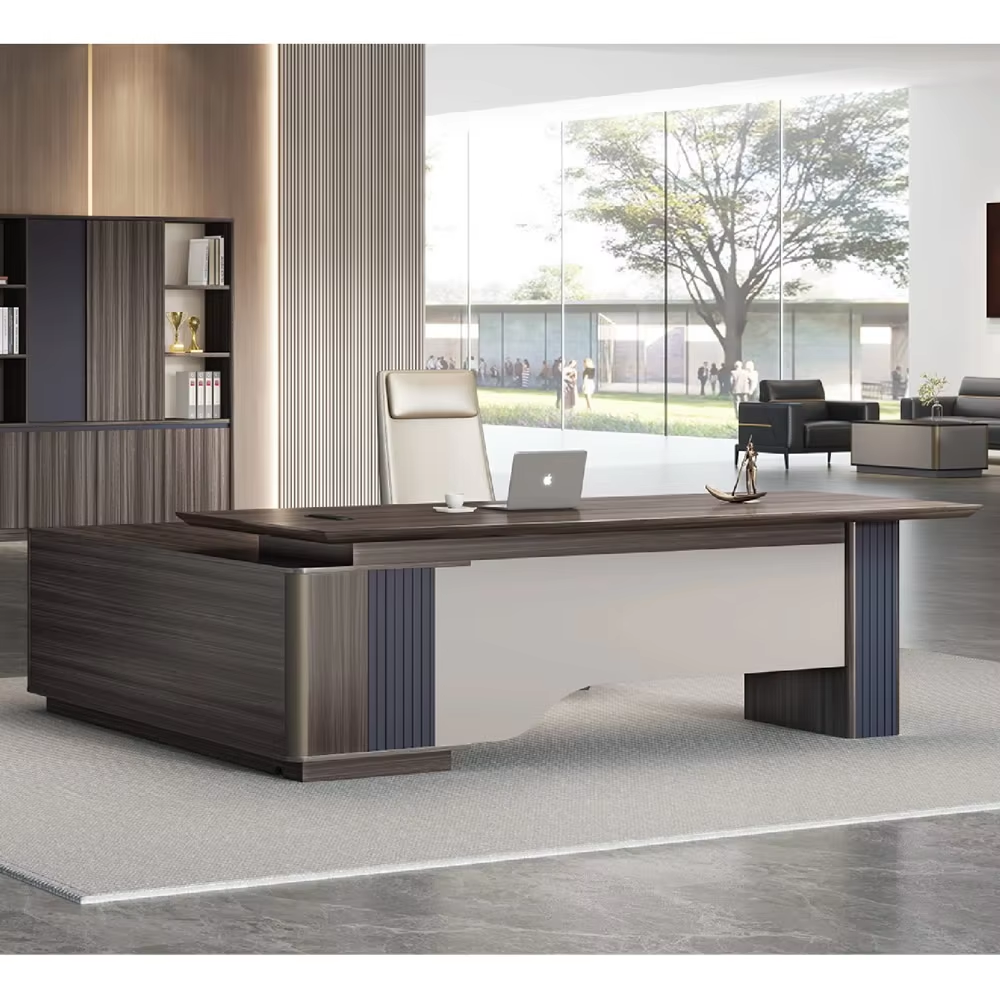
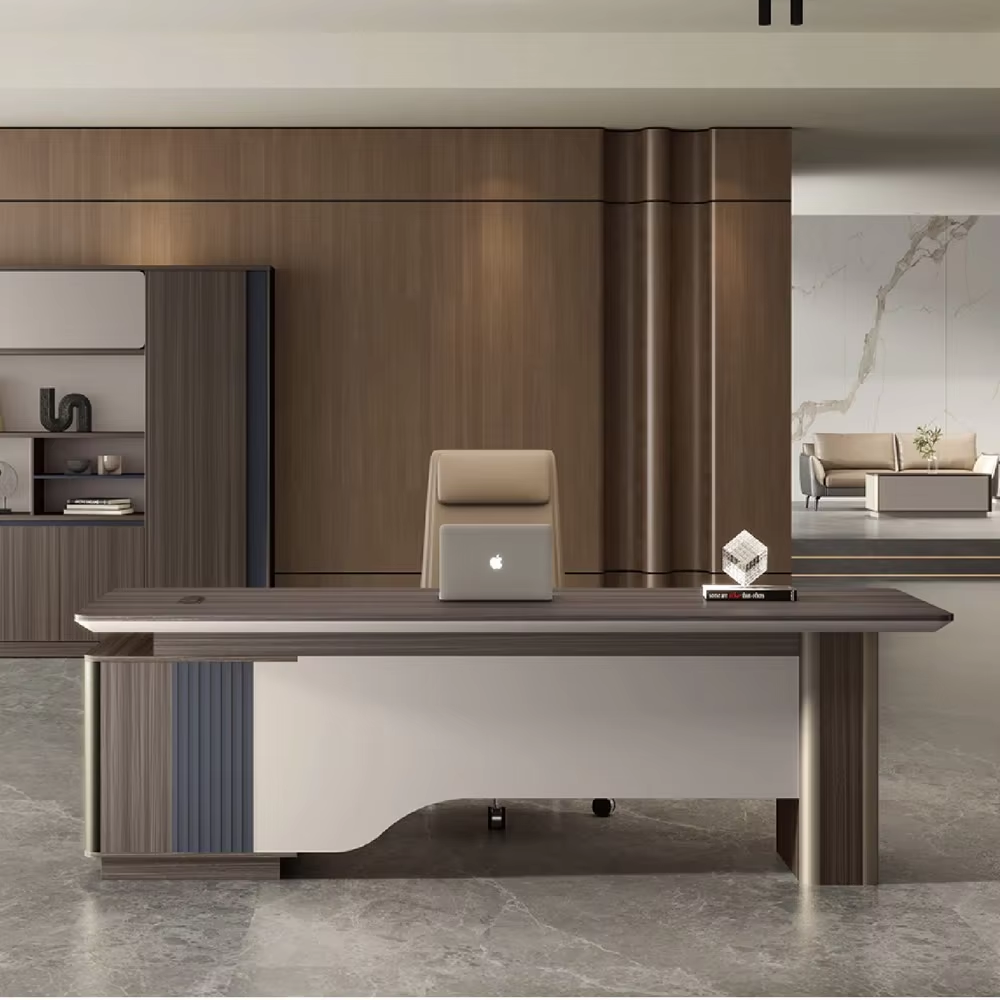
Modern L Shape Director Ceo Boss Manger Table Set Executive Office Desk
Common Area Furniture Investment:
Conference room tables and seating typically cost $15,000–$40,000 depending on size and finish quality. Reception area furnishings run $8,000–$20,000. Breakroom equipment including coffee systems, refrigerators, and seating costs $15,000–$35,000. These common areas consume 15–25% of total furniture budget but significantly impact employee morale and client perception.
Finishes and Materials: 15–25% of Budget
Wall coverings, paint, flooring finishes, and lighting fixtures comprise 15–25% of your total refurbishment budget. For a $1,000,000 project, allocate $150,000–$250,000.
Quality paint ($8–$15 per square foot) ensures durability and professional appearance. Flooring represents significant expense: commercial-grade vinyl tile costs $3–$7 per square foot, while hardwood or engineered wood runs $10–$18 per square foot. Polished concrete finishes offer a modern aesthetic at $2–$5 per square foot.
Lighting fixtures and installation cost $4–$12 per square foot including LED bulbs, fixtures, and labor. Modern office lighting often incorporates dimming controls and circadian rhythm support systems.
Technology Infrastructure: 10–15% of Budget
Wi-Fi 6 implementation, access control systems, and smart building technology require 10–15% of your budget. A 5,000 square foot office typically allocates $50,000–$150,000 for technology upgrades.
Wi-Fi 6 backbone installation costs $600–$900 per access point including hardware, cabling, and licensing. Video conferencing systems for conference rooms range from $5,000 for basic setups to $25,000+ for advanced boardroom installations. Smart environmental controls (lighting, temperature, occupancy sensors) add $3,000–$8,000 per zone.
Mobile access control and digital key systems cost $800–$1,500 per room depending on integration complexity.
Design, Permits, and Professional Services: 10–15% of Budget
Architectural design, engineering, interior design, permits, and project management typically comprise 10–15% of total costs. Professional services ensure quality outcomes and code compliance, preventing expensive corrections later.
Architectural and MEP engineering: 2–4% of construction costs
Interior design services: 5–8% of total project budget
Permitting and expediting: $20,000–$50,000+ depending on scope and jurisdiction
Project management: 3–5% of construction budget
Detailed Cost Analysis by Office Refurbishment Type
Understanding refurbishment types helps you align investment with your organizational goals.
Basic Office Refresh: $50–$100 Per Square Foot
Ideal for: Back-office operations, satellite offices, or organizations prioritizing functionality over aesthetics. Budget timeframe: 4–6 weeks.
A basic refresh focuses on cosmetic improvements and minor infrastructure updates without structural changes. New paint throughout the office in professional colors creates a fresh appearance. LED lighting upgrades replace outdated fluorescent fixtures, improving energy efficiency. New carpet or vinyl flooring in main areas and minimal partition walls add definition to spaces.
Typical inclusions:
- Paint, carpet, basic flooring
- Stock light fixtures and LED conversions
- Simple partition walls using standard materials
- Basic receptionists desk or built-in shelving
- Standard electrical outlet additions
For a 5,000 SF office:
- Construction costs: $250,000–$500,000
- FF&E (basic replacements only): $40,000–$60,000
- Permits and soft costs: $30,000–$50,000
- Total project cost: $320,000–$610,000
This tier works well for companies with functioning spaces needing visual updates without operational disruption.
Mid-Range Office Remodel: $125–$200 Per Square Foot
Ideal for: Professional services, consulting firms, tech companies, and client-facing organizations. Budget timeframe: 8–12 weeks.
Mid-range renovations deliver polished, professional environments suitable for client meetings while improving team collaboration. Space planning optimization creates dedicated zones for focused work, collaboration, and social interaction. Higher quality finishes including hardwood or engineered wood flooring at $10–$15 per square foot project durability and professionalism.
Custom or semi-custom millwork and built-ins add sophistication. Upgraded lighting systems with smart controls and warm color temperatures improve ambiance and productivity. Glass partition walls create modern open-plan layouts with acoustic privacy. HVAC zone upgrades ensure comfort across the renovated space.
Technology infrastructure investment supports modern business operations with proper cabling, power distribution, and Wi-Fi 6 backbone ready for future enhancements.
Typical inclusions:
- Hardwood or engineered wood flooring
- Custom semi-custom millwork and cabinetry
- Upgraded LED lighting with smart controls
- Glass partition walls for open-plan layouts
- HVAC modifications and zone control
- Enhanced electrical and data infrastructure
- Conference room audio-visual capabilities
For a 5,000 SF office (typical scenario):
- Construction hard costs: $625,000–$1,000,000
- FF&E for 35–50 employees: $140,000–$250,000
- Soft costs (design, engineering, permits): $125,000–$200,000
- Technology infrastructure: $50,000–$75,000
- Total project cost: $940,000–$1,525,000
Mid-range renovations offer excellent ROI, supporting employee satisfaction and client impressions while maintaining cost discipline.
Full-Scale Office Renovation: $200–$400 Per Square Foot
Ideal for: Executive headquarters, premium office locations, organizations prioritizing cutting-edge workspaces. Budget timeframe: 12–16 weeks.
Full renovations involve major structural changes, premium materials, and sophisticated technology integration. Comprehensive space reconfiguration might include floor plan redesign, new mechanical infrastructure, and advanced building systems. Premium finishes like natural stone, imported hardwoods, and custom millwork create luxury environments.
State-of-the-art technology includes integrated smart building systems, advanced security, environmental controls, and seamless IoT connectivity. High-end audio-visual systems support executive presentations. Bespoke furniture from designer collections elevates aesthetics and brand perception.
Typical inclusions:
- Comprehensive space reconfiguration
- Premium natural materials and finishes
- Custom designer furniture installations
- Advanced smart building technology
- Integrated audio-visual and conferencing
- Specialized zones (wellness, innovation labs, executive suites)
- Sustainability certifications (LEED, WELL Building)
For a 5,000 SF executive office:
- Construction hard costs: $1,000,000–$2,000,000
- FF&E (premium): $350,000–$500,000
- Soft costs and professional services: $250,000–$400,000
- Advanced technology systems: $150,000–$250,000
- Contingency (12–15%): $200,000–$350,000
- Total project cost: $1,950,000–$3,500,000
Factors That Impact Office Refurbishment Costs
Beyond square footage and scope, several variables significantly influence final project costs.
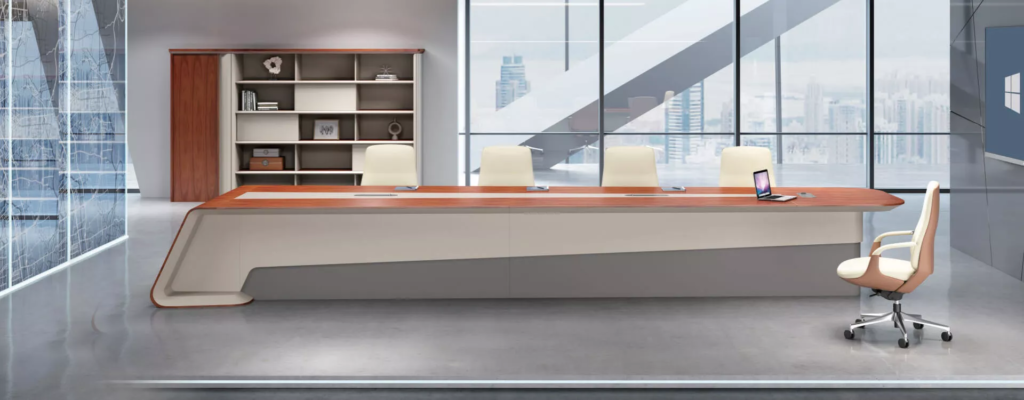
12 Person Seater Conference Table for Meeting Room
Geographic Location Impact
Location creates dramatic cost variations. Manhattan office refurbishment averages $250–$400 per square foot, while secondary markets like Austin or Denver typically cost $150–$250 per square foot. San Francisco Bay Area commands premium pricing at $280–$450 per square foot due to both labor costs and material availability.
Labor costs show the most significant geographic variation. Skilled trades in major metros earn 2–3 times more than regional counterparts. Material transportation and availability also impact pricing—coastal cities often face supply chain premiums.
Regional cost comparison (mid-range renovation per SF):
- Manhattan/NYC: $250–$400/SF
- San Francisco Bay Area: $280–$450/SF
- Boston/Washington DC: $200–$350/SF
- Chicago/Minneapolis: $150–$280/SF
- Austin/Denver: $150–$250/SF
- Secondary markets: $100–$180/SF
Building Age and Condition
Newer buildings with modern infrastructure cost less to refurbish than aging properties requiring infrastructure upgrades. A 2000s-era Class A office with recently updated MEP systems might cost 20–30% less than a historic building requiring extensive structural remediation.
Hidden conditions discovered during demolition—asbestos, outdated electrical systems, roof leaks—quickly inflate budgets. A 10–15% contingency reserve is essential for older properties.
Office Size and Employee Count
Larger offices benefit from economies of scale. Per-square-foot costs for a 10,000 SF renovation typically run 15–25% lower than equivalent-quality 2,000 SF projects due to reduced overhead and more efficient labor deployment.
Employee count directly influences FF&E budgets. A 25-person startup with mid-range furniture budgets $75,000–$125,000 total; a 100-person firm allocates $300,000–$500,000.
Scope of Structural Changes
Simple refreshes maintaining existing floor plans cost significantly less than major reconfiguration. Adding or removing walls, relocating restrooms, or creating new mechanical zones multiplies costs. Floor plan changes often require structural engineering, building permits, and extended timelines.
Open-plan conversions removing existing walls might add 15–25% to project costs for structural engineering and remediation, but save on new partition materials.
Current System Age and Condition
HVAC, electrical, and plumbing systems nearing end-of-life require replacement during refurbishment, adding $50,000–$300,000+ depending on system scope. Modern code compliance for older systems often mandates upgrades beyond surface-level refreshes.
Cost Management and Budget Optimization
Achieving refurbishment goals within budget requires strategic planning and smart decision-making.
Prioritization Strategy
Focus your investment on high-impact areas: Prioritize visible spaces like reception, conference rooms, and collaborative areas that influence employee morale and client perception. Employee work areas deserve ergonomic investment directly affecting health and productivity.
Back-office areas can accept more modest finishes without compromising functionality. Storage rooms and mechanical areas require durability over aesthetics.
Phased Refurbishment Approach
Spreading work over multiple phases reduces operational disruption and spreads capital investment. Phase 1 might tackle client-facing areas and front-of-house restrooms. Phase 2 addresses employee work areas and common spaces. Phase 3 includes back-office updates and infrastructure upgrades.
Phased approaches also allow demonstrating results from initial phases, building stakeholder enthusiasm for continued investment.
Material Selection and Cost Efficiency
Durable, lower-maintenance materials provide better long-term value. Commercial-grade vinyl flooring at $6–$8 per square foot offers superior durability and easier maintenance than cheaper alternatives, reducing lifecycle costs.
Quality ergonomic seating ($400–$600 per chair) prevents health issues and employee turnover costs far exceeding furniture replacement. Synthetic fabrics and laminates mimic premium aesthetics at 40–60% of natural material costs while providing equal durability.
Strategic vendor partnerships through professional design firms or large furniture dealers often negotiate 15–30% discounts versus retail pricing. Standardizing materials across the office reduces purchasing complexity and improves pricing.
Sustainability and Long-Term Savings
Investing in sustainable systems pays dividends. LED lighting reduces energy consumption 40–50%, saving $8,000–$25,000 annually for typical offices. Smart HVAC and occupancy sensors trim utility costs an additional 10–20%.
Low-VOC paints and sustainable materials improve indoor air quality, reducing sick days 5–10% according to workplace research. Over five years, these productivity gains frequently offset sustainability premiums.
Timeline and Planning Considerations
Project Timeline by Scope
| Phase | Basic Refresh | Mid-Range | Full Renovation |
|---|---|---|---|
| Planning & Design | 2–3 weeks | 3–5 weeks | 4–8 weeks |
| Permits & Approvals | 1–2 weeks | 2–4 weeks | 3–6 weeks |
| Construction Duration | 4–6 weeks | 8–12 weeks | 12–16 weeks |
| Move-In Prep | 1 week | 1–2 weeks | 2–3 weeks |
| Total Duration | 8–12 weeks | 14–23 weeks | 21–33 weeks |
Minimizing Operational Disruption
Phased execution allows departments to relocate sequentially, maintaining some operations throughout renovation. Off-hours and weekend work for non-disruptive tasks extends timelines but preserves productivity.
Temporary space rental ($500–$2,000 per month for modest office space) allows full-time relocation during intensive construction phases, returning to renovated space on schedule.
Key Takeaways for Office Refurbishment Planning
Calculate your realistic budget based on your market, office size, and renovation scope. A mid-range renovation in most US markets costs $125–$250 per square foot, translating to $625,000–$1,250,000 for a typical 5,000 SF office.
Allocate budget strategically across construction (40–50%), furniture (20–35%), finishes (15–25%), technology (10–15%), and professional services (10–15%). This balanced approach delivers comprehensive improvements across all office elements.
Invest in high-impact areas like reception, meeting rooms, and employee work areas while accepting more modest finishes in back-of-house spaces.
Build in contingency reserves of 12–15% for unexpected discoveries and price escalations.
Partner with experienced professionals including architects, interior designers, and project managers who guide decision-making and prevent costly errors.
Plan phased implementation to reduce operational disruption and spread capital investment.
Prioritize sustainability and long-term value over lowest first cost, improving employee health, reducing operating costs, and future-proofing your workspace.
Conclusion
Office refurbishment represents significant capital investment with substantial impacts on employee satisfaction, productivity, and company competitiveness. By understanding cost drivers, prioritizing strategically, and partnering with experienced professionals, you can create modern workspaces that support team success, attract talent, and project brand excellence.
The modern office landscape demands flexibility, technology integration, and employee-centric design. Whether pursuing a modest refresh or comprehensive renovation, thoughtful planning and strategic allocation of resources ensure your refurbishment delivers maximum value and supports organizational goals.
Start with clear objectives about what outcomes you want—improved collaboration, modern brand perception, better employee experience—then let those goals guide investment decisions. The result will be office spaces where your team thrives and your company succeeds.