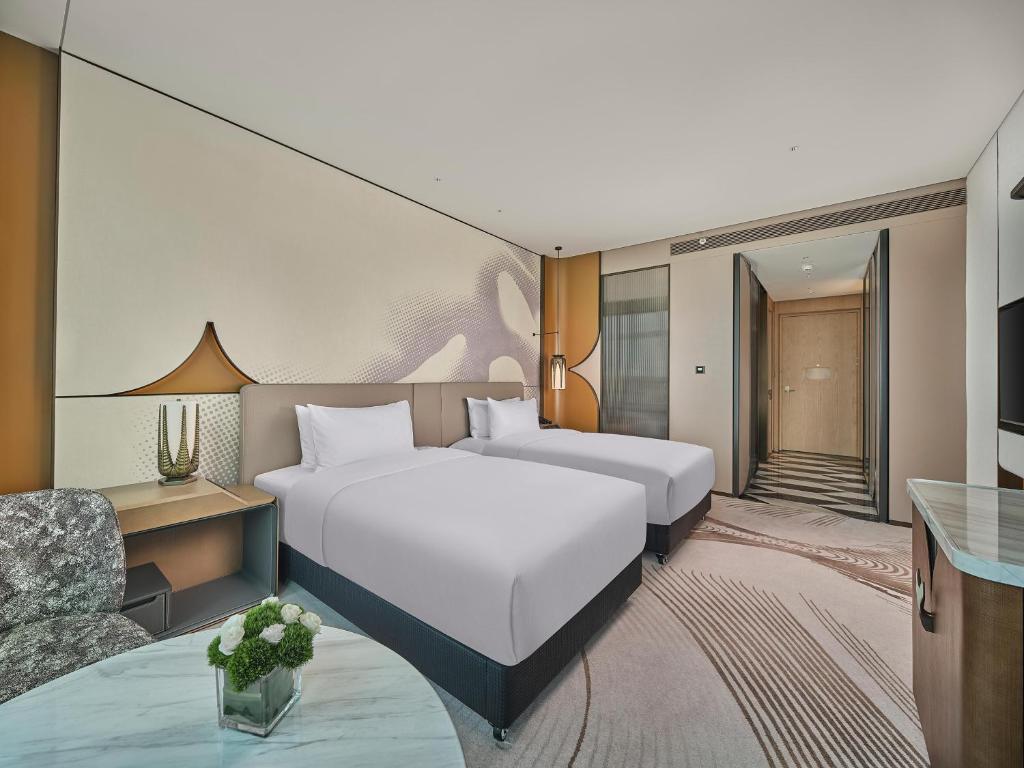
Hotel FF&E mock-up room sign-off should establish what has been reviewed, which requirements have been accepted and what must still happen before production begins.
A successful review does more than approve how a room looks. It connects the physical products to controlled drawings, material references, samples and recorded decisions.
The priority is traceability: the production team must be able to identify exactly what was approved and reproduce the accepted requirements.
This guide explains how to plan a hotel mock-up review, document samples, assess colour and appearance, manage conditions and release the appropriate items for manufacture.
Key Takeaways
- Define the purpose of the mock-up before selecting its format.
- Separate room review, item approval and production release.
- Identify where the mock-up differs from the proposed production configuration.
- Assess colour under agreed viewing conditions and relevant project lighting.
- Use project-specific acceptance criteria rather than universal colour or dimensional tolerances.
- Track approved reference samples separately from production and batch samples.
- Record conditional approvals, responsibilities and outstanding actions.
- Update the controlled documents before authorising manufacture.
What Should a Hotel FF&E Mock-Up Review Decide?
A mock-up review should answer specific questions about the proposed room and furniture package.
These may include:
- Does the layout support the intended guest experience?
- Do furniture dimensions work with circulation and services?
- Are materials, finishes and details acceptable?
- Do doors, drawers and controls operate as intended?
- Can housekeeping clean the relevant areas?
- Are installation and maintenance interfaces resolved?
- Which requirements still need technical evidence?
Define the review scope in advance so attendees know what they are being asked to decide.
Separate Three Approval Stages
Room acceptance, product approval and production release are related but different.
Room Review
This considers the combined arrangement: furniture, lighting, services, circulation and operational use.
Item and Material Approval
This records decisions about specific products, materials, finishes, hardware and construction details.
Production Release
This confirms that the required conditions have been closed and the authorised party has permitted manufacture.
Acceptance of the room’s appearance should not automatically be interpreted as approval of every hidden construction detail or unresolved product requirement.
Choose the Right Mock-Up Format
Select the format according to the decisions the project needs to make.
An on-site room, factory assembly and digital model can support different parts of the review. A project may use one or several formats, but there is no universal requirement to use all of them.
On-Site Physical Mock-Up
An on-site mock-up allows the team to examine the room within its actual building context.
It can support review of:
- Site dimensions.
- Furniture positioning.
- Door and drawer openings.
- Lighting relationships.
- Service access.
- Installation interfaces.
- Guest and housekeeping movement.
Record which building conditions are final and which remain temporary.
Off-Site Factory Mock-Up
A factory mock-up can support review of construction, assembly, finishes and hardware before the full package is produced.
Identify the limitations of the setting. Simulated walls, lighting or service positions should not be confused with verified site conditions.
Also confirm whether the sample uses the proposed production materials and components.
Digital Mock-Up
A coordinated digital model can help compare layouts, proportions and room variants.
It is useful for distributed project teams, but it does not establish tactile comfort, physical finish matching or actual hardware operation.
Use “digital mock-up” or “3D model” unless the project genuinely requires a digital-twin system. A digital twin involves more than a model with mapped materials; the distinction includes its relationship with information from the physical counterpart.
Schedule the Mock-Up Around Procurement Decisions
Do not choose a review date from a fixed number of days before opening alone.
Work backwards from the required installation and delivery dates, allowing for:
- Material procurement.
- Production.
- Necessary testing.
- Sample development.
- Review.
- Revision.
- Re-review.
- Transport.
- Site access.
- Decision-making.
Identify which decisions commit the project to cost or programme consequences.
For example, a material reservation or manufacturing instruction may need approval before the complete room review. If so, record the limited scope of that earlier decision.
A schedule should allow the team to reject or revise a proposal—not merely attend a review after the decision has effectively been made.
Prepare the Hotel Mock-Up Room Checklist
Inspect the room against the current specification and drawing register.
Do not rely on the attendees’ memory of a design presentation.
| Review Area | What to Examine | Decision or Follow-Up to Record |
|---|---|---|
| Layout | Furniture positions, circulation and opening space | Accepted arrangement or required revision |
| Casegoods | Dimensions, construction, joints, edges and storage | Product-specific comments |
| Seating | Dimensions, support, upholstery and operation | Experience review and outstanding evidence |
| Materials | Product references, texture, pattern and finish | Approved reference or resubmission |
| Hardware | Model, finish, movement and adjustment | Accepted configuration |
| Lighting and controls | Positions, operation and relevant appearance conditions | Coordinated comments |
| Services | Power, access, openings and equipment interfaces | Responsibility and next action |
| Installation | Fixings, supports, alignment and site interfaces | Approved detail or clarification |
| Housekeeping | Cleaning access and material-care requirements | Operational acceptance or query |
| Documentation | Drawings, samples, reports and revisions | Missing information and owner |
Identify Production-Intent Details
Ask the supplier to declare any difference between the mock-up and the proposed production item.
Examples include:
- Temporary hardware.
- Substitute substrate.
- Different upholstery filling.
- Sample-only coating.
- Simulated electrical modules.
- Incomplete fixing.
- Alternative assembly method.
The team may still review the sample, but its decision should not be recorded as unconditional approval of details that were not present.
Use the Mock-Up for Experience, Not as a Substitute for Testing
Sitting on a chair or opening a drawer provides useful feedback.
However, a room review does not replace required evidence for structural performance, electrical safety, fire performance or other applicable requirements.
Keep those evidence reviews connected to the item’s approval status.
Build an FF&E Sample Approval Pack

The approval pack should connect every decision to an identifiable item, sample and document revision.
AWI’s submittal framework recognises drawings, samples and material information as important tools for communicating design intent. The relevant project requirements and current documents should govern how those submissions are prepared and reviewed.
| Approval-Pack Component | Information to Include |
|---|---|
| Review cover sheet | Project, room type, date, location and review purpose |
| Document register | Drawings, specifications and revisions used |
| Item schedule | Product codes and configurations reviewed |
| Sample register | Sample identifiers, descriptions and locations |
| Mock-up difference list | Temporary or non-production details |
| Review comments | Item-specific observations and required actions |
| Evidence register | Relevant reports, limitations and outstanding submissions |
| Approval matrix | Reviewers, decision authority and responsibilities |
| Decision record | Accepted scope, conditions and rejected elements |
| Production-release record | Items and activities authorised to proceed |
Use photographs with item and sample identifiers visible. Link each image to the relevant record rather than leaving it in an unstructured message thread.
Define Approval Authority
Identify who reviews:
- Design.
- Brand requirements.
- Technical performance.
- Operations.
- Commercial changes.
- Production release.
These roles may be held by different people.
A supplier’s signature may confirm understanding and responsibility for execution; it does not necessarily give the supplier authority to approve a design change.
One meeting can help resolve conflicts, but the essential requirement is a coordinated, documented decision—not a fixed number of signatures collected in one room.
Distinguish Reference Samples From Batch Samples
Use clear definitions within the project.
The term “golden sample” can be retained if everyone understands its role, but the label alone is not enough.
Approved Reference Sample
This is the identified physical reference for the characteristics that have been accepted.
State whether it represents colour, texture, sheen, edge treatment, construction or a complete item.
Production Verification Sample
This is used to check whether the proposed production output meets the accepted requirements before a wider release.
Its scope should match the risk and the product.
Retained Batch Sample
This records characteristics of a particular production batch.
Connect it to the batch, material and shipment references where appropriate.
Record Storage and Retention Arrangements
For each retained sample, identify:
- Unique number.
- Description.
- Status.
- Approval date.
- Related documents.
- Location.
- Custodian.
- Storage conditions.
- Retention period.
- Replacement procedure.
Agree retention periods according to the contract, warranty, replenishment needs and material stability.
Do not assume the reference sample will remain unchanged indefinitely. Its condition may need review before it is used to judge later production.
Review Colour, Texture and Lighting Together
Hotel furniture colour approval requires more than a numerical reading or a photograph.
Agree how instrumental measurement and visual assessment will be combined.
Review relevant samples under a controlled condition and the project lighting needed to assess the intended result.
Define the Colour-Difference Method
If a specification uses ΔE, identify the calculation method.
Different systems—including CIELAB, CMC and CIEDE2000—do not produce interchangeable results. A tolerance should therefore be agreed with its calculation and measurement conditions.
Record relevant parameters such as:
- Instrument.
- Measurement geometry.
- Illuminant.
- Observer.
- Aperture.
- Surface orientation.
- Backing.
- Measurement locations.
- Calibration.
- Colour-difference formula.
Do not apply one universal ΔE limit to veneer, fabric, stone and painted panels.
Use Visual Range Samples Where Appropriate
Natural grain, texture and pattern may not be represented adequately by one measurement point.
Where variation is expected, approve a representative range and explain how it applies to adjacent components or room groups.
This can be more useful than requiring every piece to match one small, unusually uniform sample.
Check Matching Under Relevant Light Sources
Two samples may match under one source and no longer match under another. Controlled visual assessment can help identify this behaviour.[xrite]
Record the actual light source and viewing arrangement. Colour temperature and illuminance are useful information, but they do not completely define how a source renders materials.
Avoid stating that every change in appearance under different lighting is metamerism.
Use Photographs for Traceability
Photographs are useful for recording identity, arrangement, grain direction and review comments.
They should not replace the agreed physical and instrumental colour-review process. Camera settings, image processing and displays can alter the appearance.
Connect Approved Appearance to Batch Controls
Before production, review how the accepted appearance will be maintained across the required quantities.
Discuss:
- Material availability.
- Veneer selection and matching.
- Fabric lots.
- Laminate references.
- Coating batches.
- Component allocation.
- Production sequence.
- Replenishment.
A single lot may be useful, but it does not automatically guarantee uniformity. Nor is one lot always large enough for the project.
If multiple lots are required, define how they will be reviewed and allocated.
Determine Reserves From Project Risk
Do not apply a universal overage percentage to every material.
Assess:
- Required quantity.
- Cutting and manufacturing needs.
- Potential damage.
- Replacement strategy.
- Material availability.
- Storage.
- Matching risk.
Record who owns reserved material, where it is stored and how it may be used.
Use Conditional Approval Without Losing Control
A review does not always result in a simple approval or rejection.
Suitable statuses may include:
- Submitted.
- Under review.
- Revise and resubmit.
- Accepted with conditions.
- Approved for a stated purpose.
- Released for production.
- Superseded.
For a conditional decision, identify the precise outstanding actions.
| Release Check | Question to Resolve |
|---|---|
| Scope | Which item, configuration or process is affected? |
| Documents | Are the required revisions issued and consistent? |
| Appearance | Are the relevant samples and ranges accepted? |
| Evidence | Have required technical submissions been reviewed? |
| Conditions | Are all prerequisites for this release closed? |
| Changes | Have commercial and programme effects been accepted? |
| Authority | Who is authorised to release the work? |
| Communication | Has the manufacturer received and acknowledged the instruction? |
A limited release should state its boundaries.
For example, permission to reserve a material should not be interpreted as permission to manufacture every finished item.
Manage Changes After Mock-Up Sign-Off
A post-approval change should follow a controlled assessment.
Identify:
- Requested change.
- Reason.
- Affected items.
- Current production status.
- Materials already committed.
- Evidence affected.
- Samples required.
- Cost impact.
- Programme impact.
- Required approvals.
Do not assume that every change needs a complete re-mock-up. Equally, do not treat a small-looking substitution as automatically harmless.
The review should determine the appropriate verification.
Update the Approved Baseline
Once a change is accepted:
- Issue the revised decision.
- Update affected drawings and schedules.
- Replace or supplement sample references.
- Identify superseded information.
- Notify the relevant teams.
- Confirm the authorised restart or release.
Where only part of the package is affected, document which activities are paused and which may continue.
For a broader comparison process, see the hotel furniture value engineering guide.
Verify Production Against the Approved Requirements
Mock-up approval is the start of a controlled production comparison, not the end of quality review.
Agree which checks will occur during manufacture and before shipment.
Depending on the package, these may include:
- First-item review.
- Material identification.
- Drawing-revision checks.
- Finish comparison.
- Hardware verification.
- Assembly and operation.
- Dimensional checks.
- Packaging.
- Batch records.
Record the required inspection scope and the response to nonconforming work.
Do not use a colour result alone to accept or reject an entire product. Consider the full requirement, measurement validity and authorised decision.
The FF&E specification pack guide explains how to connect item schedules, drawings and supporting documents.
Hotel Furniture
Discuss Mock-Up and Sampling Requirements With HONGYE
Hongye Furniture Group can discuss sampling and furniture review requirements against a project’s room schedule, drawings and material references.
Confirm the agreed scope for:
- Product samples.
- Furniture assemblies.
- Factory review.
- Finish references.
- Drawing coordination.
- Production-intent differences.
- Available supporting documents.
- Revised submissions.
- Sample retention.
A factory mock-up does not automatically reproduce every site condition. Identify what is included and what still needs verification at the hotel.
Explore the hospitality project portfolio for related work.
To request a sampling discussion, send the room types, current specification status, required decisions and target installation programme through the contact page.
Review scope, timing, costs and production-release conditions should be agreed for the actual project.
Frequently Asked Questions
When should a hotel FF&E mock-up room be reviewed?
Schedule the review early enough to allow the required revisions, approvals, procurement and production before installation.
Use the project programme rather than one fixed number of days before opening.
What is the difference between mock-up acceptance and production release?
Mock-up acceptance records the aspects reviewed and accepted.
Production release confirms that the required conditions for specified manufacturing activities have been met and authorised.
Can a digital mock-up replace a physical room?
A digital model can support layout and coordination decisions.
It does not replace every physical review of materials, comfort, hardware and construction. Select the review methods according to the decisions required.
What ΔE tolerance should hotel furniture use?
Agree a project-specific tolerance with the colour-difference formula, measurement conditions and visual-review method.
Do not apply one number to every material or surface.
What is a golden sample?
It is a commonly used name for an approved physical reference.
The project should define what it represents, how it is identified and how it will be stored and used.
Who should sign the mock-up approval?
The project’s authority matrix should identify the reviewers and decision-makers.
Design acceptance, technical review, commercial approval and production release may require different authorisations.
What should happen if production differs from the approved sample?
Identify the affected scope, preserve the evidence and assess the difference against the agreed requirements.
Use the authorised process to decide on correction, further review, acceptance or rejection. Document any restrictions on shipment or use.
Make the Approved Room Reproducible
A useful sign-off record explains what was accepted, what remains unresolved and which information governs production.
Connect the room review to identified samples, controlled drawings and clear approval authority. Then verify the relevant production output before shipment.
That process gives the owner, designer, supplier and inspection team a shared reference—from the first sample to the final room package.