Healthcare waiting room seating should support cleaning, patient comfort, durability, accessibility and the facility’s infection-prevention procedures. In most high-turnover waiting areas, healthcare teams should prioritize smooth, low-seam and disinfectant-compatible seating systems rather than selecting furniture only by appearance or purchase price.
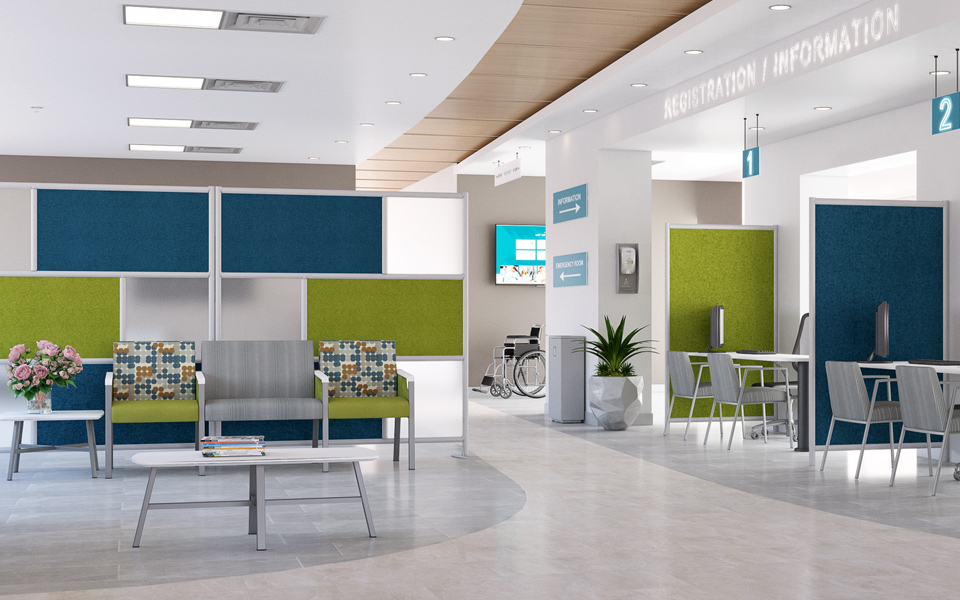
The right choice depends on the care setting. Polypropylene can work well for general outpatient zones when the product has a smooth, nonporous construction. Healthcare-grade upholstered seating may suit lower-risk, comfort-focused spaces when the cover and seams support the facility’s cleaning protocol. Stainless steel can provide strong impact resistance in selected high-abuse or secure areas, although it may not provide the comfort needed for long waits.
Important: No chair material is infection-proof. Effective infection prevention depends on the material, furniture design, cleaning method, disinfectant compatibility, staff training, contact time and timely repair of damaged surfaces.
Key Takeaways
- Smooth, low-seam seating helps environmental-services teams clean waiting areas more effectively.
- Polypropylene seating can be a practical choice for many high-turnover outpatient and clinic waiting rooms when the shell is smooth, intact and compatible with the facility’s approved products.
- Upholstered seating can support comfort in lower-risk areas, but healthcare teams should select fluid-resistant, nonporous coverings and minimize seams, piping, buttons and damaged surfaces.
- Stainless steel can perform well in high-impact, public-facing or specialist zones, but it may increase cost, weight, noise and perceived coldness.
- The CDC recommends selecting furniture and finishes that can withstand repeated cleaning and are compatible with facility disinfectants. It also advises avoiding upholstered furniture in high-risk patient-care areas and areas with increased potential for body-substance contamination.
- A zone-based seating plan often provides the strongest result: cleanable polymer seating for high-turnover waiting, carefully specified upholstery for comfort-focused zones and robust metal-frame systems where impact resistance matters.
- Buyers should request written cleaning and disinfectant-compatibility guidance for the complete chair—not only its visible seat surface.
Quick Answer
For high-turnover waiting rooms, smooth polypropylene or hard-polymer seating is often the most practical choice because it can reduce absorbent materials, deep seams and difficult cleaning points.
For family lounges, consultation areas and other lower-risk spaces where patients may wait longer, healthcare-grade upholstered seating may be appropriate. However, the furniture should use fluid-resistant, nonporous covers with limited seams and documented disinfectant compatibility.
For secure areas, emergency-department overflow zones, transport-linked clinics or high-impact public spaces, stainless steel or metal-frame seating may be appropriate. Still, facilities should assess comfort, sound, accessibility and cleaning requirements before choosing it.
| Waiting Area | Seating Direction | Main Reason |
|---|---|---|
| General outpatient waiting | Smooth polypropylene or polymer seating | Supports frequent cleaning and fast turnover |
| Emergency department waiting | Durable polymer or metal-frame seating | Handles frequent use, movement and cleaning |
| Paediatric waiting | Rounded polymer seating with minimal joints | Supports cleanability, safe edges and durability |
| Family lounge | Healthcare-grade upholstered seating where approved | Improves comfort for longer dwell times |
| Consultation waiting | Upholstered or polymer seating based on risk assessment | Balances patient experience and cleaning needs |
| Behavioural-health waiting | Risk-assessed, robust and tamper-resistant seating | Supports safety, supervision and cleanability |
| Imaging or diagnostics waiting | Polymer seating with arms and accessible positions | Helps with patient transfer and cleaning |
| Dialysis waiting | Easy-clean seating with arm support and stable frames | Supports comfort, durability and patient mobility |
| Secure or correctional health | Fixed, weighted or robust metal seating as required | Addresses security and abuse resistance |
Why Seating Materials Matter
Waiting rooms experience constant contact. Patients, visitors, caregivers, mobility aids, bags, food containers and staff all interact with chair arms, seat pans, chair backs, tables and beam systems.
As a result, seating becomes part of the healthcare facility’s environmental cleaning plan.
Research has found that some healthcare-associated pathogens can persist on dry environmental surfaces for extended periods. A review by Kramer and colleagues reported that Staphylococcus aureus, including MRSA, may survive for months on dry surfaces under certain conditions. The same review found that Clostridioides difficile spores can persist for months.
Therefore, waiting room furniture should not create unnecessary cleaning barriers.
Healthcare facilities should prioritize surfaces that staff can access, wipe and inspect. They should also select materials that resist repeated cleaning without cracking, tearing, peeling or losing surface integrity.
The CDC’s healthcare environmental-cleaning guidance recommends choosing furniture and finishes that can be effectively cleaned, maintained and repaired. It also advises avoiding difficult-to-clean features such as crevices and avoiding porous or moisture-holding materials in patient-care settings.
The goal is cleanability, not a single “best” material. A chair with a smooth shell can still become difficult to clean if it has exposed screws, deep frame gaps, damaged edges or inaccessible joints.
Polypropylene Waiting Room Seating
Polypropylene is a thermoplastic commonly used for molded waiting chairs, visitor seating, beam seating shells, stackable chairs and clinic furniture.
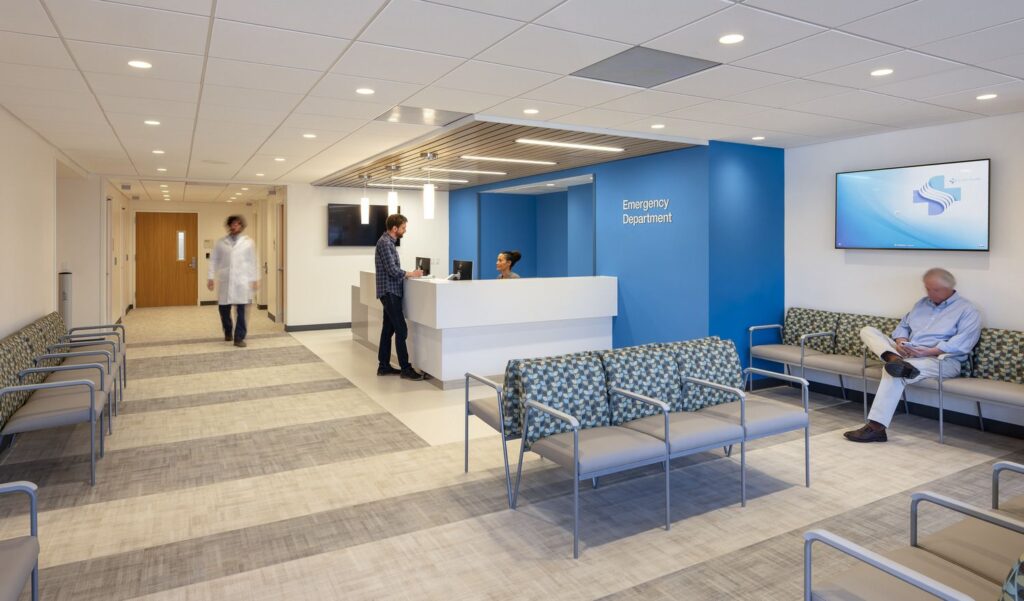
A molded polypropylene chair can provide a smooth seating surface with limited upholstery, reduced seams and fast wipe-down capability. Consequently, it is often used in outpatient departments, clinics, registration zones, diagnostic waiting rooms and other high-turnover areas.
However, buyers should not assume that every polypropylene chair is suitable for infection-control-sensitive use.
The CDC’s environmental-cleaning training material notes that porous plastics, including polypropylene, should be avoided in patient-care areas. Therefore, procurement teams should verify whether the specified product has a smooth, sealed, nonporous finish appropriate to the actual waiting-area risk level and cleaning protocol.
Advantages of Polypropylene Seating
- Smooth molded surfaces can simplify routine wipe-down.
- One-piece shells can reduce stitching, upholstery and soil-retention areas.
- Chairs can be lightweight and easy to move or reconfigure.
- Polymer seating can support stackable, linking, beam and individual-chair layouts.
- Colour options can support wayfinding, department zoning or pediatric design.
- Many models include replaceable glides, shells, arms or beam components.
- The material can provide a practical balance of cost, durability and cleanability.
Limitations of Polypropylene Seating
- Surface texture, mold lines and frame connections can still retain soil.
- Deep scratches, cracks and chips can reduce cleanability.
- Some polymers can discolor, dull or crack when exposed to incompatible cleaners.
- Poor-quality shells may flex, deform or fail under heavy use.
- Unpadded seating may reduce comfort during long wait times.
- The product’s frame, fasteners, arms and underside require the same cleaning review as the visible shell.
| Polypropylene Specification Point | What to Verify |
|---|---|
| Shell design | One-piece or low-seam shell with minimal dirt-trap features |
| Surface finish | Smooth, intact and easy-to-clean finish |
| Frame connection | Accessible joints, covered fixings and limited crevices |
| Armrest design | Smooth arm caps, secure fixing and patient-transfer support where needed |
| Disinfectant compatibility | Written confirmation for facility-approved cleaners and disinfectants |
| Damage resistance | Scratch, crack and impact resistance appropriate to the use zone |
| Weight capacity | Product-specific load rating and bariatric options where required |
| Replaceable parts | Availability of glides, arms, shells, connectors and frame components |
| Accessibility | Appropriate seat height, arms and wheelchair-adjacent spaces |
| Warranty terms | Cleaning-related limitations and repair process |
Best Uses for Polypropylene
Polypropylene seating can be a strong fit for:
- General outpatient waiting areas.
- Vaccination and immunization clinics.
- Registration and admissions zones.
- Short-stay diagnostic waiting areas.
- Pharmacy waiting areas.
- Paediatric waiting spaces with rounded, child-safe designs.
- Overflow seating zones.
- Flexible clinic seating that must be moved, linked or stacked.
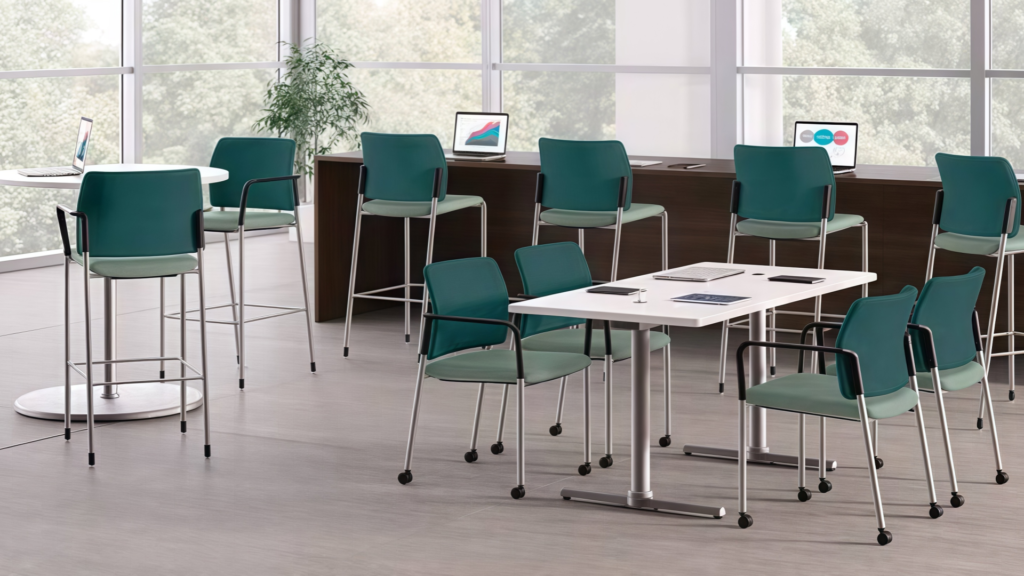
Upholstered Waiting Room Seating
Upholstered seating can make healthcare spaces feel calmer, more welcoming and less institutional. It can also offer better support for patients, visitors and family members who must wait for longer periods.
Nevertheless, upholstery requires more careful specification than hard-surface seating.
The CDC recommends avoiding upholstered furniture and furnishings in high-risk patient-care areas and in locations with increased potential for body-substance contamination, including pediatric units. For general patient-care areas, the CDC does not give a universal recommendation to avoid upholstered furniture; instead, facilities should assess local risk and maintain upholstery in good repair.
When Upholstered Seating May Be Appropriate
Healthcare-grade upholstered seating may be suitable when:
- The waiting area has a lower infection-control risk.
- The facility can maintain the furniture properly.
- The cover is fluid-resistant and nonporous.
- The product can withstand routine cleaning and approved disinfectants.
- Seams and decorative details are limited.
- Tears, punctures and worn surfaces can be repaired promptly.
- The furniture supports a longer dwell time or family-centered experience.
- The infection-prevention team approves the intended application.
Healthcare Upholstery Options
| Cover Type | Possible Strengths | Buyer Checks |
|---|---|---|
| Woven fabric | Soft appearance and acoustic comfort | Often unsuitable for high-risk zones; confirm cleaning process |
| Healthcare vinyl | Fluid-resistant and wipeable | Verify seam design, cleaner compatibility and repair method |
| Coated polyurethane | Can offer softer feel and cleanability | Verify hydrolysis performance, disinfectant compatibility and intended use |
| Silicone-coated textile | Often stain-resistant with softer hand | Confirm care guide, seam construction and cleaner approval |
| Replaceable cover system | Supports repair and refresh | Confirm closures do not create cleaning gaps or hidden soil traps |
The Association for the Health Care Environment’s cleanability guidance states that furniture materials and finishes should be compatible with hospital-grade detergents, cleaners and disinfectants.
Upholstery Details That Increase Cleaning Risk
Avoid or limit the following in infection-control-sensitive waiting areas:
- Deep button tufting.
- Decorative stitching channels.
- Open piping gaps.
- Loose cushions.
- Unsealed seams.
- Fabric skirts.
- Deep crevices around arm caps.
- Damaged vinyl.
- Cracked polyurethane surfaces.
- Exposed foam.
- Complex decorative profiles.
- Upholstered chair legs close to the floor.A cleanable cover is only one part of the chair. The frame, seams, zipper placement, cushion construction and repair method determine whether staff can maintain the seating effectively.
Best Uses for Upholstered Seating
Healthcare-grade upholstered seating can be considered for:
- Family waiting lounges.
- Consultation and counseling areas.
- Oncology or infusion family spaces.
- Private clinics.
- Administrative waiting rooms.
- Staff or visitor lounges outside clinical risk zones.
- Hospitality-focused outpatient settings.
- Long-dwell waiting zones approved by infection-prevention teams.
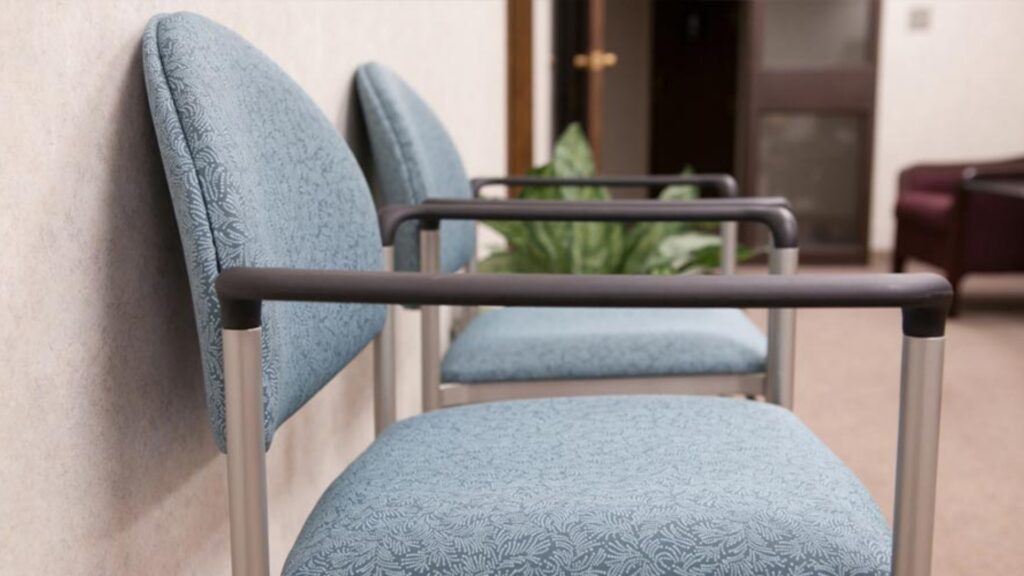
Stainless Steel Waiting Room Seating
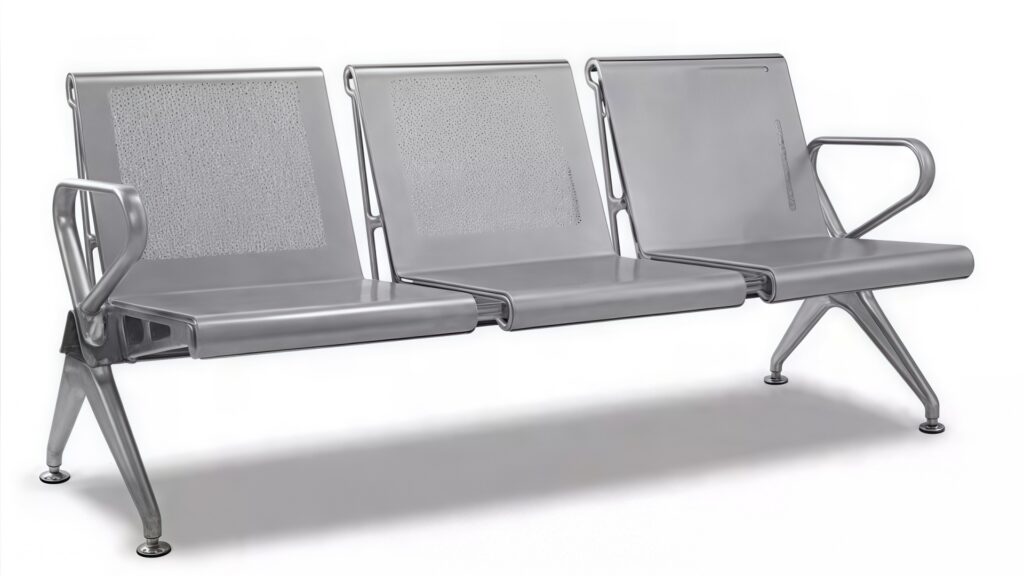
Stainless steel seating can provide strong durability, resistance to physical abuse and a smooth, hard surface for routine cleaning.
It is commonly used as a frame material for beam seating, public seating systems, secure-area furniture and high-impact environments. In selected projects, it may also form the visible seat and back structure.
Stainless steel does not automatically make a chair more hygienic. Like other materials, it must remain intact, accessible and compatible with the facility’s cleaning procedures.
Advantages of Stainless Steel Seating
- Strong resistance to impact and heavy use.
- Nonporous surface when intact and correctly finished.
- Suitable for robust beam seating and fixed public-area systems.
- Can work well in secure, high-abuse or high-turnover environments.
- Often provides a long service life when properly maintained.
- Can support floor-fixed or wall-fixed seating configurations.
- Works well as a durable frame beneath polymer shells or cleanable upholstery.
Limitations of Stainless Steel Seating
- Full-metal seats may feel cold and less comfortable for long waits.
- Metal surfaces can create more noise when bags, walkers or wheelchairs contact them.
- Stainless steel seating may cost more than polypropylene alternatives.
- Heavy systems may increase transport, handling and installation requirements.
- Welds, joints and fasteners still require accessibility for cleaning.
- Chlorine-based disinfectants can contribute to corrosion or staining when used incorrectly or left on metal surfaces.[cdc][cdc]
- Some patient groups may benefit more from supportive seating with arms, cushions or warmer-touch materials.
| Stainless Steel Specification Point | What to Verify |
|---|---|
| Steel grade | Exact steel grade and suitability for the indoor environment |
| Surface finish | Brushed, polished or textured finish and ease of cleaning |
| Welds | Smooth finish, limited crevices and consistent corrosion protection |
| Frame design | Accessible joints and no unnecessary dirt-trap geometry |
| Seat comfort | Contour, back support, armrests and optional polymer inserts |
| Anchoring | Freestanding, floor-fixed or wall-fixed stability requirements |
| Noise control | Glides, buffers and acoustic treatment where needed |
| Cleaning protocol | Approved chemicals, rinse requirements and residue-control guidance |
| Accessibility | Seat height, arms, transfer support and companion seating options |
| Repairability | Replacement components, glides and modular beam-seat parts |
Best Uses for Stainless Steel
Stainless steel or stainless-steel-frame seating may suit:
- Secure healthcare environments.
- Emergency department overflow areas.
- Transit-connected clinics.
- Registration areas with high traffic.
- Public circulation zones.
- Correctional healthcare settings.
- Areas requiring fixed beam seating.
- Specialist zones where impact resistance matters more than lounge comfort.
Polypropylene vs Upholstered vs Stainless Steel
| Selection Factor | Polypropylene | Healthcare-Suitable Upholstery | Stainless Steel |
|---|---|---|---|
| Routine cleanability | Strong when smooth and low-seam | Depends on cover, seams and construction | Strong when surface and joints remain accessible |
| Comfort | Moderate | High potential | Moderate to low without inserts or cushions |
| High-turnover use | Strong | Moderate, depending on upholstery durability | Strong |
| Fluid resistance | Good when shell remains intact | Depends on cover and seam integrity | High when surface remains intact |
| Crevice risk | Low to moderate, depending on frame design | Moderate to high unless carefully designed | Low to moderate, depending on welds and joints |
| Disinfectant compatibility | Must be confirmed for the exact polymer | Must be confirmed for cover, seam, thread and foam | Must be confirmed; improper chemical use can affect metal finish |
| Impact resistance | Moderate to strong, depending on shell design | Depends on frame and upholstery system | Very strong |
| Noise level | Moderate | Low | Can be higher |
| Patient experience | Practical and neutral | Warm, comfortable and less institutional | Functional but potentially cold or institutional |
| Initial cost | Often moderate | Moderate to high | Often higher |
| Maintenance needs | Low to moderate | Moderate to high | Low to moderate |
| Best application | General clinic and outpatient waiting | Lower-risk, comfort-focused waiting areas | Secure, high-impact or specialty zones |
Use a Zone-Based Seating Strategy
Healthcare facilities should avoid using one seating material everywhere. Instead, create a material plan based on risk, dwell time, cleaning frequency, patient needs and operational use.
High-Turnover Waiting Areas
Use smooth polymer or polypropylene seating where patients arrive, check in and leave quickly.
These areas often include:
- Registration.
- Outpatient clinics.
- Pharmacy queues.
- Vaccination centres.
- Diagnostic waiting.
- Emergency department overflow.
- Short-stay procedural waiting.
Priorities include cleanability, durable frames, chair spacing, easy access for cleaning and replaceable parts.
Comfort-Focused Waiting Areas
Use carefully specified upholstered seating only where the risk assessment supports it.
These areas may include:
- Family waiting lounges.
- Consultation areas.
- Oncology family spaces.
- Private specialty clinics.
- Administrative or billing waiting.
- Hospitality-style outpatient spaces.
Priorities include fluid-resistant upholstery, minimal seams, accessible cleaning, repair procedures and approved disinfectant compatibility.
High-Impact or Secure Areas
Use robust polymer, metal-frame or stainless-steel seating where impact resistance, safety and controlled components matter most.
These areas may include:
- Behavioural-health waiting rooms.
- Secure clinics.
- Correctional healthcare.
- Emergency department waiting.
- Transport-linked treatment facilities.
- High-abuse public zones.
For behavioural-health environments, conduct a specialist safety review. Standard waiting chairs may not meet ligature-risk, tamper-resistance, weight, anti-concealment or anchoring requirements.
Disinfectant Compatibility Matters
Furniture must tolerate the cleaning products that the facility actually uses.
The CDC advises facilities to select finishes, furniture and patient-care equipment that can be cleaned effectively and are compatible with the facility’s disinfectants. It also notes that environmental cleaning should remove visible organic material and soil before applying disinfectant.
Common healthcare environmental disinfectants may include:
- Quaternary ammonium compounds.
- Alcohol-based products.
- Chlorine-releasing agents.
- Improved hydrogen peroxide products.
- EPA-registered hospital disinfectants selected by the facility.
The facility should follow the disinfectant label, required contact time, ventilation instructions and surface-compatibility guidance.
Questions to Ask Every Furniture Supplier
- Which routine cleaners are approved for this chair?
- Which disinfectants are approved?
- Which chemicals should staff avoid?
- Does the guidance apply to the shell, frame, arms, glides, fasteners and upholstery?
- Does the guidance apply to seams, thread, foam and zipper systems?
- Is rinsing required after using certain products?
- What happens if bleach or chlorine-containing products are used?
- How many repeated cleaning cycles has the material been assessed for?
- Does the warranty remain valid under the facility’s cleaning protocol?
- How should staff repair scratches, cracks, punctures or torn upholstery?
Do Not Rely on “Bleach Compatible” Alone
“Bleach compatible” is not a complete specification.
Procurement teams should ask for the exact conditions behind the claim:
- Product and concentration assessed.
- Application method.
- Wipe or repeated-cycle process.
- Required dwell time.
- Rinsing requirement.
- Tested surface components.
- Report or manufacturer guidance.
- Warranty limitations.
A chair may tolerate one disinfectant on the polypropylene shell but not on its frame coating, upholstery, exposed thread or metal fasteners.
Healthcare Waiting Room Seating RFQ Checklist
Include the following details in the RFQ, furniture schedule and technical specification.
Infection-Control Requirements
- Define the waiting area risk level.
- Identify whether the space serves high-risk patients.
- Define cleaning frequency and cleaning responsibility.
- Minimize seams, crevices and exposed fasteners.
- Specify smooth, cleanable surfaces where required.
- Identify fluid-resistance needs.
- Require written disinfectant-compatibility documentation.
- Define repair and replacement expectations.
Product Construction
- State exact seat and back material.
- State frame material and finish.
- Define armrest construction.
- Define upholstery cover, seams, thread and foam if applicable.
- Specify exposed versus concealed fasteners.
- Define beam-seat connections or linking mechanisms.
- Identify floor anchoring requirements.
- Request details for glides, feet and edge protection.
- Require product drawings and physical samples before mass approval.
Accessibility and Patient Support
- Define seat height range.
- Include chairs with arms for patient transfer.
- Provide wheelchair-adjacent spaces in the layout.
- Consider bariatric seating requirements.
- Ensure stable chair geometry.
- Avoid trip hazards from poorly placed feet, legs or beam supports.
- Review patient mobility needs with clinical staff.
Maintenance and Warranty
- Request product-care instructions.
- Request disinfectant compatibility documents.
- Define replacement-part availability.
- Ask for spare glides, arms, shells or upholstery components.
- Confirm warranty coverage and exclusions.
- Establish a process for repairing damaged surfaces quickly.
- Require a maintenance and inspection schedule.
Hongye Healthcare Waiting Room Seating
Hongye supports healthcare furniture projects with waiting-room chairs, clinic seating, beam seating, visitor chairs, outpatient furniture and project-specific seating packages.
For qualified healthcare projects, Hongye can support:
- Waiting-room layouts and furniture schedules.
- Polypropylene, metal-frame and healthcare-suitable upholstered seating options.
- Material samples and finish approvals.
- Product drawings and seating configuration review.
- Cleaning and maintenance documentation discussions.
- Patient-transfer, armrest and seat-height specification.
- Packaging and zone-based labelling.
- Mock-up or sample-room coordination.
- Spare-part planning for glides, shells, frames and upholstery components.
- Product-specific documentation where applicable.
Hongye states that it has completed more than 1,000 commercial projects across 50+ countries. Its healthcare furniture division describes an integrated service model for hospital and healthcare furniture that combines research, production, sales and project support.
Buyers should verify the exact product configuration, material finish, frame design, seam construction, disinfectant compatibility, accessibility needs, warranty scope and local regulatory obligations before approving production.
Healthcare Furniture
Frequently Asked Questions
What is the easiest waiting room seating to clean?
Smooth, low-seam polymer or polypropylene seating is often easier to clean than traditional upholstered furniture. The final result depends on the chair’s frame joints, fasteners, surface condition and compatibility with the facility’s approved disinfectants.
Is polypropylene suitable for healthcare waiting rooms?
It can be suitable for many general outpatient, clinic and high-turnover waiting spaces when the chair has a smooth, intact and cleanable design.
However, procurement teams should verify that the exact chair construction suits the risk level of the area. CDC environmental-cleaning materials caution against porous plastics, including polypropylene, in patient-care areas.
Is upholstered seating safe for hospital waiting rooms?
Healthcare-grade upholstered seating can be suitable in lower-risk waiting areas if it uses fluid-resistant, nonporous coverings, limited seams and approved cleaning methods.
The CDC advises avoiding upholstered furniture in high-risk patient-care areas and areas with increased potential for body-substance contamination.
Is stainless steel seating more hygienic than plastic?
Not automatically. Stainless steel and polypropylene can both provide cleanable surfaces when they remain intact and accessible. Neither material disinfects itself.
The best choice depends on the seating design, cleaning chemicals, comfort requirements, patient population, frame construction and maintenance plan.
Can bleach damage waiting room chairs?
Yes. Chlorine-based products can damage some plastics, coatings, upholstery materials, adhesives and metals if they are incompatible or used incorrectly.
Facilities should follow the disinfectant label, local protocol and furniture manufacturer’s written care instructions.
What seating works best for behavioural-health waiting rooms?
Behavioural-health seating should follow a dedicated safety and risk assessment. The specification may require tamper resistance, controlled weight, reduced ligature risk, anti-concealment design, rounded edges, strong construction and cleanable surfaces.
Ordinary waiting-room chairs may not be appropriate for behavioural-health settings.
What should a healthcare seating RFQ include?
Include the location, patient population, risk level, cleaning products, required materials, frame type, seam details, disinfectant compatibility, accessibility requirements, weight capacity, fire requirements, replacement-part availability, installation details and warranty terms.
Choose Seating That Staff Can Maintain
The best healthcare waiting room seating supports the people who use it and the teams responsible for cleaning it.
For many high-turnover waiting rooms, smooth polypropylene seating can provide practical cleanability and durability. For lower-risk areas that need a more welcoming patient experience, healthcare-suitable upholstery can add comfort when its cover, seams and maintenance requirements are correctly specified. For secure or high-impact spaces, stainless steel or robust metal-frame seating may offer additional strength.
Use a zone-based approach. Match each seating type to the area’s infection-control risk, dwell time, cleaning protocol, patient mobility needs, behavioural requirements and expected wear.