EN 1729 is the European standard for chairs and tables used in educational institutions. It helps schools, architects, procurement teams and furniture manufacturers select classroom furniture that matches student body size, supports safer use and withstands everyday school wear.
The standard has two connected parts. EN 1729-1 defines functional dimensions, size marks and ergonomic measurements. EN 1729-2 sets safety requirements and test methods for strength, stability and durability. Together, they help buyers verify that school chairs and tables are not only the right size but also suitable for normal educational use.
Important: EN 1729 is a product standard, not a universal legal rule that automatically applies to every school-furniture purchase in every European country. Public tenders, local regulations, school authority requirements and project specifications may require compliance or equivalent evidence. Buyers should check the applicable tender and local requirements before placing an order.
Key Takeaways
- EN 1729 is the European standard for chairs and tables used in educational institutions.
- EN 1729-1 covers functional dimensions, size marks and ergonomic requirements for school furniture.
- EN 1729-2 covers safety requirements and test methods for stability, strength and durability.
- Standard school chair and table sizes use size marks, generally from 0 to 7. Many mainstream school projects use sizes 1 to 6, while the full EN 1729 system also includes size marks 0 and 7.
- A size mark helps procurement teams match a chair and table to the expected student stature range.
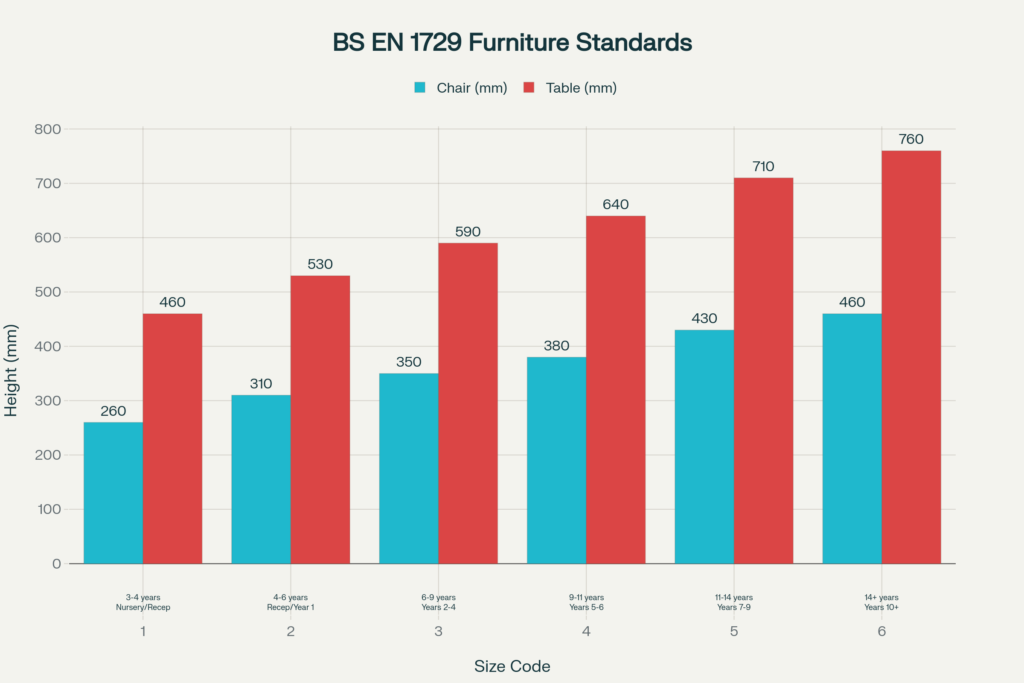
- Size 1 seating commonly uses a 260 mm seat height, while size 6 commonly uses a 460 mm seat height. Table heights increase with the corresponding size range.
- EN 1729-2 testing helps confirm that school furniture can resist normal classroom loads, tipping risks, impacts and repeated use.
- Buyers should ask for the applicable EN 1729-1 size marking and an EN 1729-2 test report for the exact furniture model and configuration.
- Hongye supports education-furniture projects with classroom chairs, desks, tables, training furniture and project-specific documentation. Buyers should verify the exact model, size mark, test report, material configuration and tender requirements before approving production.
Quick Answer: What Does EN 1729 Mean?
EN 1729 means a European standard for school chairs and tables.
It helps answer two core questions:
- Does the chair or table fit the intended student size group?
- Is the furniture stable, strong and safe enough for ordinary educational use?
EN 1729-1 answers the first question. It defines functional dimensions and size marking for educational chairs and tables.
EN 1729-2 answers the second question. It sets safety requirements and test methods for educational chairs and tables.
| EN 1729 Part | Main Purpose | What It Covers |
|---|---|---|
| EN 1729-1 | Functional dimensions | Chair and table sizes, ergonomic dimensions, size marks and colour coding |
| EN 1729-2 | Safety and testing | Stability, strength, durability, edges, structural safety and test methods |
A compliant product should match the relevant functional dimensions and pass the applicable safety and performance tests for its size mark and product design.
Why EN 1729 Matters for Schools
Students use classroom furniture for long periods every day. A chair that is too high can leave a smaller student’s feet unsupported. A chair that is too low can force excessive knee bend and poor desk alignment. Likewise, a table that is too high or too low can create awkward shoulder, neck, arm and wrist positions.
EN 1729 helps procurement teams avoid one-size-fits-all classroom furniture.
The standard links furniture dimensions to student stature and seated body measurements. It uses chair and table size marks to make selection easier for schools and buyers.
A correct seating position generally supports:
- Feet resting on the floor.
- Thighs supported by the seat.
- Lower legs positioned comfortably.
- Adequate seat depth.
- Appropriate backrest support.
- A table height that supports writing, reading and device use.
- Sufficient space for movement and classroom circulation.
The proper seat-height measurement relates to the student’s popliteal height: the distance from the floor to the back of the knee when seated with thighs generally horizontal and feet flat on the floor.
Ergonomic goal: Classroom furniture should support a suitable fit for the learner. It should not force students to adapt their posture to poorly sized chairs and tables.
EN 1729-1: Functional Dimensions and Size Marks
EN 1729-1 is the ergonomic and dimensional part of the standard.
It specifies functional dimensions and markings for chairs and tables used for general educational purposes. It includes fixed-size and adjustable furniture and also covers some standing-height table applications.
The standard uses size marks to identify furniture intended for different student stature ranges.
What EN 1729-1 Covers
EN 1729-1 may address:
- Seat height.
- Seat width.
- Effective seat depth.
- Backrest height.
- Backrest shape and radius.
- Seat angle.
- Backrest angle.
- Armrest dimensions where applicable.
- Table height.
- Clearance between chair and table.
- Student stature range.
- Size marking.
- Colour coding.
For chairs in size ranges 3 to 7, the standard uses a School Chair Measuring Device, or SCMD, to assess important functional dimensions.
Why Size Marking Matters
Size marks allow schools to identify the intended user group quickly.
A procurement specification should identify:
- Required chair size mark.
- Required table size mark.
- Expected student stature range.
- Whether furniture is fixed-size or adjustable.
- Whether chair and table sizes must be matched.
- Required size label or colour code.
- The exact EN 1729 edition required by the tender.Procurement rule: Do not order “standard school chairs” without specifying the EN 1729 size mark, intended age or stature range and matching table height.
EN 1729 Chair and Table Size Guide
The table below provides a practical guide for commonly specified classroom size marks.
Exact dimensional requirements, tolerances and marking rules should be verified against the applicable edition of EN 1729 and the product test documentation.
| Size Mark | Typical Student Stature Range | Typical Chair Seat Height | Typical Table Height | Common School Use |
|---|---|---|---|---|
| 0 | Approximately 80–95 cm | Approximately 210 mm | Approximately 400 mm | Early years and nursery applications |
| 1 | Approximately 93–116 cm | Approximately 260 mm | Approximately 460 mm | Early primary school |
| 2 | Approximately 108–121 cm | Approximately 310 mm | Approximately 530 mm | Primary school |
| 3 | Approximately 119–142 cm | Approximately 350 mm | Approximately 590 mm | Upper primary school |
| 4 | Approximately 133–159 cm | Approximately 380 mm | Approximately 640 mm | Middle school or mixed-age classrooms |
| 5 | Approximately 146–176 cm | Approximately 430 mm | Approximately 710 mm | Secondary school |
| 6 | Approximately 159–188 cm | Approximately 460 mm | Approximately 760 mm | Secondary school and adult learners |
| 7 | Approximately 174–207 cm | Approximately 510 mm | Approximately 820 mm | Taller students and adult education |
The full EN 1729 framework includes size marks 0 through 7. Size-mark labels and colour codes help users identify the intended furniture category.
Important Note About Sizes
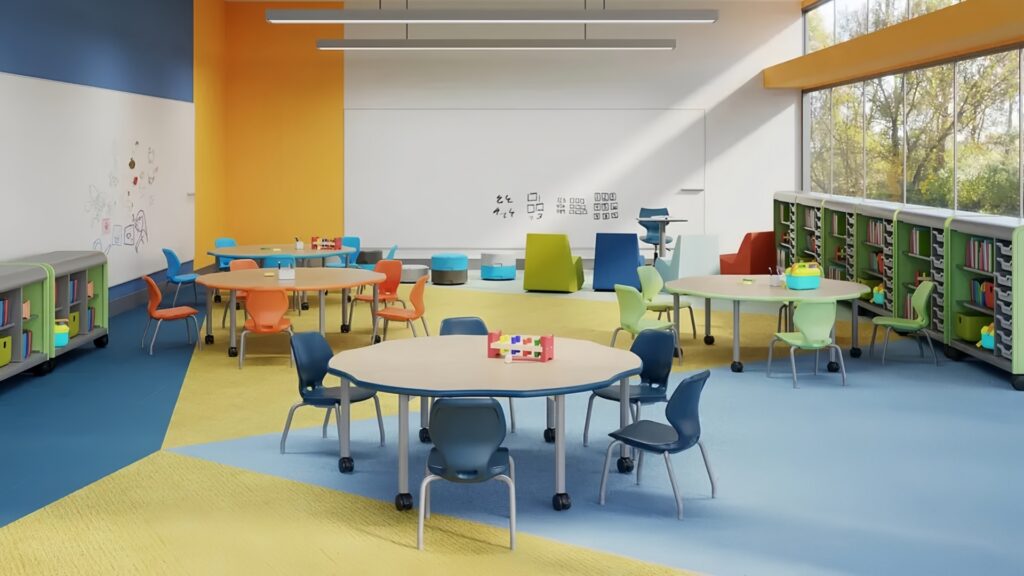
Age is only a rough planning reference. Students of the same age can have very different stature.
Therefore, schools should use height or stature ranges rather than age alone when selecting classroom chairs and tables.
For example:
- A size 5 chair may suit some younger secondary-school students.
- A size 6 chair may suit taller teenagers and adult learners.
- A mixed-age or inclusive classroom may require more than one furniture size.
- Adjustable furniture may help where student stature varies widely.
How to Match Chairs and Tables
A chair and table should work as a pair.
A correctly sized chair can still create poor posture if the table is too high, too low or too deep. Similarly, a well-sized table cannot solve the problem if a student’s chair leaves their feet unsupported.
Chair and Table Matching Principles
| Seating Issue | Possible Cause | Procurement Response |
|---|---|---|
| Feet cannot reach the floor | Seat height is too high | Select a lower-size mark or provide appropriate foot support where approved |
| Knees are sharply bent | Seat height is too low | Select a higher size mark |
| Shoulders lift when writing | Table is too high | Match the table to the chair size and student stature. |
| Student leans forward excessively | Backrest or seat depth does not fit | Review chair dimensions and seating posture |
| Chair does not fit beneath table | Mismatched chair and desk specification | Check chair-table clearance against the product dimensions. |
| Classroom has mixed student heights | One fixed size does not suit all users | Use multiple size marks or adjustable furniture. |
When students sit correctly, their thighs should generally be supported, their lower legs should be comfortable, and their feet should rest on the floor. The table should support writing and reading without forcing excessive shoulder elevation.
EN 1729-2: Safety Requirements and Test Methods
EN 1729-2 focuses on safety, stability, strength, and durability.
It applies to chairs and tables for general educational use, including early years, childcare institutions, and educational settings. It does not cover every specialist furniture type, such as laboratory workstations, workshop benches, lecture-theatre seating or teaching-staff furniture.
What EN 1729-2 Evaluates
Depending on the product type and size mark, EN 1729-2 may include requirements and test methods for:
- Forward stability.
- Rearward stability.
- Sideways stability.
- Static load.
- Seat load.
- Backrest load.
- Footrest load where relevant.
- Durability under repeated loading.
- Impact resistance.
- Chair-leg strength.
- Table-top strength.
- Table stability.
- Edge safety.
- Entrapment and pinch-point risks.
- Structural damage after testing.
The test loads, cycles and test arrangements depend on the chair or table size mark and product design.
What “Tested” Should Mean
A supplier should not simply place “EN 1729 compliant” on a catalogue page.
Instead, buyers should ask for evidence that relates to the exact item being purchased.
The document should identify:
- Product name and model number.
- Product configuration.
- Size mark.
- Test standard and edition.
- Test laboratory.
- Test date.
- Test results.
- Any limitations or exclusions.
- Material configuration.
- Chair or table adjustments included in the test.
- Whether the final production model matches the tested model.Verification rule: A test report for one chair model does not automatically prove compliance for every variation of that chair. Changes to dimensions, frame material, seat shell, joints, fasteners or adjustment mechanism may affect the result.
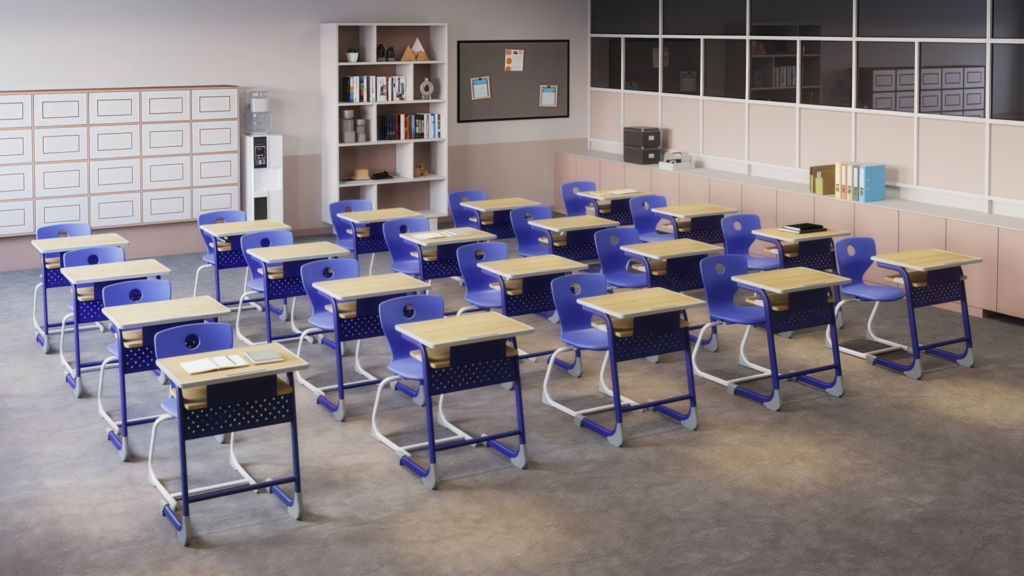
EN 1729 Safety Checks Buyers Should Understand
| Safety Area | Why It Matters | Buyer Question |
|---|---|---|
| Stability | Helps reduce tip-over risk during normal classroom use | Has the model passed the applicable stability test? |
| Structural strength | Helps confirm that the chair or table can withstand expected loads | Which model and size mark were tested? |
| Durability | Evaluates repeated use over time | Does the report include the required repeated-load tests? |
| Edge safety | Helps reduce injury and clothing-damage risk | Are seat, backrest and armrest edges rounded or protected? |
| Pinch points | Helps reduce finger or clothing entrapment | Does the adjustable mechanism have protected moving parts? |
| Table stability | Helps prevent rocking, tipping or instability | Does the table remain stable on the intended floor type? |
| Frame integrity | Helps prevent cracks, loose joints or leg failure | What frame material, welds and fasteners are used? |
| Adjustable furniture | Ensures all intended size settings perform safely | Was the product assessed at the relevant adjustment settings? |
For adjustable school furniture, functional dimensions should be assessed for all relevant size settings. Structural testing is generally performed at the highest applicable size mark.
EN 1729 Marking and Colour Codes
EN 1729 furniture commonly uses size marks and colour codes to help schools identify the intended student group.
Colour coding can help teachers, facilities teams and students pair the correct chair with the correct table. It can also simplify inventory control in multi-age schools.
However, a colour alone does not prove compliance.
A buyer should verify:
- The actual size mark.
- Product dimensions.
- Intended stature range.
- Applicable EN 1729 edition.
- Matching chair and table size.
- Test report.
- Product label or permanent marking.
- Supplier declaration and warranty scope.
| Marking Element | Why It Matters |
|---|---|
| Size mark | Identifies intended furniture size category |
| Colour code | Supports quick visual matching where used |
| Product model | Links marking to the exact tested item |
| Production batch | Supports traceability |
| Supplier information | Supports warranty and replacement-part requests |
| Standard reference | Identifies the relevant EN 1729 requirement |
| Test-report reference | Supports procurement verification |
EN 1729 and Student Ergonomics
School furniture does not replace good classroom design, movement breaks or ergonomic education. However, correctly sized furniture can support better posture and reduce avoidable discomfort.
Students may spend several hours each day sitting, writing, reading and using laptops or tablets. If chairs and tables do not match student stature, students may compensate by:
- Sliding forward in the chair.
- Perching on the seat edge.
- Raising shoulders while writing.
- Leaning heavily on the desk.
- Tucking feet beneath the chair.
- Crossing legs to create support.
- Twisting to reach an unsuitable work surface.
- Resting their back against the edge rather than the backrest.
Instead of presenting a fixed medical claim about the percentage of adolescents with back pain, procurement teams should treat furniture fit as one part of a wider wellbeing strategy.
That strategy can include:
- Multiple furniture sizes.
- Adjustable seating and tables where appropriate.
- Correct classroom layout.
- Adequate circulation.
- Regular movement breaks.
- Supportive teacher guidance.
- Device-use policies.
- Ergonomic review for special educational needs.Healthy classroom principle: A chair is not ergonomic simply because it looks modern. It must fit the learner, support the task and remain safe under daily use.
How to Specify EN 1729 School Furniture
A good school furniture RFQ should describe more than colour, quantity and price.
It should define the intended user group, required size mark, furniture configuration, material expectations and test evidence.
EN 1729 Procurement Checklist
| RFQ Requirement | What to Specify |
|---|---|
| Furniture type | Classroom chair, desk, table, stool, bench or adjustable workstation |
| Intended users | Student stature range, age range and classroom type |
| Size mark | Required EN 1729 size mark or adjustable size range |
| Chair height | Required functional seat height |
| Table height | Matching functional table height |
| EN 1729-1 | Required edition and dimensional compliance evidence |
| EN 1729-2 | Required edition and safety-test evidence |
| Product model | Exact manufacturer model and configuration |
| Materials | Seat shell, frame, tabletop, edge banding, coating and fasteners |
| Adjustability | Required adjustment range, mechanism and locking method |
| Durability | Intended use level, classroom type and maintenance expectations |
| Surface finish | Scratch resistance, cleanability and repair method |
| Safety features | Rounded edges, protected fixings, anti-tip design and pinch-point controls |
| Accessibility | Accessible seating positions and inclusive design requirements |
| Documentation | Test report, declaration, product label, maintenance instructions and warranty |
| Replacement parts | Availability of glides, seat shells, table tops, fasteners and adjustment parts |
| Samples | Required pre-production or tender sample approval |
Example RFQ Wording
Supply student classroom chairs in EN 1729 size mark 5 and size mark 6, with matching classroom tables. Provide product-specific evidence of conformity with EN 1729-1 functional dimensions and EN 1729-2 safety requirements and test methods. Submit test reports identifying the tested model, size mark, materials, test standard edition, laboratory and test date. Provide permanent size marking, maintenance guidance, warranty terms and replacement-part availability.
This wording gives suppliers a clearer technical requirement and helps buyers compare bids more accurately.

School Furniture
Common EN 1729 Procurement Mistakes
Ordering by Age Only
A school may order chairs for “ages 11–14” without considering student stature.
Better approach: Use stature range, size mark and classroom use together.
Mixing Chair and Table Sizes
A buyer may select size 6 chairs but use tables designed for size 5.
Better approach: Specify matched chair and table size marks or verify functional compatibility.
Requesting a Generic Compliance Letter
A supplier may provide a general statement without model-specific test evidence.
Better approach: Request a report for the exact model, configuration and size mark.
Ignoring Adjustable Furniture Settings
An adjustable chair or desk may cover several size marks.
Better approach: Verify functional dimensions at relevant settings and confirm the tested configuration.
Treating EN 1729 as the Only Requirement
EN 1729 does not cover every requirement for every school project.
Better approach: Also consider local fire rules, accessibility requirements, indoor-emissions requirements, building codes, procurement rules, cleaning needs and classroom layout.
Selecting Furniture Without Maintenance Planning
School chairs and tables receive daily impacts, dragging, spills and frequent rearrangement.
Better approach: Request repair instructions, spare glides, replacement shells, fasteners and table-top maintenance guidance.
Hongye EN 1729 School Furniture Support
Hongye supports education-furniture projects with classroom chairs, student desks, classroom tables, training furniture, library furniture, dormitory furniture and project-specific school furniture packages.
For qualified education projects, Hongye can support:
- Classroom furniture schedules.
- Student chair and table size selection.
- Fixed-size and adjustable furniture discussions.
- Product drawings and technical specifications.
- Material, frame and tabletop finish samples.
- Project-specific size marking requirements.
- Product-specific test-documentation coordination where applicable.
- Packaging, export logistics and installation planning.
- Spare-part and maintenance planning.
Hongye states that it has delivered more than 1,000 commercial furniture projects across 50+ countries. The company also describes a large-scale manufacturing operation serving education, healthcare, office and hotel projects.
Buyers should verify the exact furniture model, EN 1729 size mark, applicable standard edition, test report, material configuration, tender requirements, installation conditions and local regulatory obligations before approving production.
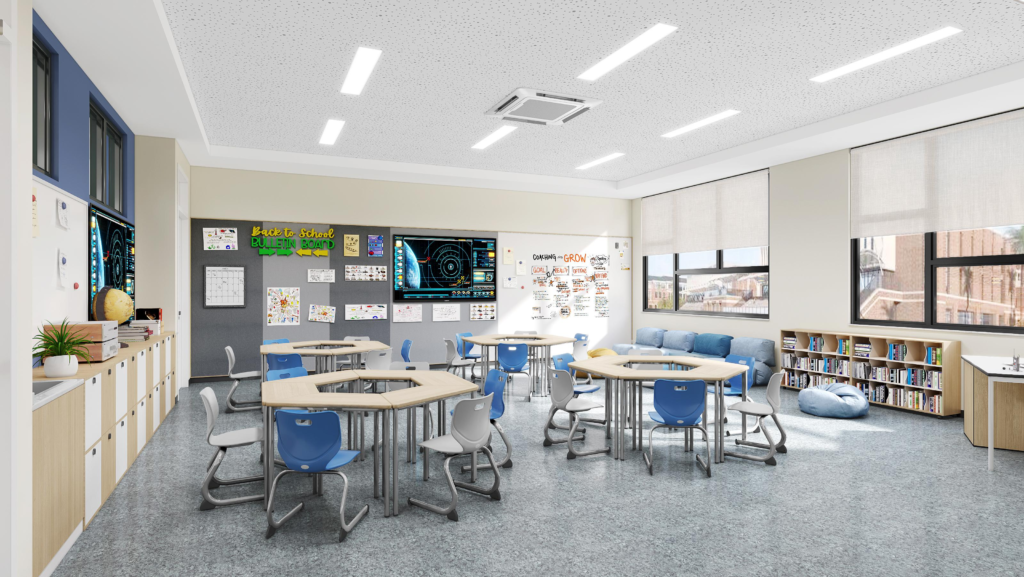
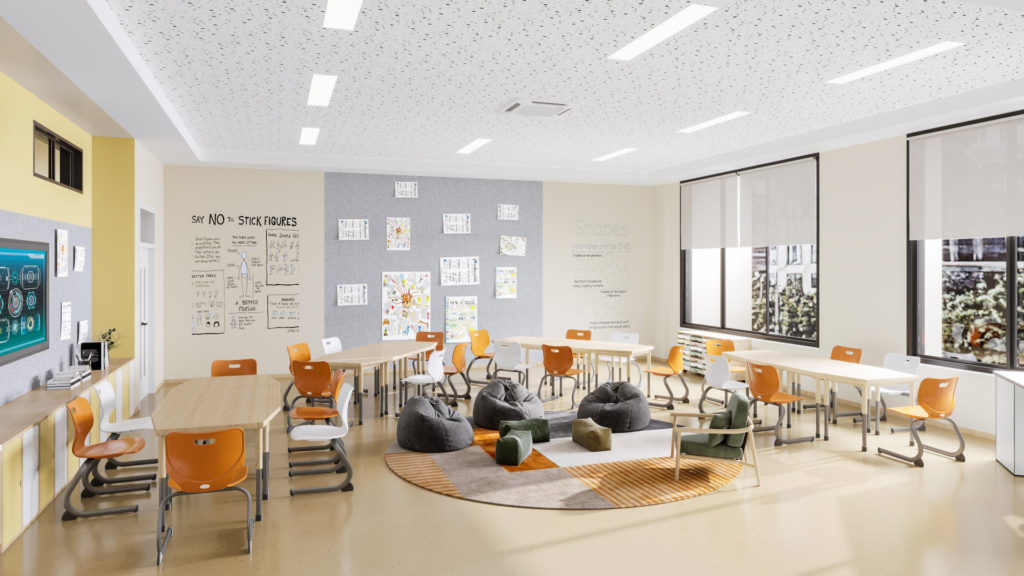
Charterhouse Lagos | Education Project by Hongye Furniture
Frequently Asked Questions
What is EN 1729?
EN 1729 is the European standard for chairs and tables used in educational institutions.
EN 1729-1 covers functional dimensions and size marking. EN 1729-2 covers safety requirements and test methods for school furniture.
Is EN 1729 mandatory for school furniture?
EN 1729 is a European standard, not a single blanket law that automatically governs every school-furniture purchase.
However, public tenders, school authorities, local procurement rules and project specifications may require EN 1729 compliance or equivalent evidence. Buyers should confirm the requirement in the applicable tender and country.
What is the difference between EN 1729-1 and EN 1729-2?
EN 1729-1 defines functional furniture dimensions, including chair and table size marks.
EN 1729-2 defines safety requirements and test methods for stability, strength and durability.
What chair height is EN 1729 size 6?
An EN 1729 size 6 classroom chair commonly has a seat height of approximately 460 mm. It is generally intended for taller secondary-school students and adult learners.
What table height matches an EN 1729 size 6 chair?
A size 6 table commonly uses a height of approximately 760 mm. Buyers should still verify the exact functional dimensions and tolerance requirements in the applicable EN 1729 standard and product documentation.
What EN 1729 size is suitable for secondary school?
Many secondary schools use size 5 and size 6 furniture. Size 5 commonly has a chair seat height of approximately 430 mm, while size 6 commonly has a seat height of approximately 460 mm.
However, schools should base the final choice on student stature, not age alone.
Does EN 1729 apply to laboratory furniture?
Not necessarily. EN 1729 applies to chairs and tables for general educational purposes. It does not cover every special-purpose workstation, such as laboratory benches, workshop furniture, ranked seating or teaching-staff furniture.
What documents should I request from a school furniture supplier?
Request the exact product model, size mark, EN 1729-1 dimensional evidence, EN 1729-2 test report, test-standard edition, product drawings, material specification, permanent marking details, maintenance instructions, warranty terms and replacement-part information.
Choose Furniture That Fits Students
EN 1729 gives schools a practical framework for selecting classroom furniture that fits students and withstands daily educational use.
The standard combines ergonomic sizing with safety testing. EN 1729-1 helps buyers match chair and table dimensions to student stature. EN 1729-2 helps buyers verify stability, strength and durability.
When schools specify size marks, request model-specific test evidence and match chairs with tables, they can create classrooms that are safer, more comfortable and easier to manage.