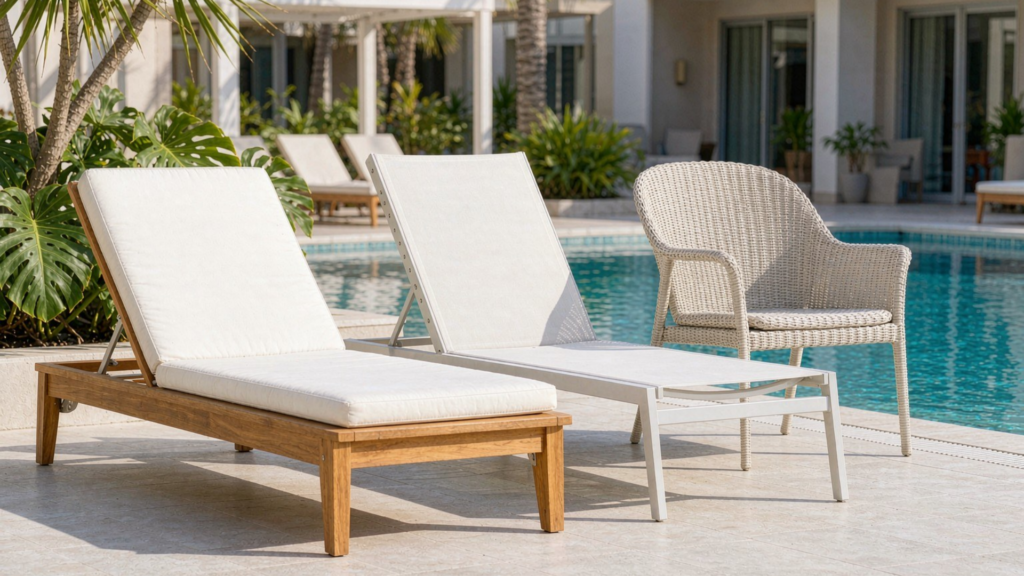
Hotel outdoor furniture should be selected for the conditions at the property—not simply for an outdoor label or an attractive showroom sample.
A sheltered courtyard, chlorinated pool deck and exposed rooftop create different requirements. The specification should explain where each item will be used, how it will be maintained and what evidence supports the proposed construction.
Start with exposure. Then review the complete product: frame, joints, surface treatment, fixings, cushions, glides and replaceable components.
This guide explains how to compare materials, read weathering reports, prepare poolside furniture specifications and plan maintenance, storage and replacement costs.
Key Takeaways
- Define the location and operating conditions before selecting materials.
- Compare complete furniture assemblies rather than material names alone.
- Do not convert accelerated test hours directly into outdoor service years.
- Request test conditions and results relevant to the proposed product.
- Review cushions as complete assemblies, including covers, filling and drainage.
- Coordinate wind management and site safety with qualified project reviewers.
- Confirm spare parts, storage arrangements and maintenance instructions before ordering.
- Build replacement budgets from documented assumptions, not universal lifespan claims.
Define the Site Exposure Before Selecting Furniture
A useful outdoor FF&E brief describes the actual environment and operation.
Record:
- Location within the property.
- Sheltered or exposed position.
- Direct sunlight.
- Rain and humidity.
- Coastal salt exposure.
- Pool-water splash.
- Cleaning products.
- Ground surface.
- Frequency of movement.
- Seasonal storage.
- Expected intensity of use.
Also identify unusual conditions, such as an exposed rooftop, persistent standing water or furniture used partly inside and partly outside.
Avoid using “coastal grade” or “all-weather” as a complete requirement. Ask suppliers to explain what those descriptions mean for the proposed product and its warranty.
Separate the Property Into Zones
Create an item schedule for each area.
A restaurant terrace may require frequent movement and compact storage. A pool lounger needs suitable adjustment mechanisms, contact surfaces and cushion care. A sheltered garden seat may have different maintenance priorities.
The furniture schedule should connect each item code to its location, quantities, dimensions, construction and operating conditions.
Compare Hotel Outdoor Furniture as Complete Assemblies
No material is automatically the best choice for every outdoor location.
Review how the frame, surface, connections and soft components work together.
| Material or Construction | Potential Applications | Questions to Resolve |
|---|---|---|
| Timber, including teak | Chairs, tables, benches and feature furniture | Which species, construction, finish and maintenance approach are proposed? |
| Coated aluminium | Seating frames, loungers and tables | What pretreatment, coating, joints and repair instructions apply? |
| Stainless steel | Frames, components and fixings | Which alloy, surface finish and exposure conditions are supported? |
| Synthetic woven furniture | Lounge seating and other framed products | What are the weave and frame materials, and can the woven component be replaced? |
| Moulded polymer furniture | Chairs, tables and other products | What evidence supports the product’s outdoor use, loading and ageing performance? |
| Outdoor upholstered assemblies | Cushions, pads and upholstered seating | How do the cover, seams, filling, backing and drainage work together? |
A synthetic weave is not the same as its supporting frame. Likewise, solid polymer furniture should not be treated as equivalent to a woven covering over a metal structure.
Ask the supplier to identify every relevant material rather than describing the entire product as “HDPE” or “resin.”
Teak vs Aluminium Outdoor Furniture: What Should Buyers Compare?
Teak and aluminium can both be considered for hotel outdoor furniture, but their maintenance and construction requirements differ.
For timber products, review:
- Species and sourcing information.
- Joint construction.
- Surface condition.
- Finish or treatment.
- Permitted cleaning.
- Expected appearance changes.
- Repair options.
For coated aluminium products, review:
- Alloy and component construction.
- Welds and connections.
- Surface preparation.
- Coating system.
- Protection around fasteners and openings.
- Cleaning and repair instructions.
Do not decide from weight, colour or material reputation alone.
Agree on the Intended Appearance
For timber, clarify whether natural weathering is acceptable or whether the hotel intends to maintain a particular appearance.
For coated frames, approve the colour, texture and sheen through identified samples.
Ask how repairs may affect the appearance. A local touch-up may not produce the same result as a factory-applied finish.
Avoid Guaranteed Surface-Temperature Claims
Do not assume that a material will remain comfortable to touch in direct sun.
Review the actual surfaces, colours and exposure. Where hot contact surfaces are a concern, include them in the project’s product assessment and operating plan.
How to Review Weather-Resistance Evidence
A report is useful when it identifies the material or product tested, the conditions applied and the changes observed.
A statement such as “tested for 2,000 hours” is incomplete without the rest of that information.
Request the standard, edition, procedure, specimen details and acceptance requirements.
| Evidence Area | Information to Request | Important Limitation |
|---|---|---|
| Accelerated light and moisture exposure | Lamp or light source, cycle, temperature, duration and evaluation method | Exposure hours do not automatically equal outdoor service years |
| Corrosion | Metal, coating, preparation, specimen details and assessment criteria | Salt-spray results alone do not predict field life |
| Colour change | Measurement method, calculation, conditions and reference | Results need a consistent basis for comparison |
| Physical change | Relevant observations or retained properties | Confirm why the property matters to the proposed use |
| Textile performance | Fabric identification, method and reported results | A fabric report does not establish complete cushion performance |
| Structural performance | Product configuration, applicable method and results | Confirm coverage of the item being purchased |
Do Not Convert Laboratory Hours Into Years
ASTM G154 uses controlled accelerated exposure. There is no universal direct conversion between its test duration and actual outdoor exposure time.
Similarly, ASTM B117 provides a controlled salt-fog environment, but standalone salt-spray results generally do not establish performance in natural environments.
Use such evidence to support defined comparisons and identify changes—not to promise a fixed lifespan.
Compare Equivalent Test Conditions
Two reports with the same number of hours may use different conditions.
Check the light source, exposure cycle, temperature, specimen and assessment. When ISO 4892 is referenced, identify the relevant part and procedure rather than citing the series alone.
The project should establish acceptance requirements appropriate to the product. Do not invent a universal colour-change or corrosion threshold for every outdoor item.
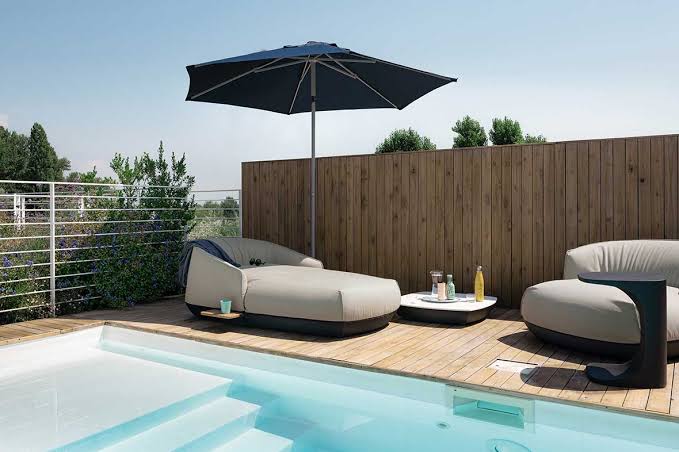
Write Poolside Furniture Specifications Around Actual Risks
Poolside furniture may encounter wet users, splash, cleaning chemicals and repeated movement.
Review these conditions at the complete-product level.
Contact With the Deck
Ask how feet and glides interact with the actual surface.
Consider:
- Marking.
- Wear.
- Stability.
- Movement under use.
- Trapped debris.
- Replacement.
- Compatibility with the deck.
Do not use a pedestrian flooring classification as proof that a furniture glide will resist movement.
Floor slip-resistance assessment and furniture-contact assessment are different tasks. Guidance distinguishes between testing for shod and barefoot pedestrian conditions; these should not be reduced to a generic R rating for furniture feet.
Water Entry and Drainage
Ask the supplier to show how the design manages water.
Review openings, joints, orientation and internal spaces. Depending on the construction, the design may prevent entry, provide drainage or use another documented approach.
Avoid prescribing one drainage-hole diameter for every product. The detail should suit the actual frame and manufacturing process.
Chemicals and Corrosion
Provide the intended cleaning products and describe pool-water exposure.
Confirm:
- Product name.
- Concentration.
- Contact time.
- Application method.
- Rinsing.
- Frequency.
- Material restrictions.
Do not assume that a coating or stainless-steel designation makes the complete item resistant to every poolside condition.
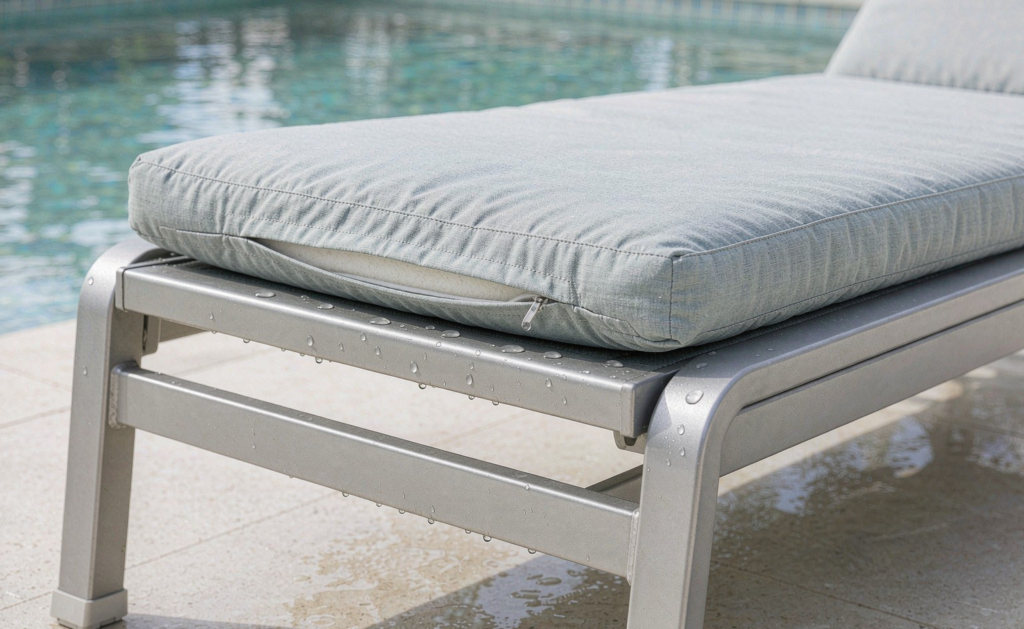
Specify Cushions for Cleaning, Drainage and Replacement
“Quick-dry” is not a complete cushion specification.
Review the cover, seams, lining, filling and underside as one assembly.
Ask:
- Where does water enter?
- How does it leave?
- How should the cushion be positioned for drying?
- Which cleaning methods are permitted?
- Can the cover be removed?
- Are replacement covers available?
- Can the filling be replaced?
- What storage conditions apply?
A foam description alone does not prove that the finished cushion will dry within a particular time.

Confirm Care Instructions for the Exact Cover
Do not assume that every solution-dyed fabric cover is machine washable.
The completed cover may include backing, piping, fasteners or other details with separate care requirements.
Request written instructions for the supplied assembly and pass them to housekeeping before handover.
Set spare-cover quantities according to laundry capacity, occupancy and turnaround needs rather than a fixed rule for every hotel.
Coordinate Wind Management With the Site Team
Wind planning is a site-specific responsibility.
Do not rely on a universal wind-speed trigger, furniture weight or generic anchoring clause.
Have qualified project reviewers assess the proposed products and locations, including:
- Site exposure.
- Furniture geometry.
- Adjustable positions.
- Available restraint methods.
- Manufacturer limitations.
- Ground or structural interfaces.
- Storage options.
- Monitoring and operating responsibilities.
Umbrellas, canopies and other accessories require their own review. Do not assume that a seating specification covers them.
Document the Operating Procedure
The hotel should know who monitors conditions, who authorises action and where furniture can be moved safely.
Any stacking, restraint, covering or transport procedure should follow the manufacturer’s limitations and the approved site plan.
Furniture weight alone should not be treated as proof of resistance to movement or overturning.
Plan Outdoor Furniture Maintenance, Spares and Storage
Maintenance should follow the product instructions and actual use.
Ask suppliers for inspection points and conditions requiring action.
These may concern:
- Loose connections.
- Damaged coatings.
- Corrosion.
- Cracked components.
- Worn glides.
- Loose weave.
- Damaged slings.
- Faulty adjustments.
- Torn covers.
- Unstable furniture.
Record which repairs are permitted and who may carry them out.
Confirm Replacement Components Before Ordering
Request a parts list for the items most likely to need maintenance.
Identify model references, finishes and ordering information. Ask how future replacement parts will be matched to the supplied configuration.
Do not assume that later production will remain compatible.
Calculate Storage From Manufacturer Data
Request:
- Maximum stack quantity.
- Stacked dimensions.
- Stack weight.
- Protective spacers.
- Handling method.
- Covering requirements.
- Storage restrictions.
Allow space for movement and access, not just the furniture footprint.
Clean and dry products as instructed before storage. Do not improvise a stacking or wrapping method that conflicts with the manufacturer’s guidance.
Hotel Furniture
Plan Replacement From Condition, Not a Universal Calendar
Outdoor furniture does not have one predictable replacement date.
Instead, distinguish:
- Inspection.
- Routine maintenance.
- Component repair.
- Refurbishment.
- Full replacement.
Use product condition, repair feasibility, operational requirements and available parts to decide the next action.
For budgeting, the hotel can model several scenarios. Label them as planning assumptions rather than manufacturer promises or market-wide service lives.
A frame and its cushions may require different decisions at different times.
Compare Total Cost of Ownership on a Consistent Basis
Compare products that perform the same function and use the same commercial scope.
A hardware set cannot be ranked against a complete lounger using one purchase index.
For each option, include the relevant costs:
Total cost of ownership=Purchase+Delivery and installation+Maintenance+Repair+Replacement+Other defined costs
State the analysis period, quantities, labour assumptions and replacement scenarios.
If the analysis uses discounted cash flow, identify that basis. If it is a simple budget total, say so.
Keep Uncertain Costs Visible
Where repair frequency or component life is unknown, test different scenarios.
This is more useful than assigning a fixed eight-year ranking to teak, aluminium or polymer products without project data.
Price is one part of the decision. Storage, housekeeping effort, parts availability and disruption should also be considered where relevant.
Outdoor FF&E Procurement Checklist
Use the following checklist before approving the order.
| Review Area | Information to Confirm | Required Record |
|---|---|---|
| Site exposure | Location, sun, water, chemicals and shelter | Exposure brief |
| Product identity | Model, dimensions and complete configuration | Item schedule |
| Materials | Frame, surface, joints, fixings and soft components | Material specification |
| Evidence | Relevant procedures, conditions and results | Reviewed document register |
| Appearance | Colour, texture and permitted variation | Identified sample approval |
| Poolside use | Deck contact, cleaning and water management | Product and site review |
| Wind | Site assessment and operating arrangements | Approved management plan |
| Cushions | Care, drainage, replacement and storage | Written assembly instructions |
| Maintenance | Inspection, repair and spare parts | Maintenance plan |
| Storage | Limits, dimensions and handling | Storage layout and procedure |
| Commercial scope | Delivery, assembly, exclusions and warranty | Agreed quotation and contract |
Close outstanding technical questions before the decision they affect. Keep proposed alternatives separate from approved production information.
Discuss an Outdoor Furniture Package With HONGYE
Hongye Furniture Group can discuss an outdoor furniture brief against the project’s item schedule, drawings and exposure requirements.
Confirm the available scope for each proposed product, including manufacturing arrangements, supporting documents and maintenance information.
An initial brief should include:
- Property location.
- Outdoor zones.
- Furniture types and quantities.
- Layouts.
- Material direction.
- Pool or coastal exposure.
- Cleaning regime.
- Storage arrangements.
- Delivery destination.
- Target programme.
Review the hotel furniture range and project case studies for related categories.
Send the brief through the contact page to confirm suitable product options, document availability and the agreed review scope.
Production timing and delivery arrangements should be confirmed for the actual order. General company certifications do not replace product-specific weathering or performance evidence.
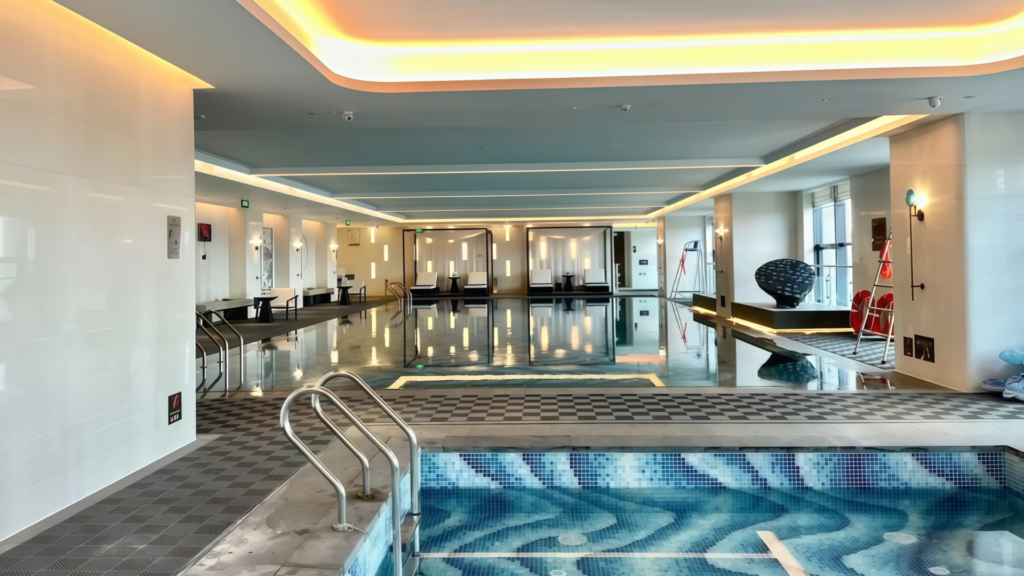
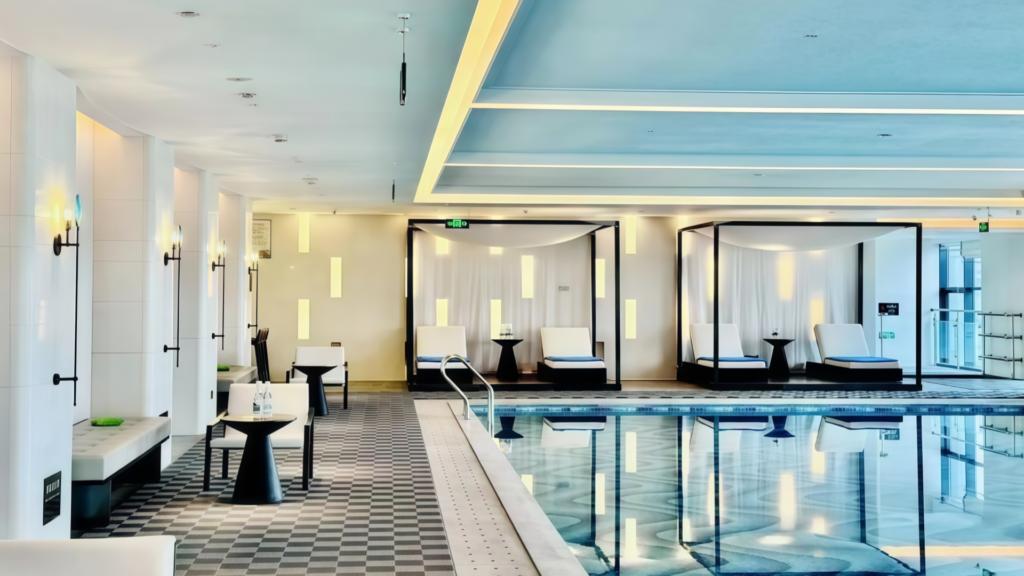
Wingate By Wyndham | Hospitality Project Solution By Hongye Furniture
Frequently Asked Questions
Which material is best for hotel outdoor furniture?
There is no single best material.
Compare the complete product against its location, use, cleaning, maintenance and storage requirements.
Is teak or aluminium better for hotel terraces?
Both may be considered.
Review the intended appearance, construction, maintenance approach, product evidence and operational requirements rather than choosing by material name alone.
Do accelerated weathering hours prove outdoor lifespan?
No universal conversion applies.
Controlled testing can support comparisons, but the hours should not be presented as a guaranteed number of years outdoors.
Does a salt-spray report prove poolside suitability?
Not by itself.
Review the proposed material, coating, construction, cleaning and actual exposure. Salt-spray results alone generally do not establish natural-environment performance.
What should a poolside cushion specification include?
Identify the cover, seams, lining, filling, drainage, cleaning instructions and replacement arrangements.
Request information for the complete assembly, not just the foam or fabric.
When should outdoor furniture be replaced?
Use inspection findings, repair options, parts availability and operational requirements.
Avoid treating a fixed year as the correct replacement date for every product.
How should hotels plan wind precautions?
Use a site-specific assessment and operating procedure.
Confirm manufacturer limitations, restraint or storage options, responsibilities and action triggers with qualified project reviewers.
How long does an outdoor furniture package take to produce?
Confirm a project-specific programme.
The proposed products, quantities, approvals, materials, manufacturing arrangements and delivery scope determine the schedule.
Specify for the Site and Plan for Operation
A reliable outdoor furniture package connects product selection with the way the hotel will use, clean, move and store it.
Define the exposure. Review the complete assembly and relevant evidence. Confirm maintenance, spares and site responsibilities before ordering.
That process creates a stronger basis for procurement than a weather-resistant label or a fixed replacement-year promise.