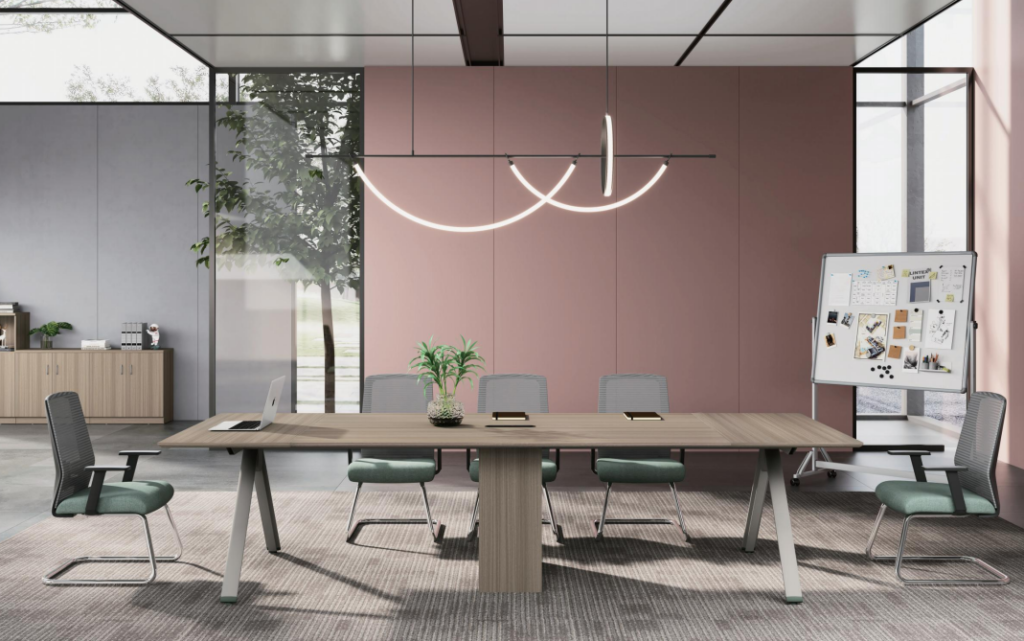
In the modern corporate world, the conference room is the heart of collaboration, decision-making, and professional networking. Whether you are hosting a high-stakes board meeting or a creative brainstorming session, the physical environment plays a critical role in the outcome.
One of the most frequent challenges office managers and procurement specialists face is determining the correct conference table dimensions for their space. A table that is too small leads to a cramped, uncomfortable environment that stifles productivity. Conversely, a table that is too large for the room makes the space feel claustrophobic and hinders movement.
This ultimate guide will break down everything you need to know about meeting room seating capacity, table shapes, and the essential “3-foot rule” for spatial planning.
The Master Conference Table Seating Capacity Chart
For those in a hurry, here is a quick-reference guide to the most common standard conference table sizes and their corresponding seating capacities.
| Table Length (Feet) | Table Length (CM) | Seating Capacity | Recommended Room Size (Feet) | Recommended Room Size (Meters) |
| 6 Feet | 183 cm | 4 – 6 People | $10′ \times 12’$ | $3.0 \times 3.6$ m |
| 8 Feet | 244 cm | 6 – 8 People | $12′ \times 14’$ | $3.6 \times 4.2$ m |
| 10 Feet | 305 cm | 8 – 10 People | $12′ \times 18’$ | $3.6 \times 5.5$ m |
| 12 Feet | 366 cm | 10 – 12 People | $14′ \times 20’$ | $4.2 \times 6.1$ m |
| 14 Feet | 427 cm | 12 – 14 People | $14′ \times 24’$ | $4.2 \times 7.3$ m |
| 16 Feet | 488 cm | 14 – 16 People | $16′ \times 26’$ | $4.8 \times 7.9$ m |
| 20+ Feet | 610+ cm | 18 – 22+ People | Custom | Custom |
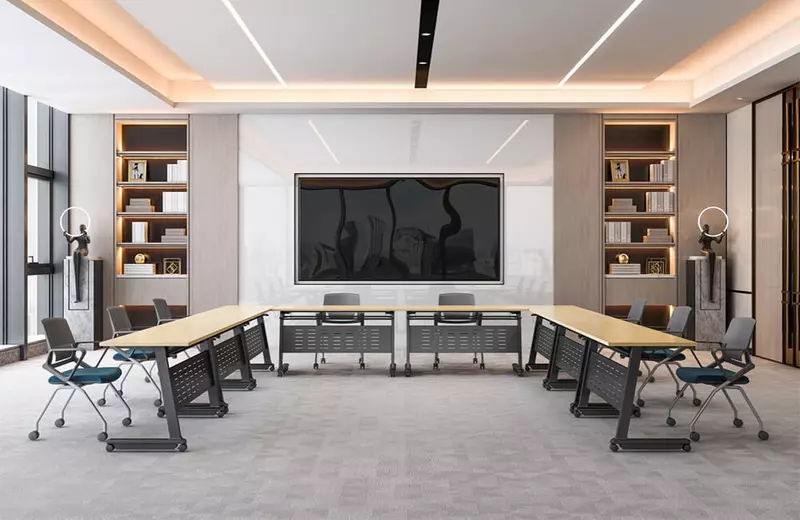
Modular Training Conference Room Table
1. The 6-Foot Conference Table: The Huddle Room Essential
The 6-foot conference table is the cornerstone of the “Huddle Room” trend. As companies move toward agile workflows, smaller, more frequent meetings are replacing massive boardroom gatherings.
Key Dimensions & Features
- Standard Size: 72″ L x 36″ W (183cm x 91cm).
- Capacity: Optimally seats 4 people (two on each side). Can accommodate 6 if you use the “heads” of the table.
- Best Use Case: Small team scrums, private interviews, or as a secondary table in an executive suite.
Why It Works for Space
In terms of office space planning, the 6ft table is incredibly versatile. It fits into rooms as small as 120 square feet while still allowing for a professional appearance. If your business focuses on tech startups or co-working spaces, the 6ft modular table is a top-performing product.
2. The 8-Foot Conference Table: The Industry Standard
If there is one size that fits 80% of corporate needs, it is the 8-foot conference table. It is the “Queen size bed” of the office furniture world—spacious enough for most tasks but compact enough to fit in standard office footprints.
Key Dimensions & Features
- Standard Size: 96″ L x 42″ – 48″ W (244cm x 107-122cm).
- Capacity: Comfortably seats 6-8 people.
- Best Use Case: Departmental meetings, standard conference rooms, and client presentations.
The Comfort Factor
When calculating seating capacity for an 8ft table, you must consider the “elbow room.” For a professional setting, each person should have at least 24 to 30 inches of horizontal space. An 8ft table provides exactly 32 inches per person for a 6-person layout, which is considered “Executive Level” comfort.
3. The 10-Foot Conference Table: The Executive Choice
Stepping up to a 10-foot conference table signals a shift from functional to formal. This size is typically found in the primary boardroom of a medium-sized company.
Key Dimensions & Features
- Standard Size: 120″ L x 48″ W (305cm x 122cm).
- Capacity: Seats 8-10 people.
- Best Use Case: Board of Directors meetings, legal depositions, and large-scale project planning.
Technical Integration
At the 10-foot mark, cable management for conference tables becomes non-negotiable. Most 10ft tables come in two pieces (to facilitate shipping and installation) and feature dual power grommets. This allows participants at both ends of the table to plug in laptops without cables stretching across the room.
4. The 12-Foot Table and Beyond: Large-Scale Boardrooms
For multinational corporations and large legal firms, the 12-foot to 20-foot boardroom table is a statement piece.
- 12-Foot Tables: Seat 10-12 people.
- 14-Foot to 16-Foot Tables: Seat 12-16 people.
- Modular Systems: For rooms requiring 20+ seats, we recommend modular conference furniture. This allows you to reconfigure the tables into a U-shape, classroom style, or one continuous long table.
The “3-Foot Rule”: How to Measure Your Room
The most common mistake in B2B office furniture procurement is forgetting about the people, not just the furniture. You need to calculate the “Clearance Zone.”
The Mathematical Formula for Room Selection
To ensure a comfortable flow of traffic, follow the 48-36 Rule:
- Ideal Clearance: 48 inches (122 cm) between the table edge and the wall. This allows someone to walk behind a seated person.
- Minimum Clearance: 36 inches (91 cm). This is the absolute minimum required to pull out a chair and sit down.
Example Calculation:
If you have an 8ft table (96″ x 48″) and want ideal clearance:
- Total Length Required: $96″ + 48″ + 48″ = 192″$ (16 feet)
- Total Width Required: $48″ + 48″ + 48″ = 144″$ (12 feet)
- Minimum Room Size: $16′ \times 12’$
How Table Shape Affects Your Seating Capacity
The shape of the table is not just an aesthetic choice; it dictates the psychology of the meeting and the actual number of chairs you can fit.
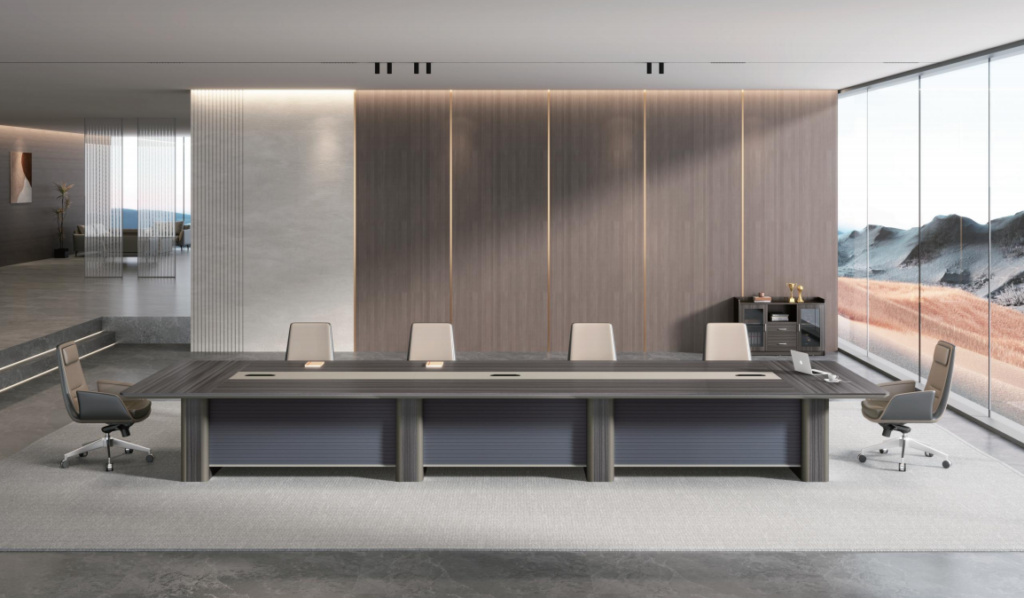
Rectangular Tables
The most traditional shape. It reinforces hierarchy (with the leader at the head) and maximizes the use of straight walls.
- Pros: Easy to align, maximizes seating along the length.
- Cons: People at the ends may feel disconnected from those in the middle.
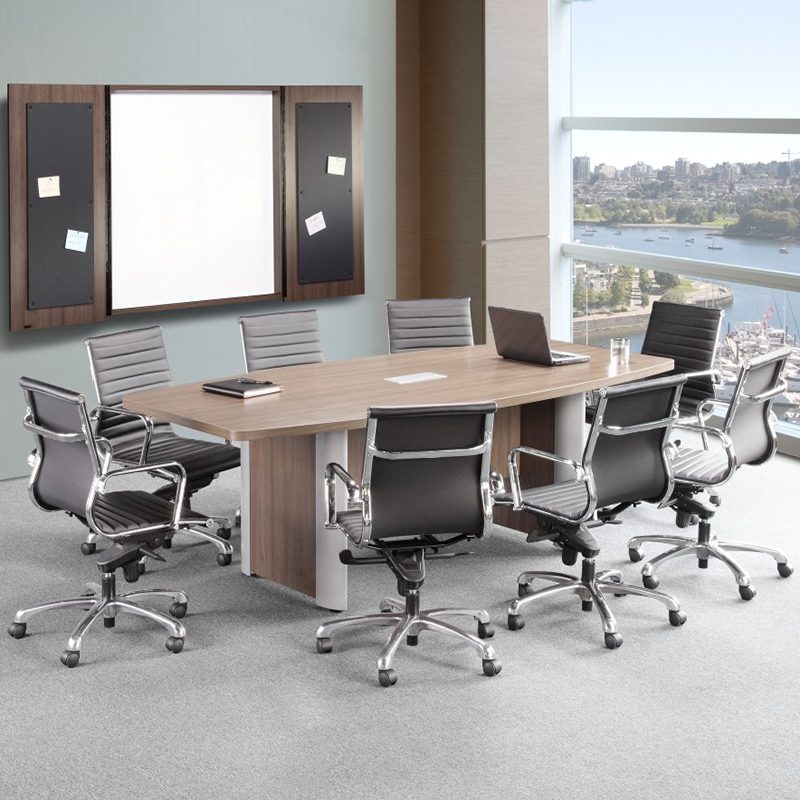
Boat-Shaped Tables
Slightly convex sides (wider in the middle, narrower at the ends).
- Pros: Improves sightlines for video conferencing. Everyone can see the screen without leaning forward.
- Cons: Requires slightly more floor space in the center of the room.
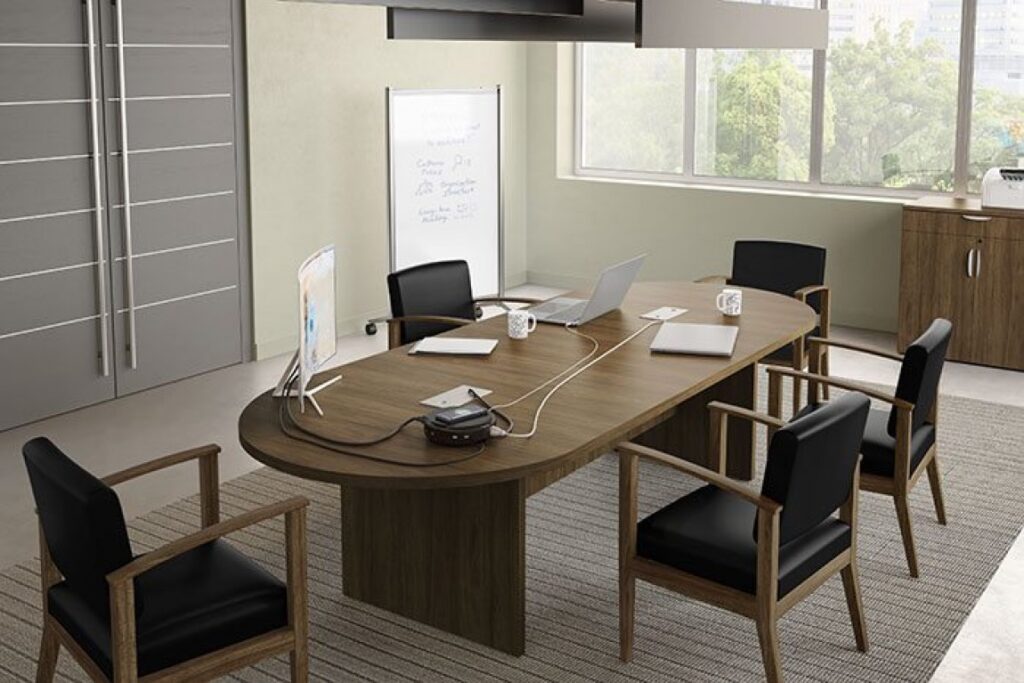
Oval (Racetrack) Tables
Similar to rectangular but with rounded ends.
- Pros: No sharp corners (better for high-traffic rooms) and creates a more collaborative, less hierarchical feel.
- Cons: You lose the “usable” surface area at the very ends of the table.
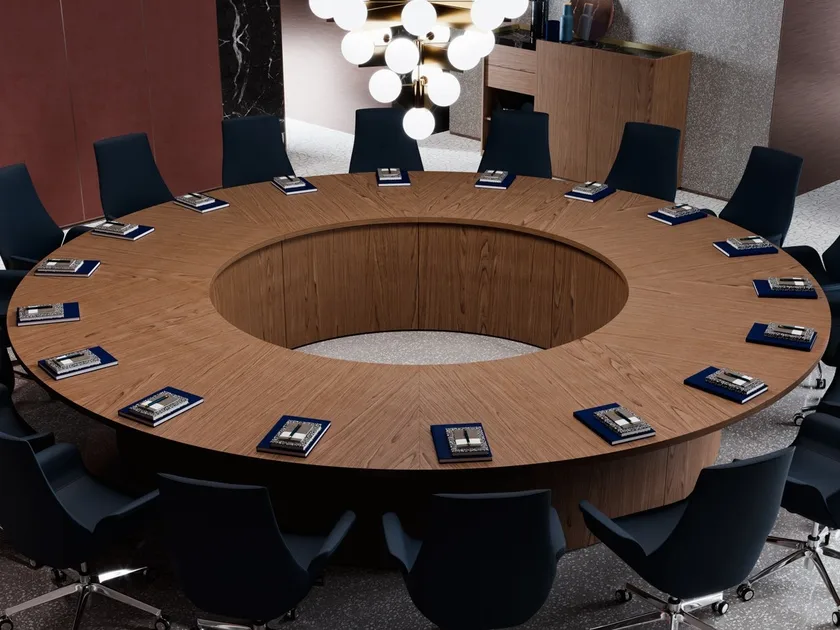
Round Tables
Best for small groups (3-6 people).
- Pros: Perfect for equal-status collaboration and “War Room” scenarios.
- Cons: Very difficult to scale for more than 8 people without losing the ability to reach the center.
Essential Factors for B2B Furniture Buyers
When browsing a hotel or office furniture catalog, keep these three “Pro Considerations” in mind:
1. Power and Connectivity
Modern meetings are digital. Ensure your chosen table supports integrated power modules. Look for “flip-top” units that include AC outlets, USB-A/C ports, and HDMI connections.
2. Chair Width and Armrests
Your meeting room seating capacity will drop by 15-20% if you use oversized executive chairs with wide armrests. For maximum capacity, choose “Conference Side Chairs” which are typically 20-22 inches wide.
3. Table Base Design
- Panel Bases: Offer a solid, heavy look but can restrict legroom.
- C-Leg or T-Leg: Provide maximum legroom for participants.
- Pedestal Bases: Common on round or smaller tables to eliminate “knee-knocking” against table legs.
FAQ: Frequently Asked Questions About Conference Tables
Q1: How much space does each person need at a conference table?
For standard meetings, allow 24 to 30 inches of space per person. For executive boardrooms where participants use laptops and large notebooks, 30 to 36 inches is recommended.
Q2: What is the standard height of a conference table?
The standard height is 30 inches (76 cm). This is designed to work perfectly with standard office task chairs which have a seat height of 18-22 inches.
Q3: Can a 10-foot table fit in a 12×12 room?
No. While the table physically fits, you would only have 1 foot of clearance on the ends, making it impossible to sit down or enter the room. A 10ft table requires a room at least 16 feet long.
Q4: What are the best materials for a durable boardroom table?
For high-traffic commercial use, High-Pressure Laminate (HPL) is the best for durability and scratch resistance. For luxury executive suites, natural wood veneers or stone tops offer a premium aesthetic but require more maintenance.
Q5: How do I choose a table for video conferencing?
Choose a Boat-shaped or V-shaped table. These shapes are specifically designed to ensure that the camera at the front of the room can see every participant’s face clearly without obstruction.
Conclusion: Investing in the Right Foundation
Choosing the right conference table size is an investment in your company’s culture. It’s about more than just furniture; it’s about creating a space where ideas can flow without physical constraints.
Whether you are looking for a sleek 6ft huddle table for your startup or a massive 20ft custom boardroom table for a multinational headquarters, Hongye Furniture provides the expertise and craftsmanship to bring your vision to life.
Are you ready to optimize your office space? [Contact our space planning experts today for a free consultation and a custom quote for your next project.]
Would you like me to generate a specific Product Description for one of these sizes (e.g., an 8ft Executive Boat-Shaped Table) to help with your e-commerce listings?