The Three Materials That Define Commercial Furniture Construction
You’re standing in front of three material samples, each with different price tags, durability promises, and aesthetic possibilities. The stakes are high: choosing the right material for your commercial furniture directly impacts your bottom line, workspace aesthetics, and long-term operational costs.
This is the decision commercial furniture buyers face constantly. Whether you’re furnishing a hotel, office, restaurant, or retail space, material selection shapes everything—from initial capital investment to maintenance costs to the furniture’s lifespan. A seemingly small choice about substrate material can translate into cost differences of 30-50% per piece, multiplied across dozens or hundreds of furniture items.
The three main contenders—solid wood, plywood, and MDF (Medium Density Fiberboard)—each offer distinct advantages and trade-offs. Solid wood delivers timeless durability and aesthetic appeal. Plywood provides excellent stability at moderate cost. MDF offers budget-friendly solutions with surprising versatility.
But which one actually makes financial and functional sense for commercial applications? More importantly, how do you navigate the complexity of comparing materials with different strengths, different lifespans, and different price trajectories?
This guide provides the comprehensive comparison commercial furniture buyers need—with detailed cost data, durability metrics, specific applications, and the decision framework to choose correctly.
What is Solid Wood Furniture? Understanding the Premium Option
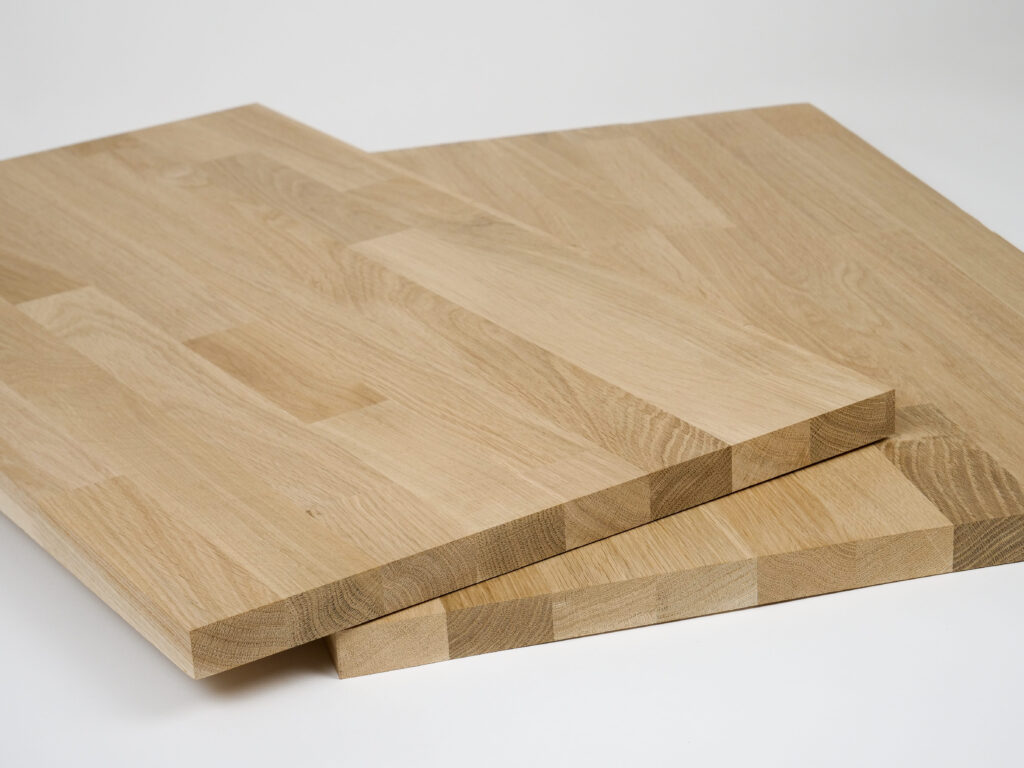
Definition: Solid wood furniture is constructed from wood boards cut directly from tree trunks, without additives or engineered components. Each piece is 100% natural wood.
Key Characteristics of Solid Wood
Composition:
- Direct harvest from logs
- Minimal processing (sawing, drying, finishing)
- Natural grain patterns vary by wood species
- No additives or binding agents
Common Wood Species for Commercial Furniture:
- Hardwoods: Oak, maple, walnut, cherry (durable, premium)
- Softwoods: Pine, fir, spruce (lighter, more affordable hardwood option)
- Exotic: Teak, acacia, mango (specialized applications)
Natural Properties:
Density: 400-900 kg/m³ (varies by species)
Strength: High tensile strength (excellent for load-bearing)
Appearance: Unique grain patterns, natural color variation, warmth
Workability: Can be sanded, stained, refinished
Sustainability: Depends on source (FSC certification available)
Solid Wood Advantages
| Advantage | Commercial Impact |
|---|---|
| Durability | 20-40 year lifespan with proper care; generations-long heirloom quality |
| Repairability | Easy to sand, refinish, repair damage without replacement |
| Aesthetic Appeal | Natural grain, warmth; enhances upscale spaces |
| Strength | High load-bearing capacity; suitable for high-use furniture |
| Refinishability | Can be stained to match evolving design schemes |
| Value Retention | Retains 60-80% of value over 10 years |
| Sustainability | Fully recyclable; FSC sources available |
Solid Wood Limitations
| Limitation | Commercial Impact |
|---|---|
| Cost | 2-4x more expensive than plywood/MDF ($5,000-$25,000 for kitchen cabinets) |
| Moisture Sensitivity | Warping/cracking in high-humidity environments (bathrooms, kitchens) |
| Expansion/Contraction | Dimensional changes with humidity fluctuations |
| Weight | Heavier than alternatives (installation/handling costs) |
| Lead Time | Requires sourcing, drying (weeks to months) |
| Maintenance | Requires regular sealing in wet environments |
| Waste Sensitivity | Wood waste during manufacturing (4 pieces needed per 1 usable) |
What is Plywood? The Balanced Middle Option
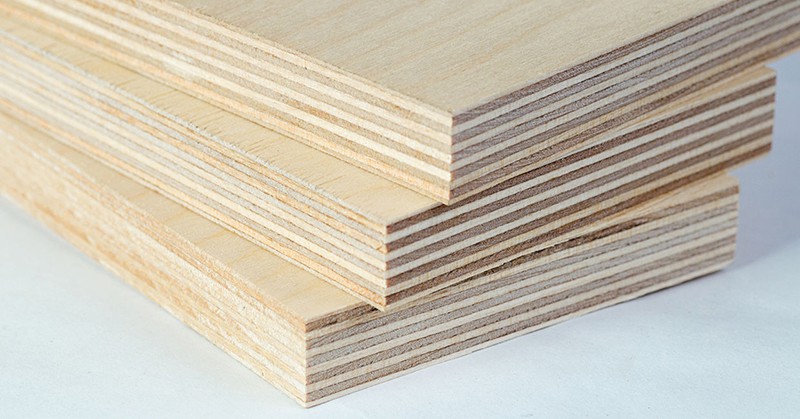
Definition: Plywood is engineered wood made from thin wood veneers (peeled from logs) glued together in alternating grain directions, creating a stable laminated panel.
Key Characteristics of Plywood
Composition:
- Multiple thin veneer layers (typically 3-7 layers for furniture)
- Cross-grain construction (alternating directions)
- Wood-based adhesive binding
- Outer veneers: hardwood or softwood veneer
- Core layers: lower-grade wood
Common Plywood Types:
- Softwood plywood: Pine/fir veneer ($15-$55/sheet)
- Hardwood plywood: Oak/birch/maple veneer ($40-$100+/sheet)
- Marine-grade plywood: Waterproof adhesive, moisture resistant ($50-$150/sheet)
- Baltic birch: Multiple birch layers, exceptional stability ($80-$150/sheet)
Key Properties:
Density: 500-700 kg/m³ (lighter than solid wood)
Strength: Moderate tensile strength; excellent shear strength
Stability: Minimal warping/cupping (cross-grain design)
Appearance: Veneer surface mimics wood; edge shows lamination
Workability: Easy to cut, drill, shape
Moisture Resistance: Good (especially marine-grade)
Plywood Advantages
| Advantage | Commercial Impact |
|---|---|
| Cost-Effectiveness | 40-60% cheaper than solid wood; $40-$60 per sheet vs solid wood |
| Stability | Cross-grain construction resists warping in humid environments |
| Dimensional Stability | Minimal expansion/contraction (ideal for humid commercial spaces) |
| Large Panels | Available in 4’x8′ sheets; fewer joints needed |
| Strength-to-Weight | High shear strength despite lighter weight (easier installation) |
| Moisture Resistance | Good performance in kitchens, bathrooms, basements |
| Environmental Efficiency | Uses veneer cutting (90% wood recovery vs 25% for solid wood) |
| Availability | Readily available in multiple grades and thicknesses |
Plywood Limitations
| Limitation | Commercial Impact |
|---|---|
| Delamination Risk | Edge layers can separate if exposed to moisture |
| Edge Visibility | Lamination visible on edges (requires finishing) |
| Lower Perceived Value | Doesn’t command premium pricing like solid wood |
| Veneer Durability | Top veneer can chip if not protected |
| Repair Difficulty | Delamination requires panel replacement (can’t sand and refinish) |
| Lifespan | 10-15 year typical lifespan (vs 20-40 years for solid wood) |
| Load-Bearing | Lower tensile strength than solid wood (less suitable for some applications) |
What is MDF? The Budget-Conscious Solution
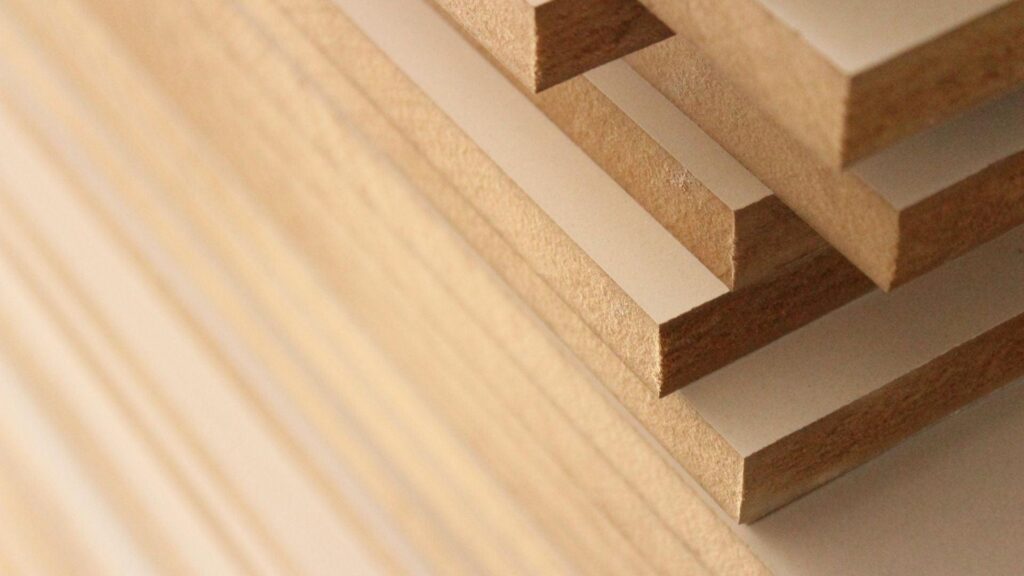
Definition: MDF (Medium Density Fiberboard) is engineered wood made from wood fibers (sawdust and wood residue) bonded together with synthetic resin under heat and pressure.
Key Characteristics of MDF
Composition:
- 80% wood fiber (residue from sawmill processing)
- 20% synthetic resin binder
- Particle size: 0.5-2.0 mm
- Uniform density throughout (no grain direction)
- No voids or knots
Density Classifications:
- MDF: 600-800 kg/m³ (most common)
- HDF (High-Density): 800-1,100 kg/m³ (stronger but heavier)
- LDF (Low-Density): <600 kg/m³ (cheaper but less durable)
Key Properties:
Density: 600-800 kg/m³ (heavier than plywood)
Strength: Moderate; adequate for most furniture (not load-bearing)
Workability: Excellent; cuts, drills, shapes easily
Appearance: Smooth, uniform surface; requires veneer or finish
Moisture Resistance: Poor (swells when wet)
Sustainability: Uses recycled wood fibers (eco-positive)
Surface Finish: Accepts paint, veneer, laminate excellently
MDF Advantages
| Advantage | Commercial Impact |
|---|---|
| Cost | 50-70% cheaper than solid wood ($2,000-$7,000 for kitchen vs $5,000-$25,000 for solid) |
| Smooth Surface | Perfect for detailed carving, moldings, decorative elements |
| Workability | Cuts cleanly; no grain direction; easy for production |
| Consistency | No knots, voids, or grain variation (predictable results) |
| Size Options | Available in 100+ thickness options (2mm-60mm) |
| Finishes | Accepts paint, veneer, laminate, stain uniformly |
| Sustainability | Uses reclaimed wood fiber (avoids sawmill waste) |
| Availability | Widely available; fast production |
MDF Limitations
| Limitation | Commercial Impact |
|---|---|
| Moisture Sensitivity | Swells/warps significantly when wet (unsuitable for humid areas) |
| Weight | Heavier than plywood (makes handling difficult for large panels) |
| Durability | 8-12 year lifespan (vs 10-15 for plywood, 20-40 for solid wood) |
| Chipping | Edge chipping if not properly sealed |
| Repairability | Cannot be sanded/refinished like solid wood (damage is permanent) |
| Load Bearing | Lower strength than plywood/solid wood (not suitable for heavy-use items) |
| Dust Issues | Fine dust during cutting (health/safety concern) |
| Perception | Often perceived as “cheap” (affects luxury positioning) |
Comprehensive Cost Comparison: The Numbers That Matter
Material Cost Per Unit
| Material | Item | Price | Notes |
|---|---|---|---|
| Solid Wood | Kitchen cabinets (full set) | $5,000-$25,000 | Hardwood species; varies 5x by type |
| Dining table (6-seat) | $1,200-$5,000 | Solid hardwood construction | |
| Office desk | $800-$2,500 | Solid wood with finishing | |
| Plywood | 4’x8′ sheet (3/4″) | $40-$100 | Softwood $40-60; hardwood $60-100 |
| Kitchen cabinets (full set) | $2,500-$8,000 | Veneer ply; 40-60% less than solid | |
| Office desk | $400-$1,200 | Ply with veneer | |
| MDF | 4’x8′ sheet (3/4″) | $20-$40 | Standard; HDF slightly higher |
| Kitchen cabinets (full set) | $2,000-$7,000 | Most budget-friendly option | |
| Office desk | $250-$800 | Lowest cost option |
Cost per Piece for Commercial Applications
Hotel Nightstand:
  Solid Wood: $300-$600
  Plywood: $150-$250
  MDF: $80-$150

Hotel Headboard (Queen):
  Solid Wood: $400-$800
  Plywood: $200-$350
  MDF: $100-$200

Restaurant Booth Seat (linear foot):
  Solid Wood: $80-$150
  Plywood: $40-$80
  MDF: $30-$60

Office Desk (6-foot):
  Solid Wood: $1,000-$2,500
  Plywood: $500-$1,200
  MDF: $300-$700
Hidden Cost Factors
| Cost Factor | Solid Wood | Plywood | MDF |
|---|---|---|---|
| Installation Labor | High(heavier) | Medium | Medium |
| Finishing | Moderate(stain) | High(edge sealing) | High(veneer/paint) |
| Maintenance(annual) | $50-200 | $20-50 | $10-30 |
| Repair Costs | Low(easy to fix) | Moderate(edge delamination) | High(replacement only) |
| Replacement Cycle | 20-40 years | 10-15 years | 8-12 years |
10-Year Total Cost of Ownership (per piece):
Solid Wood Nightstand:
  Purchase: $450 (average)
  Maintenance: $1,000 (over 10 years)
  Repair: $200 (refinishing)
  Total: $1,650

Plywood Nightstand:
  Purchase: $200
  Maintenance: $300
  Repair: $100
  Total: $600

MDF Nightstand:
  Purchase: $115
  Maintenance: $150
  Repair: $50
  Total: $315 (but replaced at year 10)
Durability Comparison: Lifespan & Longevity
Expected Lifespan by Environment
| Environment | Solid Wood | Plywood | MDF |
|---|---|---|---|
| Dry Indoor | 20-40 years | 10-15 years | 8-12 years |
| Standard Hotel Room | 15-25 years | 8-12 years | 6-10 years |
| High-Humidity (Bath/Kitchen) | 10-15 years* | 12-18 years | 3-6 years |
| Wet (Exposed) | Unsuitable | 8-10 years | Unsuitable |
*with protective sealing
Key Durability Factors
Solid Wood:
- Micro-cracks develop over time (character/beauty)
- Can be refinished repeatedly (extends life indefinitely)
- Wood movement in humidity extremes causes issues
- Proper sealing critical in wet environments
Plywood:
- Veneer can chip/damage (reduces lifespan)
- Cross-grain construction provides inherent stability
- Delamination main failure mode in humidity
- Edge sealing prevents moisture ingress
MDF:
- Fine finishes (paint/veneer) protect core
- Moisture damage is catastrophic (swelling)
- Damage cannot be repaired (requires replacement)
- Consistent density means predictable failure modes
Detailed Comparison Table: Head-to-Head Metrics
| Metric | Solid Wood | Plywood | MDF | Winner |
|---|---|---|---|---|
| Initial Cost | $$$$ | $$ | $ | MDF |
| 10-Year Cost | $$$ | $$ | $ | Plywood |
| Durability (Dry) | 40yrs | 15yrs | 12yrs | Solid |
| Stability | Good | Excellent | Fair | Plywood |
| Moisture Resistance | Poor | Good | Poor | Plywood |
| Aesthetic Appeal | Excellent | Good | Fair | Solid |
| Repairability | Easy | Difficult | Impossible | Solid |
| Workability | Difficult | Easy | Excellent | MDF |
| Load Bearing | Excellent | Good | Fair | Solid |
| Veneer Quality | N/A | Good | Excellent | Plywood |
| Environmental Impact | Mixed | Positive | Positive | Plywood/MDF |
| Luxury Perception | High | Medium | Low | Solid |
| Production Speed | Slow | Fast | Fast | MDF/Plywood |
| Finish Options | Limited | Moderate | Unlimited | MDF |
| Sustainability | Mixed | High | High | Plywood |
Application Recommendations: Where Each Material Excels
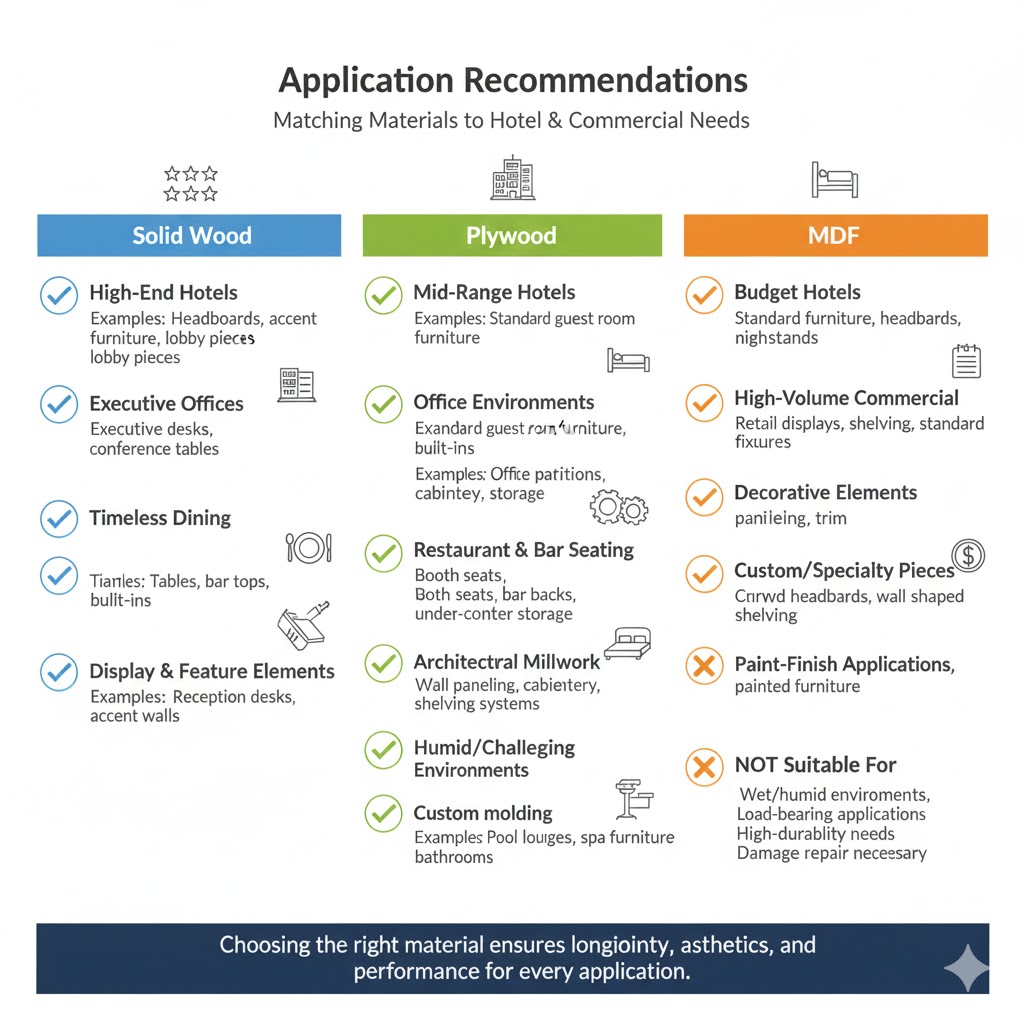
Solid Wood is Best For:
✓ High-End Hotels (5-star properties)
- Visual premium appeals to luxury guests
- 20+ year lifespan justifies investment
- Refinishing capability maintains appearances
- Examples: Headboards, accent furniture, lobby pieces
✓ Executive Offices (CEO suites, client meeting rooms)
- Professional aesthetics matter
- Longevity matches 30+ year facility planning
- Repairs maintain appearance indefinitely
- Examples: Executive desks, conference tables
✓ Timeless Dining (fine dining restaurants, country clubs)
- Natural beauty enhances ambiance
- High-durability justifies premium pricing
- Character development improves with age
- Examples: Tables, bar tops, built-ins
✓ Display & Feature Elements
- Where appearance is paramount
- Heirloom quality longevity
- Examples: Reception desks, accent walls, feature walls
Plywood is Best For:
✓ Mid-Range Hotels (3-4 star properties)
- Balanced cost/performance
- 12-15 year lifespan matches property upgrade cycles
- Moisture-resistant for humid climates
- Examples: Standard guest room furniture, built-ins
✓ Office Environments (corporate offices, coworking)
- Cost-effective for large-scale deployments
- Stability supports modular/flexible layouts
- Veneer appearance acceptable for professional settings
- Examples: Office partitions, cabinetry, storage
✓ Restaurant & Bar Seating
- Durability in high-traffic areas
- Moisture resistance for spill-prone environments
- Cost allows for refresh cycles
- Examples: Booth seats, bar backs, under-counter storage
✓ Architectural Millwork (built-ins, paneling)
- Large panels reduce joint count
- Stability in complex designs
- Accepts stain/finish like solid wood
- Examples: Wall paneling, cabinetry, shelving systems
✓ Humid/Challenging Environments
- Superior to solid wood in moisture conditions
- Better than MDF in damp areas
- Examples: Pool lounges, spa furniture, bathrooms
MDF is Best For:
✓ Budget Hotels (2-3 star properties, motels)
- Cost-critical applications
- Acceptable for 6-10 year replacement cycles
- Smooth surfaces hide design imperfections
- Examples: Standard furniture, headboards, nightstands
✓ High-Volume Commercial (chains, franchises)
- Consistency across locations
- Fast production timelines
- Uniform appearance across properties
- Examples: Retail displays, shelving, standard fixtures
✓ Decorative Elements (that don’t face wear)
- Excellent for carving, moldings, details
- Smooth surface takes paint beautifully
- Examples: Crown molding, wall paneling, trim
✓ Custom/Specialty Pieces
- Unlimited thickness options (2-60mm)
- Excellent machinability for complex shapes
- Examples: Curved headboards, shaped shelving, artistic installations
✓ Paint-Finish Applications
- Accepts paint uniformly (no grain variation)
- High-gloss finishes look professional
- Examples: Lacquered cabinets, painted furniture, commercial shelving
✗ NOT Suitable For:
- Wet/humid environments (bathrooms, kitchens)
- Load-bearing applications
- High-durability needs
- Spaces where damage repair is necessary
Environmental & Sustainability Considerations
Environmental Impact Comparison
| Factor | Solid Wood | Plywood | MDF |
|---|---|---|---|
| Raw Material | Harvested logs | Veneer from logs | Reclaimed sawmill waste |
| Processing Waste | 75% waste | 10% waste | 0% waste (uses reclaimed) |
| Manufacturing Energy | Moderate | Moderate | Low (wet process) |
| Transportation | Heavier (higher emissions) | Lighter | Lighter |
| End-of-Life | Biodegradable | Biodegradable | Biodegradable |
| Sustainability Rating | Depends on source | Good (if FSC) | Good (uses waste) |
Certification Options
Solid Wood:
- FSC Certification (responsible forest management)
- PEFC Certification (sustainable forestry)
- Premium for certified sources (10-20% cost increase)
Plywood:
- FSC Certified plywood available
- BIFMA standards for furniture
- Marine-grade (special adhesive) for durability
MDF:
- Made from recycled/waste wood fibers (inherently sustainable)
- No old-growth harvesting
- Some emissions concerns with adhesive (low after curing)
How to Choose: Decision Framework for Commercial Buyers
Step 1: Define Your Priority
What matters most?
- Longevity (20+ years) → Solid Wood
- Humidity Resistance → Plywood
- Budget Minimization → MDF
- Balance → Plywood
Step 2: Assess Your Environment
| Environment | Best Choice | Reason |
|---|---|---|
| Dry climate, low-humidity interior | Solid Wood | Optimal conditions for longevity |
| Temperate, standard humidity | Plywood | Best balance |
| High-humidity (kitchens, bathrooms) | Plywood | Superior moisture resistance |
| Wet/exposed environments | Marine Plywood | Only viable option |
Step 3: Calculate True Cost of Ownership
Formula:
Total 10-Year Cost = Purchase + Annual Maintenance + Repair + Replacement Cycle

Example: Hotel nightstand
  Solid: $450 + ($100/yr × 10) + $200 repair = $1,650 (lasts 15+ years)
  Plywood: $200 + ($30/yr × 10) + $100 repair = $500 (replaced at year 12)
  MDF: $115 + ($15/yr × 10) + $50 + new unit at year 10 = $565
Step 4: Apply Use-Case Criteria
| Use Case | Decision Path |
|---|---|
| High-traffic, visible furniture | Solid Wood (if budget allows) → Plywood (if cost-conscious) |
| Large institutional order | Plywood (consistency) or MDF (extreme budget) |
| Humid environment | Plywood (only viable option) |
| Luxury property | Solid Wood (required for perception) |
| Budget property | MDF → Plywood (if humidity is factor) |
| Repair-required items | Solid Wood (only repairable option) |
Step 5: Validate Against Aesthetic Goals
- Premium appearance required? → Solid Wood (non-negotiable)
- Professional appearance acceptable? → Plywood veneer
- Budget appearance acceptable? → MDF with quality finish
Frequently Asked Questions
Q: Can MDF be used in kitchens or bathrooms?
A: No. MDF swells catastrophically when wet. Even moisture exposure causes permanent damage. Plywood is suitable for kitchens/bathrooms (with edge sealing). Solid wood requires protective sealing.
Q: Which material is strongest?
A: Solid hardwood > Plywood > MDF for load-bearing. For shear strength, Plywood actually exceeds solid wood due to cross-grain construction.
Q: Can you refinish plywood and MDF like solid wood?
A: Plywood veneer can be sanded lightly (carefully). MDF cannot be truly refinished—once damage occurs, replacement is required. Only solid wood can be sanded and fully refinished.
Q: What’s the environmental impact of each?
A: Plywood and MDF are more sustainable (less waste, can use certified sources). MDF particularly uses reclaimed sawmill waste.
Q: Will solid wood furniture last decades?
A: Yes, 20-40 year lifespans are common with proper care. Refinishing can extend lifespan indefinitely. Cost is high but longevity justifies it for premium applications.
Q: Why is solid wood more expensive?
A: Harvesting, drying (months-years), processing, and craftsmanship all add cost. Fewer pieces yield usable material (25% recovery vs 90% for plywood veneer). Longevity justifies premium.
Q: Is plywood as strong as solid wood?
A: Not for tensile/load-bearing strength. But for shear strength and stability, plywood matches or exceeds solid wood due to cross-grain construction.
Q: What’s the typical lifespan of MDF furniture in a hotel?
A: 6-10 years in dry conditions, 3-6 years in humid environments. More frequent replacement cycles than plywood/solid wood.
Q: Can you refinish hotel furniture between guests?
A: Solid wood: Yes (sand and refinish). Plywood: Limited (light sanding only). MDF: No (damage is permanent). This impacts choosing materials for high-turnover hospitality.
Conclusion: Making Your Final Decision
Solid wood, plywood, and MDF each serve specific roles in commercial furniture.
Solid wood is the premium choice for luxury applications where longevity, repairability, and aesthetic appeal justify higher costs. Twenty-to-forty-year lifespans and the ability to refinish indefinitely make solid wood an investment that pays dividends in upscale hospitality and executive settings.
Plywood is the balanced choice for most commercial applications. Superior moisture resistance, excellent stability, moderate cost, and acceptable 12-15 year lifespans make plywood ideal for hotels, restaurants, offices, and humid environments. For many commercial buyers, plywood represents the optimal cost-performance trade-off.
MDF is the budget choice for cost-critical applications. Lowest initial cost, excellent workability, and acceptable appearance (with quality finishes) make MDF suitable for budget properties, high-volume deployments, and decorative elements. However, poor moisture resistance and limited repairability restrict MDF to controlled dry environments.
The right choice depends on your priorities:
- Maximum lifespan & aesthetics? → Solid Wood
- Best balance of cost & performance? → Plywood
- Minimum upfront cost? → MDF
For most commercial applications, we recommend starting with plywood as the default choice, then adjusting up to solid wood for luxury properties or down to MDF for extreme budget constraints.