A hotel furniture BOQ, or Bill of Quantities, is the control document that connects design intent, room quantities, product specifications, pricing, samples, production, shipping, and installation.
A strong BOQ does more than list furniture. It gives every item a traceable code, identifies where the item belongs, defines its dimensions and materials, links it to drawings and clarifies what the supplier must price and deliver.
When a BOQ contains vague descriptions, unapproved finishes, unclear quantities, or missing revision records, the project can face substitutions, change orders, rework, delivery disputes, and installation delays.
To read a hotel furniture BOQ correctly, procurement teams should verify 15 core fields. They should also review the supporting drawings, material schedules, test reports, sample approvals, delivery plans and contract terms that make the BOQ enforceable.
This guide explains how hotel owners, FF&E directors, procurement managers, and project teams can review a hotel furniture BOQ before signing.
Key Takeaways
- A hotel furniture BOQ should allow each item to be quoted, sampled, produced, inspected, shipped, and installed without ambiguity.
- The BOQ, furniture schedule, drawings, material schedule, and purchase order work together but serve different purposes.
- Every furniture item should have a unique code, location, quantity, unit, dimensions, material specification, finish, drawing reference, and revision history.
- Fire performance, warranties, payment terms, installation scope, and inspection rights should be controlled through supporting documents and contract attachments.
- Buyers should reconcile BOQ quantities against the approved room matrix, furniture schedule, floor plans and accessible-room requirements.
- Material, hardware and finish lines need enough detail to prevent unapproved substitutions during production.
- A golden sample, approved bill of materials, and revision-controlled drawings give buyers a practical benchmark for quality control.
Quick Answer: What Is a Hotel Furniture BOQ?
A hotel furniture BOQ is an itemized document that identifies the furniture scope, quantities, locations and commercial pricing for a hotel project.
In hotel FF&E procurement, a BOQ often works together with a furniture schedule. It typically tracks item codes, room types, quantities, dimensions, finishes, material references, pricing, and revision status.
The BOQ itself does not replace the technical drawings, material schedule, test reports, sample approvals or purchase order. Instead, it should link to them.
Procurement principle: Every BOQ line should be traceable to a drawing, a specification, an approved sample, a price and a delivery requirement.
BOQ vs Furniture Schedule vs Purchase Order
Hotel projects often use similar documents with different names. Clarifying their role prevents gaps between design, procurement, and production.
| Document | Primary Purpose | What It Should Control |
|---|---|---|
| BOQ or furniture schedule | Scope, quantities, budget, and item tracking | Item code, room location, quantity, unit, dimensions, finishes, price and revision |
| Drawings or shop drawings | Technical design and construction | Dimensions, mounting, sections, joints, electrical and installation details |
| Material schedule or BOM | Approved materials and components | Board, veneer, fabric, foam, hardware, finish and edge details |
| Sample approval form | Physical benchmark | Golden sample, colour, sheen, texture and workmanship |
| Test and compliance package | Product and material evidence | Fire, emissions, structural, electrical and market-specific documents |
| Purchase order or contract | Commercial and legal control | Payment, inspection rights, warranty, delivery, delay remedies and dispute terms |
| Packing and delivery plan | Logistics and installation control | Labels, room sets, cartons, containers, delivery phase and site handling |
A complete furniture package should align all of these documents. The BOQ provides the item-level structure that allows the project team to track the same product from design approval to installation.
The 15 BOQ Fields Procurement Must Verify
The following 15 fields create a practical structure for a hotel furniture BOQ.

Scope and Location Fields
| Field | What Procurement Must Verify |
|---|---|
| 1. Item code | Use a unique, traceable code that matches drawings and furniture schedules |
| 2. Room or area | Identify guestroom type, lobby, restaurant, meeting room, corridor or back-of-house location |
| 3. Item description | Use a clear, plain-language furniture definition |
| 4. Quantity | Reconcile quantities against room matrix, floor plan and approved scope |
| 5. Unit | Define each, set, linear metre, square metre, room set or another clear unit |
Product and Specification Fields
| Field | What Procurement Must Verify |
|---|---|
| 6. Dimensions | State W × D × H and include installation, clearance or mounting requirements |
| 7. Material or core | Identify board, wood, metal, foam, glass, stone or other primary material |
| 8. Surface finish | Identify veneer, laminate, lacquer, fabric, powder coat, stain and sample code |
| 9. Hardware and accessories | List slides, hinges, locks, glides, power modules, brackets and mounting components |
| 10. Drawing reference | Link to the latest drawing revision and relevant detail reference |
| 11. Product model or supplier | Identify approved model, custom code or manufacturer reference |
Commercial and Control Fields
| Field | What Procurement Must Verify |
|---|---|
| 12. Unit rate, currency, and line total | State price basis, currency, inclusions, and line total |
| 13. Approval status | Record drawing, material, sample, and prototype approval status |
| 14. Delivery phase | Define production, packing, shipping, and installation sequence |
| 15. Revision control | Record the revision date, revision number, change description, and approval owner |
Control rule: If a BOQ line cannot be connected to a drawing, material schedule, approval record and delivery plan, it is not ready for production release.
What to Verify in Each BOQ Field
1. Item Code
Every item requires a unique code, such as GR-01 for a guestroom headboard or LB-03 for lobby lounge chair.
Avoid generic descriptions without a code. A code allows design, procurement, factory engineering, QC and installers to refer to the same item without confusion.
2. Room or Area Allocation
The BOQ should identify where each item will be installed.
Examples include:
- Standard king guest room.
- Double queen guest room
- Accessible guestroom.
- Suite living room.
- Lobby reception.
- All-day dining restaurant.
- Ballroom.
- Meeting room.
- Staff changing room.
- Back-of-house office.
Accessible guestrooms may require different furniture dimensions, clearances, mounting heights or hardware. Buyers should not assume that standard-room furniture applies to accessible rooms.
3. Item Description
A good item description should identify the product, use and key construction direction.
Weak description:
“Hotel bed.”
Better description:
“GR-01: King bed base with upholstered headboard, wall-mounted, including side wings and concealed fixing brackets.”
The description should match the approved furniture schedule and drawing title.
4. Quantity
Quantities should reconcile with:
- Room matrix.
- Room-type schedule.
- Floor plans.
- Public-area layouts.
- Furniture plans.
- Back-of-house plans.
- Accessible-room count.
- Model-room scope.
- Spare or attic-stock requirement.
A quantity error often appears late, when the project team discovers that the room mix changed but the BOQ did not.
5. Unit
Define the measurement unit clearly.
| Unit Type | Example |
|---|---|
| Each | One lounge chair |
| Set | One dining table plus defined number of chairs |
| Linear metre | Built-in banquette or cornice |
| Square metre | Wall panel or decorative screen |
| Room set | Complete furniture package for one guestroom |
| Lot | Defined group of accessories or installation materials |
Common risk: Do not use “set” unless the BOQ clearly lists every component included in that set.

Hotel Furniture
6. Dimensions
Dimensions should use a consistent measurement system, usually millimetres for international projects.
Every item should show:
- Width.
- Depth.
- Height.
- Seat height where relevant.
- Mounting height where relevant.
- Clearance requirements.
- Door, elevator and service-route limitations where relevant.
- Electrical or plumbing coordination where required.
The project team should compare BOQ dimensions with approved shop drawings and as-built site measurements—not only early concept drawings.
7. Material or Core
The BOQ should identify the primary material and refer to the detailed material schedule.
Examples:
- Engineered panel with specified density, thickness and moisture-resistance requirement.
- Solid timber species and construction method.
- Plywood core with defined veneer system.
- Powder-coated steel frame.
- Stainless-steel grade where relevant.
- Stone or solid-surface top.
- Foam type and density range.
- Tempered or laminated safety glass.
Do not rely only on phrases such as “premium MDF” or “high-quality plywood.” Instead, specify the required core, thickness, moisture performance, edge treatment and applicable emissions documentation for the destination market.
8. Surface Finish
Surface finish is one of the most important BOQ fields because it affects price, appearance, maintenance and replacement consistency.
The BOQ should define:
- Veneer species and cut.
- Laminate brand, code and texture.
- Lacquer, stain or paint system.
- Metal finish and colour.
- Powder-coat reference.
- Fabric supplier and code.
- Leather or faux-leather reference.
- Stone type and finish.
- Edge-band or solid-edge detail.
- Approved sample reference.
Avoid broad phrases such as “oak finish” or “walnut colour.” Those descriptions can refer to veneer, laminate, printed film, stain or paint, each with a different cost and performance profile.
9. Hardware and Accessories
Hardware often determines daily usability and maintenance cost.
List:
- Drawer slides.
- Hinges.
- Locks.
- Pulls and handles.
- Glides.
- Castors.
- Cable grommets.
- Power modules.
- Wall-fixing brackets.
- Bed connectors.
- Adjustable feet.
- Anti-tip devices.
- Mounting hardware.
Do not accept “supplier standard” unless the supplier identifies the brand, model, performance level and warranty.
10. Drawing Reference
Each BOQ line should connect to the current drawing revision.
For example:
| BOQ Item | Drawing Reference |
|---|---|
| GR-01 King headboard | FF&E-GR-101, Rev C |
| GR-02 Nightstand | FF&E-GR-102, Rev B |
| LB-03 Lobby lounge chair | FF&E-LB-204, Rev D |
This prevents the factory from building to an old plan after the designer issues a revision.

11. Product Model or Supplier Reference
The BOQ should identify whether an item is:
- A custom design.
- An approved manufacturer model.
- A supplier-developed equivalent.
- A client-nominated product.
- A designer-supplied item.
- An operator-supplied item.
This field helps the procurement team distinguish custom manufacturing from catalogue sourcing.
12. Unit Rate, Currency and Line Total
Each pricing line should state:
- Unit rate.
- Currency.
- Quantity.
- Line total.
- Price basis.
- Trade term.
- Cost inclusions.
- Cost exclusions.
For example, an FOB factory price does not include ocean freight, cargo insurance, customs duty, local delivery, installation or room-by-room placement.
13. Approval Status
Record whether the following are approved, pending or rejected:
- Drawing.
- Material.
- Finish.
- Fabric.
- Hardware.
- Sample.
- Model-room item.
- Test report.
- Packaging.
- Installation method.
This prevents the factory from starting mass production while important decisions remain unresolved.
14. Delivery Phase
Large hotels often need staged deliveries. The BOQ should identify whether each item belongs to:
- Model room.
- Early mock-up.
- Guestroom production batch.
- Public-area batch.
- Opening-critical delivery.
- Back-of-house delivery.
- Spare-parts shipment.
- Post-opening replacement batch.
Room-set labels, carton codes and delivery phases help installation teams place furniture efficiently.
15. Revision Control
A BOQ should show:
- Revision number.
- Revision date.
- Change description.
- Person who issued the change.
- Approval owner.
- Impact on quantity, price, production or delivery.
Without revision control, teams may quote, manufacture and install different versions of the same item.
Supporting Documents That Make a BOQ Enforceable

A BOQ needs supporting documents. Procurement teams should not try to force every technical or commercial requirement into one spreadsheet.
Drawings, BOM and Material Schedule
Drawings show geometry and installation. The bill of materials and material schedule define construction, finishes, fabrics, foam, hardware and edges.
Sample Approval and Golden Samples
A golden sample provides the physical benchmark for finish, texture, colour, workmanship, comfort and hardware function.
The factory should retain the approved sample. Inspectors should compare production items against that sample.
Test and Compliance Evidence
Documentation should match product category, destination market and hotel brand requirements.
| Requirement Area | Possible Evidence | Buyer Check |
|---|---|---|
| Upholstered furniture fire performance | Project-required fire report | Match the approved fabric, foam, barrier and construction |
| Composite wood emissions | Destination-market emissions documentation | Confirm panel or finished-product scope |
| Office-style task chair performance | Applicable product-category evidence | Confirm exact model and configuration |
| Low chemical emissions | GREENGUARD or equivalent product/material evidence | Confirm product or approved material configuration |
| Wood traceability | FSC Chain of Custody documentation where specified | Confirm certificate holder, status and scope |
| Electrical furniture components | Destination-market electrical documentation | Confirm voltage, plug, product and market applicability |
| Outdoor furniture | UV, corrosion, and weather-resistance evidence | Match project climate and maintenance plan |
California TB 117-2013 addresses certain upholstered-furniture component materials and their smolder-resistance requirements. It does not replace every hotel, public-area or destination-market fire requirement.
Packing, Delivery, and Installation Plan
The delivery plan should define:
- Carton dimensions.
- Corner protection.
- Moisture barriers.
- Room-set labels.
- Item codes on cartons.
- Container loading plan.
- Delivery sequence.
- Storage conditions.
- Floor distribution.
- Assembly requirements.
- Packaging removal.
- Punch-list process.
Common BOQ Errors That Cause Scope Creep
| BOQ Area | Common Error | Potential Consequence |
|---|---|---|
| Item description | Generic wording | Substitution or inconsistent interpretation |
| Quantity | Room matrix mismatch | Shortage or excess during installation |
| Dimensions | Concept drawings used instead of as-built data | Rework, poor fit or installation delays |
| Finish | “Oak finish” without veneer or laminate definition | Price and appearance dispute |
| Hardware | “Supplier standard” | Quality downgrade or change order |
| Unit rate | Trade term omitted | Freight, duty or installation-cost dispute |
| Approval status | No golden-sample reference | No physical quality benchmark |
| Delivery phase | No room-set labelling | Onsite sorting and installation inefficiency |
| Revision control | Old BOQ issued to factory | Incorrect production or duplicated work |
A BOQ cannot eliminate every project risk. However, a controlled BOQ can reduce ambiguity before the factory begins engineering, procurement and production.
How to Verify a Hotel Furniture BOQ Before Signing
Use the following sequence before countersigning a BOQ.
1. Reconcile Scope and Quantities
Compare every item code and quantity with the approved room matrix, furniture schedule, floor plan and public-area layout.
2. Verify Dimensions Against As-Built Conditions
Confirm that furniture fits actual wall lengths, ceiling heights, door openings, elevators, MEP locations and finished floor levels.
3. Lock Materials and Finishes
Approve material codes, veneer samples, laminate codes, fabrics, foam, hardware, metal finishes and edge details before production release.
4. Confirm Applicable Compliance Requirements
Identify the product-specific structural, fire, emissions, electrical, wood-traceability or outdoor-performance evidence required by the project.
Do not request a generic “full certification package.” Instead, request the documents relevant to each product, market and brand requirement.
5. Confirm Pricing Basis and Exclusions
State whether each rate is EXW, FOB, CIF, DDP, landed or installed. List excluded services such as electrical work, wall preparation, artwork, accessories, site storage or local installation.
6. Review Sample, Inspection and Delivery Controls
Define the golden sample, in-process inspection, pre-shipment inspection, AQL, delivery phase, packing rules and corrective-action process.
7. Confirm Change-Control Procedure
No party should change materials, quantities, drawings or delivery dates without a written revision, cost impact and approval record.
Contract Controls Beyond the BOQ
The BOQ should link to the purchase order or contract, which controls the broader commercial relationship.
| Contract Control | Why It Matters |
|---|---|
| Payment milestones | Links deposits and balances to approved samples, inspection and shipment |
| Inspection rights | Allows buyer or third party to inspect production before shipment |
| AQL and defect definitions | Defines critical, major and minor defects |
| Warranty | Separates frame, finish, hardware, upholstery, foam and labour coverage |
| Delay remedies. | Defines response to missed production or shipment milestones |
| Subcontracting disclosure | Requires supplier approval before outsourcing key processes |
| Insurance and freight claims | Defines responsibility for transit damage |
| Installation scope | Defines assembly, placement, packaging removal, and punch-list obligations |
| Dispute process | Establishes escalation and contract-enforcement route |
For office furniture products, ANSI/BIFMA X5.5 relates to desk and table products, while ANSI/BIFMA X5.9 relates to office storage units. Buyers should use the appropriate evidence for the specific product category rather than treating BIFMA as a blanket hotel casegoods standard
How Hongye Supports BOQ Review
Hongye supports qualified hotel furniture projects with line-item BOQ review, product drawings, material schedules, sample development and project-specific documentation where applicable.
For project teams, Hongye can support:
- BOQ and furniture-schedule review.
- Room-matrix quantity reconciliation.
- Product drawings and shop-drawing coordination.
- Material, finish, upholstery and hardware schedules.
- Golden-sample and model-room coordination.
- Production and delivery phase planning.
- Packing, carton-marking and room-set labelling.
- In-process and pre-shipment inspection coordination.
- Applicable documentation for eligible products and materials.
Buyers should independently verify exact scope, product configuration, report relevance, certificate validity and destination-market requirements before approving production.
For broader procurement guidance, read FF&E Procurement Explained: A Hotel Developer’s Complete Guide.


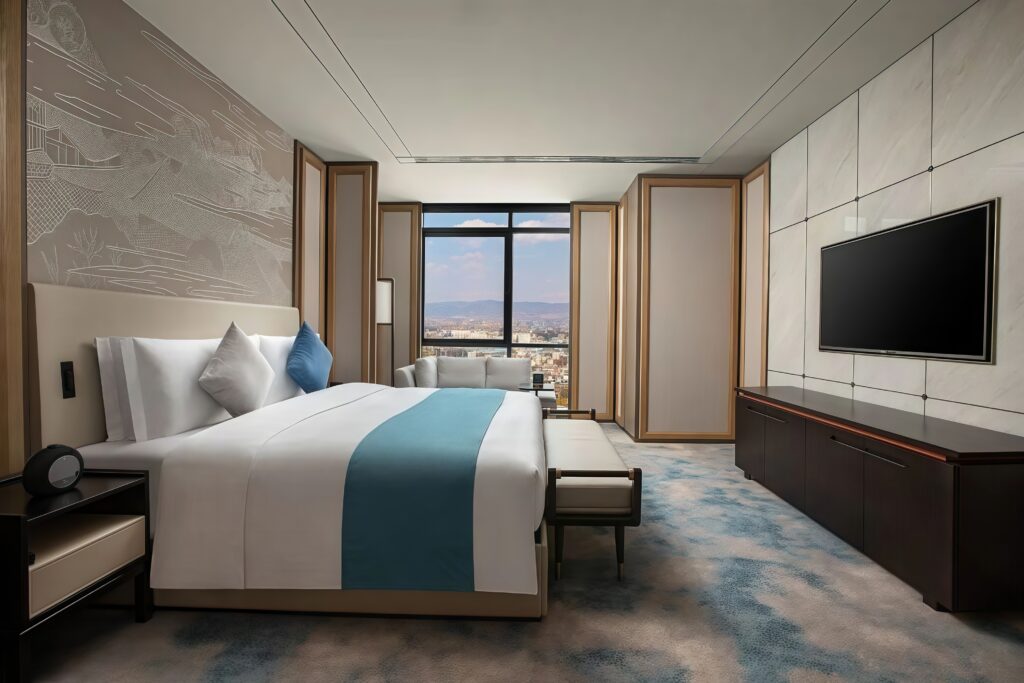
Wingate By Wyndham | Hospitality Project Solution By Hongye Furniture
Frequently Asked Questions
What does BOQ mean in hotel furniture procurement?
BOQ means Bill of Quantities. In hotel furniture procurement, it is an itemised document that tracks furniture codes, room locations, quantities, units, dimensions, materials, finishes, pricing and revisions. It provides the commercial structure for quoting, production, shipping and installation.
Which BOQ lines cause the most disputes?
Common high-risk areas include unclear item descriptions, quantity mismatches, dimensions based on outdated drawings, vague finish descriptions, omitted hardware, unclear trade terms and missing approval records. These issues can lead to substitutions, change orders, rework and delivery disputes.
How do I verify fire-performance compliance in a furniture BOQ?
Identify the destination-market, hotel brand and occupancy requirements first. Then require each upholstered item to reference the relevant test standard and provide documentation that matches the approved fabric, foam, barrier and construction. Do not accept “FR foam” or “fireproof fabric” as a complete requirement.
Why are hotel furniture quantities sometimes wrong on a BOQ?
Quantity errors usually occur when the BOQ does not match the final room matrix, room-type schedule, floor plans or public-area layouts. Design changes, accessible-room requirements and revised suite layouts can also affect quantities. Reconcile every BOQ line before release.
What certifications should a hotel furniture BOQ reference?
Reference only the documentation required for the relevant product, destination market and hotel brand standard. Upholstered seating may need project-specific fire documentation, composite wood may need emissions evidence, office-style chairs may need relevant structural-performance reports and wood products may need chain-of-custody documentation where specified.
Should the BOQ unit price include installation and shipping?
The BOQ should state exactly what every unit rate includes. FOB rates usually exclude freight, insurance, customs, local delivery and installation. CIF adds freight and insurance to the destination port. DDP or installed rates may include more services, but buyers should confirm every inclusion and exclusion in writing.
How long does hotel furniture BOQ verification take?
The time required depends on project complexity, document quality, room count, customisation and approval status. When the room matrix, drawings and material schedule are complete, a procurement team can review the main fields efficiently. Complex projects with multiple room types, public areas and brand requirements may require more coordination.
Can one BOQ template serve all hotel brands?
A basic BOQ structure can be reused. However, each hotel brand, market and project may require different materials, fire evidence, emissions requirements, warranties, accessibility details and approval procedures. Project teams should adapt the BOQ and supporting documents to the specific hotel standard.
Turn the BOQ Into a Project Control Tool
A hotel furniture BOQ should do more than provide a price list. It should control what the factory makes, how the project approves it, where installers place it and how the team resolves changes.
Start with unique item codes. Link every item to room locations, drawings, materials, finishes and approval status. Then support the BOQ with samples, test evidence, delivery plans and contract controls.
When the BOQ, drawings, material schedule and purchase order all match, hotel teams can move from design intent to production with fewer assumptions and a stronger record for quality, cost and delivery control.